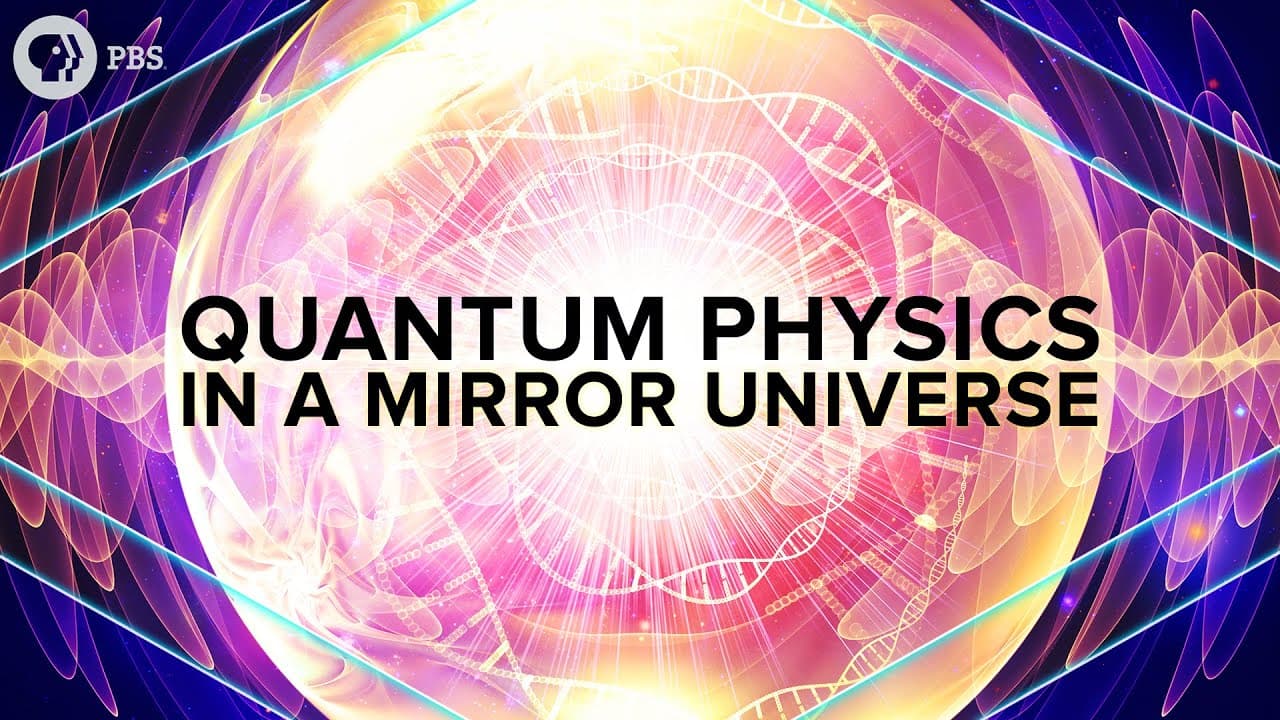
Quantum Physics in a Mirror Universe
TL;DR
Mirror universe laws differ from our universe's physics.
Transcript
thanks to brilliant org for supporting PBS Digital Studios when you look in a mirror you might think you see a perfect reflection but you're actually looking at a universe whose laws are fundamentally different when we think about symmetry the first thing that comes to mind is mirror symmetry butterflies Rorschach tests and classically attractive f... Read More
Key Insights
- Mirror symmetry in physics implies unchanged laws under coordinate transformations, yet the universe isn't fully symmetric under mirror reflection.
- Parity transformation, or mirror reflection, is a discrete symmetry unlike continuous symmetries like spatial or temporal shifts.
- Parity violation was discovered through the tau-theta problem, showing weak force doesn't conserve parity.
- Cobalt-60 experiments demonstrated parity violation by showing electron emissions correlated with nuclear spin, flipping in a mirror universe.
- Quantum chirality, a specific form of handedness, is violated by weak interactions, interacting only with left-chiral particles.
- CPT symmetry, combining charge, parity, and time reversal, remains a fundamental symmetry holding in all experiments.
- Parity violation challenges the assumption of mirror symmetry, suggesting fundamental differences in mirror universe physics.
- The exploration of symmetry in physics aids understanding of fundamental forces and particle interactions.
Install to Summarize YouTube Videos and Get Transcripts
Explore YouTube Video Summarizer or Get YouTube Transcript Extractor
Questions & Answers
Q: What is parity transformation in physics?
Parity transformation, also known as mirror reflection, is a discrete symmetry in physics where spatial axes are flipped. Unlike continuous symmetries such as spatial or temporal shifts, parity transformation is a full reflection without partial changes. It affects properties like position and momentum but leaves others like energy unchanged.
Q: How was parity violation discovered?
Parity violation was discovered through the tau-theta problem, where two particles with identical properties except for decay products suggested parity non-conservation. Experiments with cobalt-60 showed electron emissions correlated with nuclear spin, flipping in a mirror universe, providing evidence for parity violation in weak nuclear interactions.
Q: What is quantum chirality?
Quantum chirality refers to a specific form of handedness in quantum mechanics, related to quantum spin but independent of motion for particles with mass. It represents a fundamental internal asymmetry, where most chiral particles have both right and left-handed versions. The weak interaction only affects left-chiral particles, contributing to parity violation.
Q: What role does CPT symmetry play in physics?
CPT symmetry is a fundamental principle combining charge conjugation, parity transformation, and time reversal, holding in all experiments. It suggests that a system can be restored to its original state through these combined transformations, providing a deeper symmetry beyond the broken symmetry of parity, guiding physicists in understanding fundamental forces.
Q: Why is the concept of symmetry important in physics?
Symmetry in physics is crucial as it implies unchanged laws under certain transformations, aiding in understanding fundamental forces and particle interactions. It helps identify conserved quantities and predict behavior under transformations, such as spatial shifts, time reversal, and charge conjugation, providing insights into the universe's fundamental structure.
Q: What is the significance of the tau-theta problem?
The tau-theta problem highlighted parity violation in weak nuclear interactions, challenging the assumption of parity conservation. It involved two particles with identical properties but different decay products, suggesting a fundamental difference in their interactions. This discovery led to a deeper understanding of symmetry and its role in fundamental forces.
Q: How does the cobalt-60 experiment demonstrate parity violation?
The cobalt-60 experiment demonstrated parity violation by aligning the spin of cobalt-60 nuclei and observing electron emissions. The electrons were emitted in a direction correlated with the nuclear spin, flipping in a mirror universe. This correlation indicated a violation of parity symmetry, as such relationships should remain unchanged in a mirror reflection.
Q: What challenges does parity violation pose to physics?
Parity violation challenges the assumption of mirror symmetry in physics, suggesting fundamental differences in mirror universe physics. It raises questions about why weak interactions violate parity and how this affects our understanding of fundamental forces. Exploring these challenges aids in developing a more comprehensive theory of particle interactions.
Summary & Key Takeaways
-
The video explores the concept of mirror symmetry in physics, revealing that the universe is not entirely symmetric under mirror reflection. Parity transformation, a discrete symmetry, flips spatial axes but doesn't affect some properties like energy and mass.
-
Parity violation was discovered through the tau-theta problem, showing that weak nuclear force doesn't conserve parity. Experiments with cobalt-60 demonstrated that electron emissions correlated with nuclear spin, flipping in a mirror universe.
-
Quantum chirality, a form of handedness, is violated by weak interactions, which only affect left-chiral particles. CPT symmetry, combining charge, parity, and time reversal, remains a fundamental symmetry holding in all experiments, guiding physicists in understanding fundamental forces.
Read in Other Languages (beta)
Share This Summary 📚
Summarize YouTube Videos and Get Video Transcripts with 1-Click
Try YouTube Summary with ChatGPT & Claude or YouTube Transcript Generator
Explore More Summaries from PBS Space Time 📚


Summarize YouTube Videos and Get Video Transcripts with 1-Click
Try YouTube Summary with ChatGPT & Claude or YouTube Transcript Generator