How Does Dark Energy Cause Universe Expansion?
TL;DR
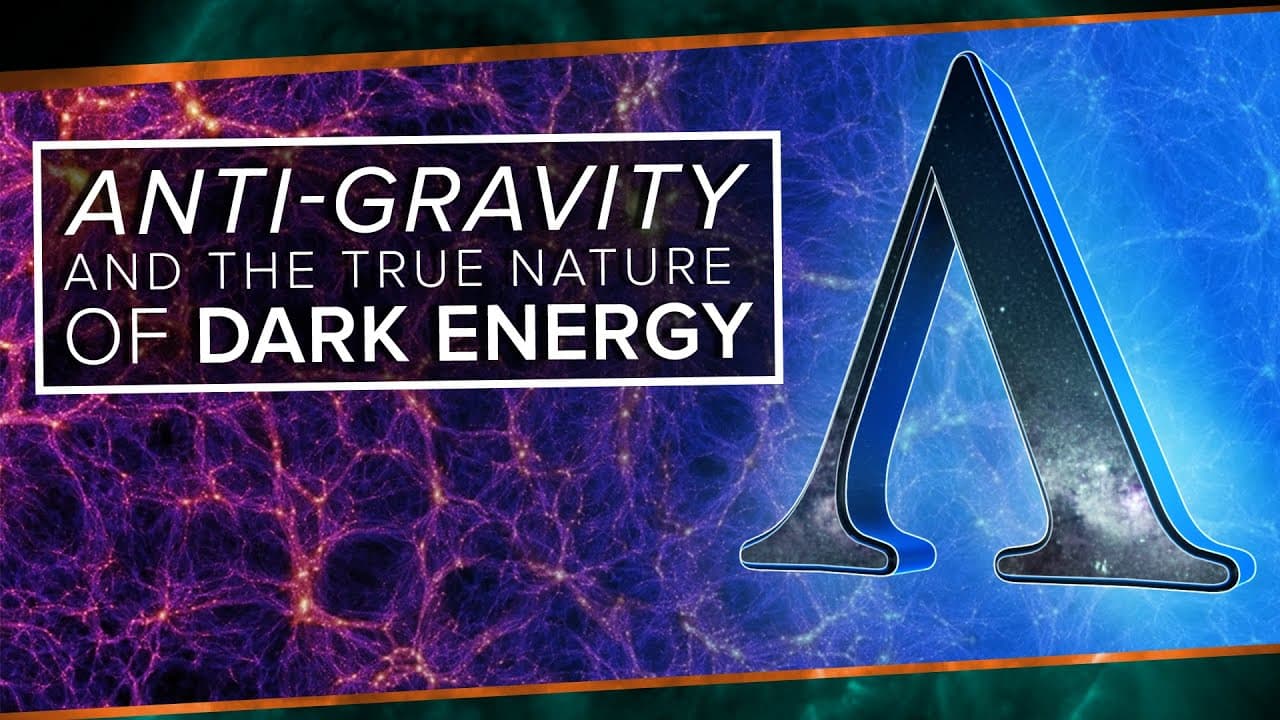
Dark energy is responsible for the universe's accelerating expansion due to its unique anti-gravity effect, which stems from its negative pressure. This pressure results in an outward push, counteracting gravity's inward pull. The cosmological constant in Einstein's equations describes this effect, suggesting that dark energy's density remains constant as the universe expands.
Transcript
The true nature of dark energy confounds even the world's smartest astrophysicists. It's strange anti-gravity effect is unlike anything we've ever encountered. Today, we get to the bottom of it. A few episodes ago, I asked you to take a wild ride with me into the heart of Einstein's general theory of relativity and its description of the vaster of ... Read More
Key Insights
- The universe is expanding and will continue to do so indefinitely due to insufficient matter to cause recollapse.
- Dark energy's presence is inferred from the universe's near-perfect flatness, despite expectations of a negatively curved geometry.
- The expansion of the universe is accelerating, as evidenced by observations of distant supernovae.
- Dark energy is described by the cosmological constant, which contributes to the universe's exponential expansion.
- Dark energy's constant energy density means more dark energy is present as the universe's volume increases.
- Negative pressure from dark energy results in an anti-gravity effect, causing outward acceleration.
- The law of conservation of energy does not apply in an expanding universe, allowing energy to be gained or lost.
- Dark energy's negative pressure is a relativistic effect, not easily explained intuitively, and is critical to its anti-gravity influence.
Install to Summarize YouTube Videos and Get Transcripts
Explore YouTube Video Summarizer or Get YouTube Transcript Extractor
Questions & Answers
Q: How does dark energy cause the universe's expansion to accelerate?
Dark energy causes the universe's expansion to accelerate due to its negative pressure, which results in an outward push that counteracts the inward pull of gravity. This anti-gravity effect is described by the cosmological constant in Einstein's equations, suggesting that dark energy's density remains constant as the universe expands, leading to exponential growth.
Q: What evidence supports the accelerating expansion of the universe?
The accelerating expansion of the universe is supported by observations of distant supernovae, which allow scientists to map the universe's past expansion history. These observations reveal that the universe is expanding at an increasing rate, suggesting the influence of an unseen force, known as dark energy, which drives this acceleration.
Q: What is the cosmological constant's role in dark energy?
The cosmological constant plays a crucial role in describing dark energy's effect on the universe. It represents a constant energy density that contributes to the universe's exponential expansion. The cosmological constant's inclusion in Einstein's equations accounts for the anti-gravity effect of dark energy, balancing the gravitational forces that would otherwise slow or reverse the expansion.
Q: Why does dark energy have a negative pressure?
Dark energy has a negative pressure because its energy density remains constant as the universe expands. This means that as the universe's volume increases, more dark energy is created, which requires work to expand. This characteristic of gaining energy upon expansion defines negative pressure, leading to the outward acceleration of the universe.
Q: How does negative pressure lead to anti-gravity?
Negative pressure leads to anti-gravity by creating an outward push that counteracts the inward pull of gravity. In the context of general relativity, negative pressure has a relativistic effect that results in the universe's accelerated expansion. This effect is not due to the motion of dark energy particles but rather its constant energy density, causing the universe to expand more rapidly.
Q: What challenges exist in explaining dark energy's effects intuitively?
Explaining dark energy's effects intuitively is challenging because its negative pressure and anti-gravity influence are relativistic effects not easily visualized. Unlike positive pressure, which results from particle motion, negative pressure arises from a constant energy density, complicating intuitive understanding. The concept defies classical physics, as energy can be gained or lost in an expanding universe.
Q: Does the law of conservation of energy apply in an expanding universe?
The law of conservation of energy does not apply in an expanding universe governed by general relativity. In such a universe, space and time are dynamic, allowing energy to be gained or lost as the universe expands. This departure from Newtonian physics enables dark energy's unique properties, such as its constant energy density and negative pressure, which drive the universe's accelerated expansion.
Q: What is the significance of dark energy's constant energy density?
Dark energy's constant energy density is significant because it ensures that as the universe's volume increases, more dark energy is created, maintaining the density. This characteristic leads to the universe's accelerated expansion, as the energy required for expansion is gained, resulting in negative pressure. This property is central to dark energy's anti-gravity effect, driving the universe's outward acceleration.
Summary & Key Takeaways
-
Dark energy causes the universe's expansion to accelerate due to its unique anti-gravity effect, rooted in negative pressure. This pressure results in an outward push, counteracting the inward pull of gravity. The cosmological constant in Einstein's equations describes this effect, suggesting that dark energy's density remains constant as the universe expands.
-
The universe is expanding and will continue indefinitely, as there is insufficient matter to cause a recollapse. Observations of distant supernovae confirm the universe's accelerating expansion. The presence of dark energy is inferred from the universe's unexpected flatness, which contradicts expectations of a negatively curved geometry.
-
Dark energy's negative pressure, a relativistic effect, is key to its anti-gravity influence. As the universe's volume increases, more dark energy is created to maintain a constant energy density. The law of conservation of energy does not apply in an expanding universe, allowing energy to be gained or lost, which contributes to dark energy's mysterious properties.
Read in Other Languages (beta)
Share This Summary 📚
Summarize YouTube Videos and Get Video Transcripts with 1-Click
Try YouTube Summary with ChatGPT & Claude or YouTube Transcript Generator
Explore More Summaries from PBS Space Time 📚



Summarize YouTube Videos and Get Video Transcripts with 1-Click
Try YouTube Summary with ChatGPT & Claude or YouTube Transcript Generator