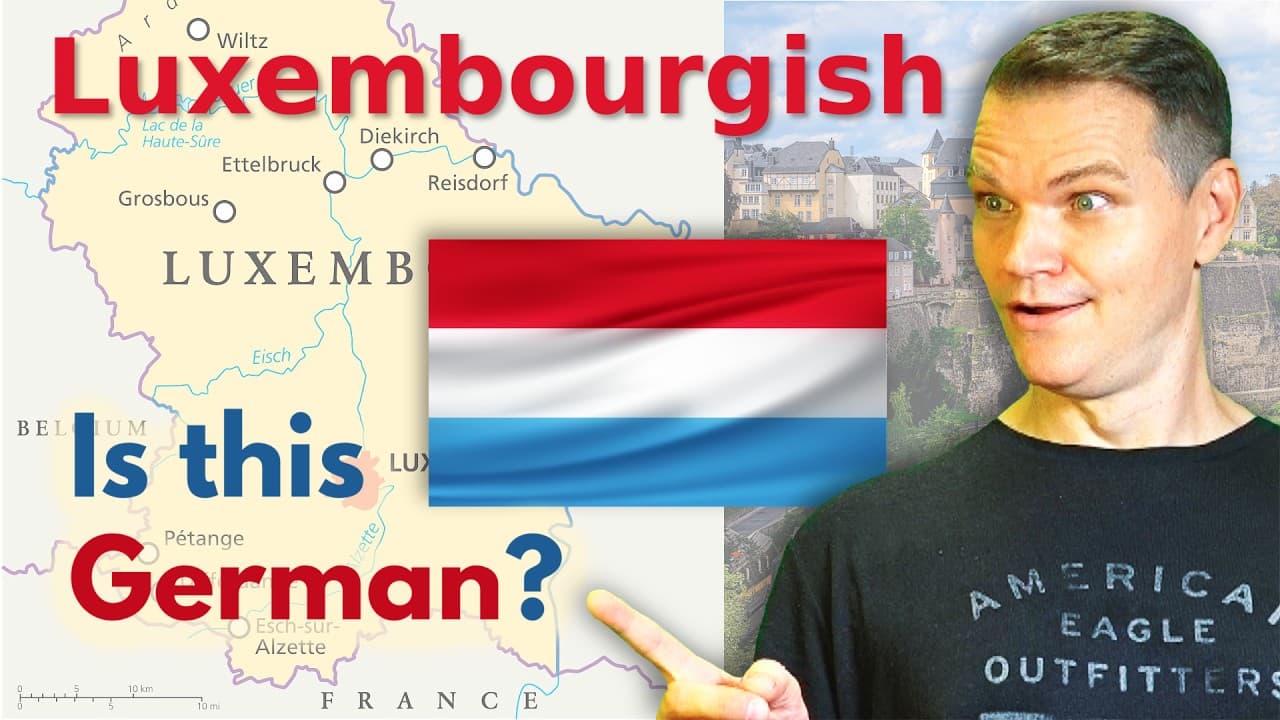
Luxembourgish - A Dialect of German? Or Separate Language?
TL;DR
Luxembourgish is a distinct language with influences from German and French.
Transcript
Luxembourg is a tiny country measuring just 82 km from north to south and 52 km from west to east and its resident population is only around 643,000 for a country this small one official language is probably enough right well Luxembourg actually has three official languages German French and luxembourgish the national language which has historicall... Read More
Key Insights
- Luxembourg is a multilingual country with Luxembourgish, French, and German as official languages, reflecting its rich linguistic diversity.
- Luxembourgish is a standardized form of the Moselle Franconian dialect, distinct yet closely related to German.
- French and German historical influences have shaped Luxembourg's linguistic landscape, with French serving as an administrative language.
- Luxembourgish has evolved to include loanwords from French and English, distinguishing it further from German.
- The EA rule in Luxembourgish affects pronunciation and spelling, showcasing unique phonological features compared to German.
- While Luxembourgish and German share similarities, Luxembourgish has developed unique grammatical structures, such as simplified noun cases.
- Luxembourgish uses compound tenses for past and conditional forms, differing from the simpler forms in standard German.
- Despite its similarities to German, Luxembourgish is considered its own language due to its standardized form and formal usage.
Install to Summarize YouTube Videos and Get Transcripts
Explore YouTube Video Summarizer or Get YouTube Transcript Extractor
Questions & Answers
Q: Why does Luxembourg have three official languages?
Luxembourg's three official languages—Luxembourgish, French, and German—reflect its geographical and historical context. Situated at the intersection of Germany, France, and Belgium, Luxembourg has absorbed linguistic influences from these regions. French historically served as the administrative language, while Luxembourgish evolved from a local dialect, becoming a national language.
Q: How has Luxembourgish evolved from its Germanic roots?
Luxembourgish evolved from the Moselle Franconian dialect, part of the West Central German dialect group. Over time, it was standardized and incorporated loanwords from French and English. This evolution, along with its formal use and unique grammatical features, distinguishes Luxembourgish from its Germanic origins and contributes to its recognition as a separate language.
Q: What is the EA rule in Luxembourgish?
The EA rule in Luxembourgish is a phonological feature where words ending in 'n' drop the 'n' if the next word begins with a consonant other than 'n', 'd', 't', 'z', or 'h'. This rule affects both spoken and written language, reflecting pronunciation in orthography. It's a characteristic of Western High German dialects, including Luxembourgish.
Q: How does Luxembourgish grammar differ from standard German?
Luxembourgish grammar differs from standard German in several ways. It has simplified noun cases, with nominative and accusative forms being identical. The language uses compound tenses for past and conditional forms, unlike the simpler forms in German. Additionally, Luxembourgish often uses 'méi' for comparatives instead of the German '-er' suffix.
Q: What role does French play in Luxembourgish vocabulary?
French significantly influences Luxembourgish vocabulary, with many loanwords incorporated into daily speech. This influence is a result of historical French administrative dominance and the bilingual nature of Luxembourg. Examples include words like 'Merci' for 'thank you' and 'Gare' for 'train station', showcasing the integration of French into Luxembourgish.
Q: Why is Luxembourgish considered its own language?
Luxembourgish is considered its own language due to its standardized form, distinct vocabulary, and formal usage in writing and official contexts. Despite its roots in the Moselle Franconian dialect, which is part of the German dialect continuum, Luxembourgish has diverged significantly, incorporating elements from French and English and developing unique grammatical features.
Q: How does Luxembourg's multilingual environment affect daily life?
Luxembourg's multilingual environment profoundly impacts daily life, with residents often switching between languages based on context and conversation partners. Workplaces are predominantly multilingual, with French and English frequently used. This linguistic diversity fosters a dynamic cultural exchange and requires residents to be adaptable in their language use.
Q: What is the significance of Luxembourgish being an official language?
Luxembourgish's status as an official language underscores its cultural importance and national identity. It symbolizes the country's commitment to preserving its linguistic heritage amid external influences. As an official language, Luxembourgish is used in education, media, and government, reinforcing its role in unifying the diverse linguistic landscape of Luxembourg.
Summary & Key Takeaways
-
Luxembourgish is a distinct language derived from the Moselle Franconian dialect, with significant influences from French and German. It serves as one of Luxembourg's three official languages, reflecting the country's multilingual environment.
-
Luxembourg's linguistic history is marked by French and German influences, with French historically serving as the administrative language. Despite its Germanic roots, Luxembourgish has developed unique features and a standardized form.
-
Luxembourgish incorporates loanwords from French and English, and its grammar includes unique elements such as the EA rule and simplified noun cases. These distinctions contribute to its status as a separate language from German.
Read in Other Languages (beta)
Share This Summary 📚
Summarize YouTube Videos and Get Video Transcripts with 1-Click
Try YouTube Summary with ChatGPT & Claude or YouTube Transcript Generator
Explore More Summaries from Langfocus 📚
Summarize YouTube Videos and Get Video Transcripts with 1-Click
Try YouTube Summary with ChatGPT & Claude or YouTube Transcript Generator