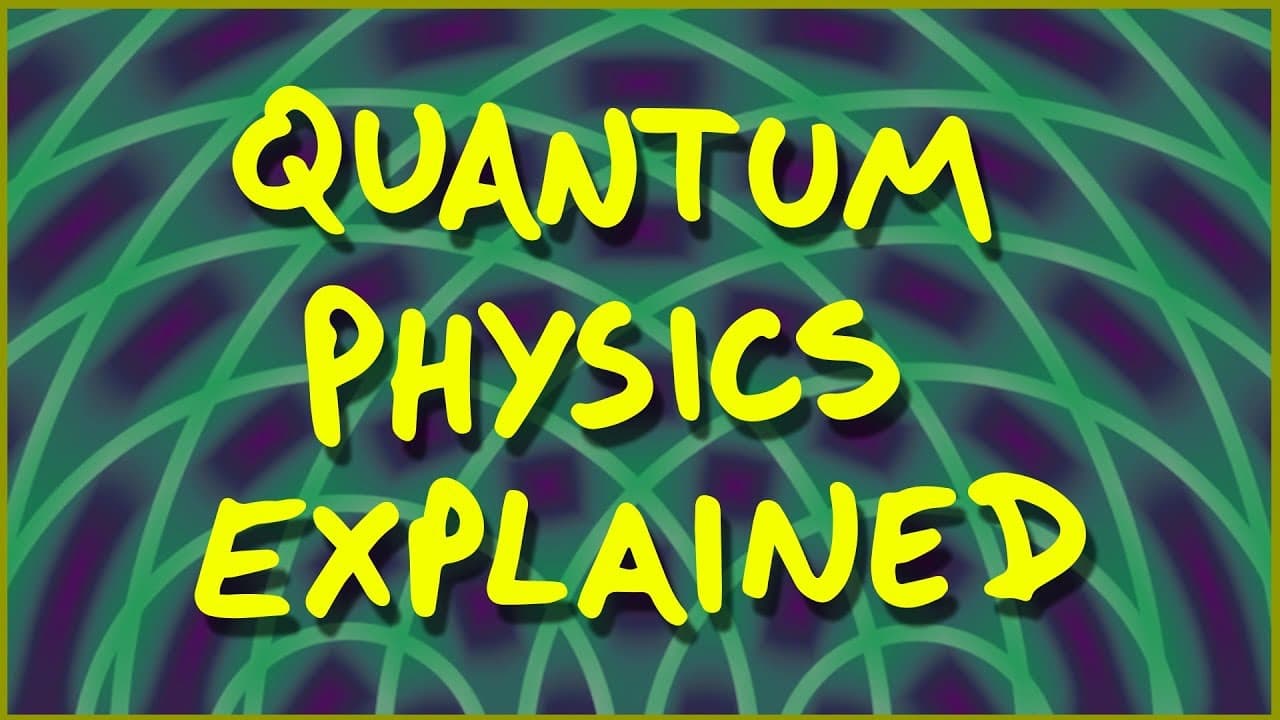
If You Don't Understand Quantum Physics, Try This!
TL;DR
Quantum physics explains the smallest parts of the universe through wave functions and phenomena like superposition and entanglement.
Transcript
quantum physics has a mystique of being complicated and hard to understand in fact Richard Fineman who won the Nobel Prize for his work on quantum electrodynamics said if you think you understand quantum physics you don't understand quantum physics which is kind of disheartening for us because if he didn't understand it what chance to the rest of u... Read More
Key Insights
- 👋 Quantum physics utilizes wave functions for predicting probabilities of particle properties.
- 👋 Wave-particle duality and phenomena like superposition challenge classical physics notions.
- 😫 The Heisenberg uncertainty principle sets foundational limits on measuring position and momentum simultaneously.
- 🫀 Energy quantization in quantum physics explains discrete spectra in atomic transitions.
- 👻 Quantum tunneling allows particles to pass through barriers based on probabilities.
- ❓ Entanglement showcases correlated behaviors of particles regardless of distance.
- 🦾 Quantum mechanics reconciles accurate predictions with conceptual challenges like the measurement problem.
Install to Summarize YouTube Videos and Get Transcripts
Explore YouTube Video Summarizer or Get YouTube Transcript Extractor
Questions & Answers
Q: How does quantum physics describe the behavior of subatomic particles?
Quantum physics uses wave functions to predict probabilities of position and momentum for particles, revealing the wave-particle duality and phenomena like superposition and entanglement.
Q: What is the significance of the double-slit experiment in quantum physics?
The double-slit experiment demonstrates the wave-like behavior of particles, showing how electrons exhibit interference patterns, highlighting the inherent uncertainty and wave-particle duality in quantum mechanics.
Q: What is the Heisenberg uncertainty principle in quantum physics?
The Heisenberg uncertainty principle states that there are limits to simultaneously knowing the exact position and momentum of a particle, showcasing the fundamental uncertainty at the quantum level.
Q: How does quantum physics explain energy quantization in atomic spectra?
Quantum physics describes energy quantization in atoms as electrons transitioning between quantized energy levels, emitting light as discrete packets of energy known as photons.
Summary & Key Takeaways
-
Quantum physics describes the smallest entities in the universe through wave functions like electrons.
-
Wave functions predict probabilities rather than certainties of position and momentum of particles.
-
Phenomena like superposition, entanglement, quantum tunneling, and the Heisenberg uncertainty principle define quantum physics.
Read in Other Languages (beta)
Share This Summary 📚
Summarize YouTube Videos and Get Video Transcripts with 1-Click
Try YouTube Summary with ChatGPT & Claude or YouTube Transcript Generator
Explore More Summaries from Domain of Science 📚

Summarize YouTube Videos and Get Video Transcripts with 1-Click
Try YouTube Summary with ChatGPT & Claude or YouTube Transcript Generator