What Are the Key Contributions to the Scientific Method?
TL;DR
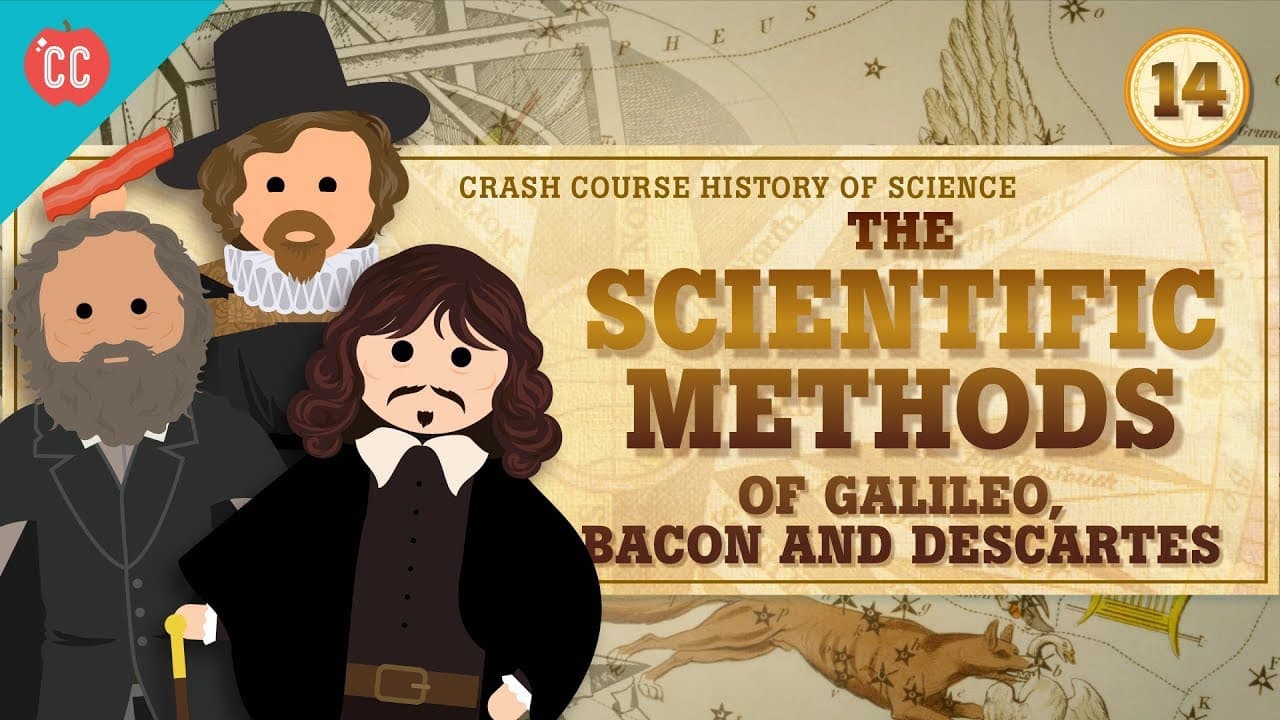
The scientific method evolved through the contributions of Galileo, Bacon, and Descartes, each emphasizing different principles: Galileo championed observation and experimentation, Bacon focused on practical applications and state support, while Descartes advocated for a systematic philosophical approach. Together, they laid the groundwork for modern scientific inquiry and emphasized the importance of rationality, testing, and self-examination.
Transcript
I started this course by saying that people have made knowledge about the natural world, pretty much forever. They’ve done this by carefully observing the world and then devising tests to find out if their ideas are true. Today, we refer to a specific series of steps—coming up with a hypothesis, testing it, and drawing conclusions—as the scientific... Read More
Key Insights
- Galileo, Bacon, and Descartes significantly shaped the development of the scientific method by introducing principles such as rationality, experimentation, and self-examination.
- Galileo's work with telescopes revolutionized astronomy and supported the heliocentric model, despite opposition from the Church.
- Francis Bacon proposed a practical approach to science, emphasizing technology and state support, and envisioned a utopian scientific community in his book New Atlantis.
- René Descartes contributed to epistemology and mathematics, advocating for a reductionist view of the universe and systematic doubting as a method of verifying knowledge.
- Galileo's trial and house arrest highlight the conflict between emerging scientific ideas and established religious doctrines during his time.
- Bacon's vision of science involved a structured, hierarchical system where different roles were assigned to gather, experiment, and analyze knowledge.
- Descartes' Cartesian coordinate system bridged algebra and geometry, providing a mathematical framework to describe physical phenomena.
- The historical development of the scientific method was shaped by various thinkers who emphasized different aspects such as observation, experimentation, and philosophical inquiry.
Install to Summarize YouTube Videos and Get Transcripts
Explore YouTube Video Summarizer or Get YouTube Transcript Extractor
Questions & Answers
Q: What contributions did Galileo make to the scientific method?
Galileo contributed significantly to the scientific method by emphasizing observation and experimentation. He improved telescope technology, which allowed for better astronomical observations, supporting the heliocentric model. His insistence on independent confirmation of scientific findings laid the groundwork for modern scientific inquiry.
Q: How did Francis Bacon envision the role of science in society?
Francis Bacon envisioned science as a practical endeavor aimed at improving human well-being through technological advancements. He proposed a state-supported, structured system of scientific inquiry, outlined in his book New Atlantis, where knowledge was systematically gathered, experimented upon, and analyzed for public benefit.
Q: What was René Descartes' approach to scientific knowledge?
René Descartes approached scientific knowledge through a philosophical lens, focusing on epistemology. He emphasized the importance of systematic doubting and reductionism, using math to describe physical phenomena. Descartes believed that only mathematical certainty could provide a reliable foundation for understanding the universe.
Q: What challenges did Galileo face due to his scientific beliefs?
Galileo faced significant challenges due to his support for the heliocentric model, which conflicted with the Church's geocentric views. His vocal advocacy led to scrutiny by the Inquisition, resulting in a trial and house arrest. Despite these challenges, Galileo continued his scientific work, contributing to physics and astronomy.
Q: How did Bacon's view of science differ from that of Aristotle?
Bacon's view of science differed from Aristotle's by rejecting purely rational argumentation. Instead, Bacon advocated for empirical observation and experimentation to derive practical benefits. He criticized Aristotle's approach as neglecting the Christian duty of improving human welfare through technological progress.
Q: What is the significance of Descartes' Cartesian coordinates?
Descartes' Cartesian coordinates are significant because they bridged algebra and geometry, providing a mathematical framework to describe and analyze physical phenomena. This system revolutionized mathematics by allowing for the graphical representation of equations, facilitating the study of calculus and analytic geometry.
Q: What role did state support play in Bacon's scientific vision?
State support played a crucial role in Bacon's scientific vision, as he believed that centralized planning and funding were essential for scientific progress. He envisioned a structured, hierarchical system where scientific inquiry was conducted for the public good, with the state providing resources and organization.
Q: How did the scientific approaches of Galileo, Bacon, and Descartes differ?
Galileo, Bacon, and Descartes had differing scientific approaches: Galileo emphasized observation and experimentation, Bacon focused on practical applications and state support, and Descartes pursued philosophical inquiry and mathematical certainty. Together, their contributions laid the foundation for modern scientific methods and inquiry.
Summary & Key Takeaways
-
The video explores the evolution of the scientific method, highlighting contributions from Galileo, Bacon, and Descartes. It discusses their differing approaches and the historical context in which they worked, emphasizing the lack of a singular scientific method.
-
Galileo's advancements in telescope technology and his support for the heliocentric model are discussed, alongside his conflicts with the Church. Bacon's pragmatic approach to science and Descartes' philosophical contributions are also examined.
-
The video emphasizes the historical diversity in scientific approaches, with Galileo focusing on observation, Bacon on practical applications, and Descartes on philosophical foundations, collectively shaping modern scientific inquiry.
Read in Other Languages (beta)
Share This Summary 📚
Summarize YouTube Videos and Get Video Transcripts with 1-Click
Try YouTube Summary with ChatGPT & Claude or YouTube Transcript Generator
Explore More Summaries from CrashCourse 📚



Summarize YouTube Videos and Get Video Transcripts with 1-Click
Try YouTube Summary with ChatGPT & Claude or YouTube Transcript Generator