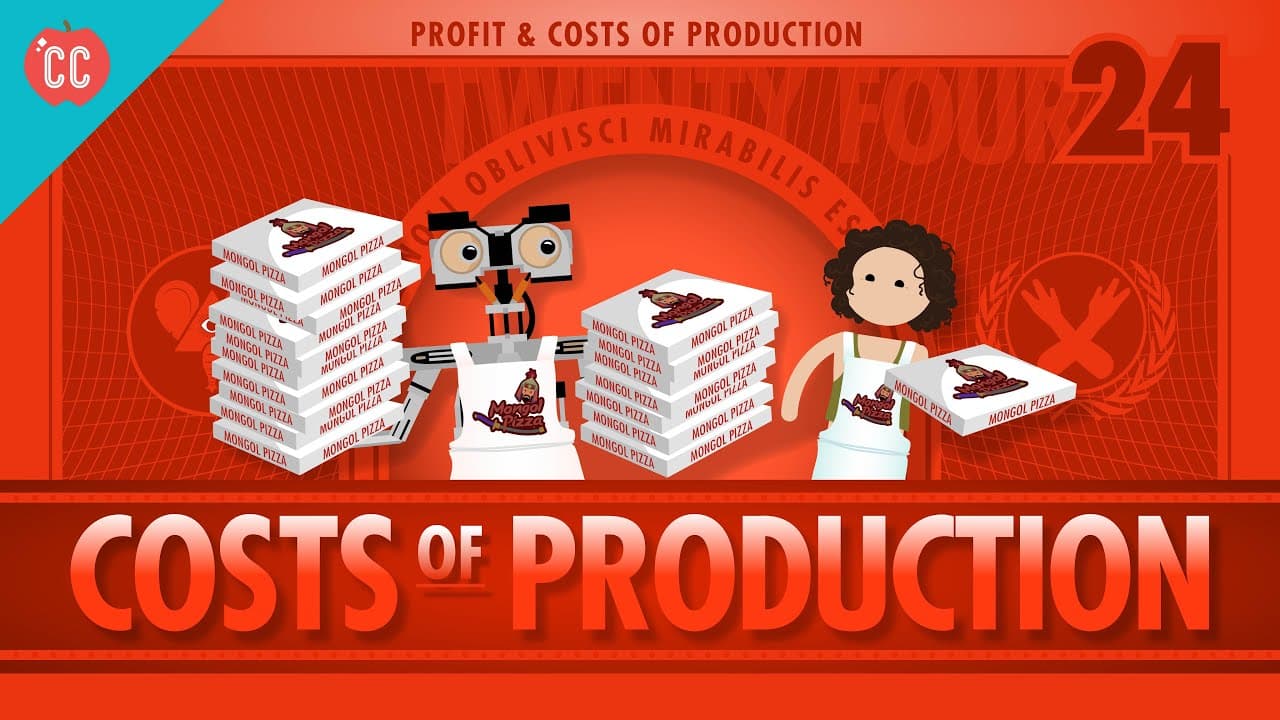
Revenue, Profits, and Price: Crash Course Economics #24
TL;DR
Understanding economic and accounting profits in business decisions.
Transcript
Adriene: Welcome to Crash Course Economics, I’m Adriene Hill Jacob: and I’m Jacob Clifford, and I have a confession. Economists’ perfect little models don’t exactly reflect real life. Which is disappointing. Adriene: Don’t worry. You’re not wasting your time. Microeconomics explains ideas and concepts in pretty broad terms, and leaves the business ... Read More
Key Insights
- Economics provides broad insights into business decision making, focusing on concepts like opportunity cost and economic profit, which are crucial for entrepreneurs.
- Accounting profit considers only explicit costs, while economic profit includes both explicit and implicit costs, affecting business decisions significantly.
- Opportunity cost plays a vital role in evaluating business success, as it considers the income foregone from alternative ventures.
- In highly competitive markets, businesses tend to achieve zero economic profit, known as normal profit, as competition erodes extra profits.
- Businesses must distinguish between fixed costs, which remain constant, and variable costs, which change with production levels, to manage expenses effectively.
- Economies of scale allow larger companies to reduce average costs by spreading fixed costs over a large number of units, giving them a competitive edge.
- The law of diminishing marginal returns highlights that adding more of a variable resource eventually decreases the additional output, impacting production decisions.
- Sunk costs, which are irrecoverable, should not influence future business decisions, though people often struggle to ignore them.
Install to Summarize YouTube Videos and Get Transcripts
Explore YouTube Video Summarizer or Get YouTube Transcript Extractor
Questions & Answers
Q: What is the difference between accounting profit and economic profit?
Accounting profit is calculated as total revenue minus explicit costs, which are the direct, out-of-pocket expenses. Economic profit, on the other hand, considers both explicit and implicit costs, including opportunity costs. It provides a more comprehensive view of a business's profitability by factoring in the income foregone from other potential ventures.
Q: Why is opportunity cost important in business decision-making?
Opportunity cost is crucial because it represents the potential benefits an individual or business misses out on when choosing one alternative over another. For businesses, considering opportunity costs ensures that decisions are made with a full understanding of what is being sacrificed, leading to more informed and potentially profitable choices.
Q: How does competition affect economic profit in a market?
In competitive markets, economic profit tends to be zero, known as normal profit. This occurs because any extra profits attract new competitors, driving prices down and reducing sales. As a result, businesses only earn enough to cover their opportunity costs, preventing them from making excess economic profit.
Q: What role do fixed and variable costs play in business production?
Fixed costs are expenses that remain constant regardless of production levels, such as rent or equipment. Variable costs fluctuate with production, like raw materials and wages. Understanding these costs helps businesses manage expenses, set prices, and determine the optimal production level to maximize profits.
Q: What are economies of scale and how do they benefit businesses?
Economies of scale occur when a company reduces its average costs by increasing production. By spreading fixed costs over a larger number of units, businesses can lower the cost per unit, gaining a competitive advantage. This often allows larger firms to dominate their industry and limit competition.
Q: How does the law of diminishing marginal returns impact production decisions?
The law of diminishing marginal returns states that adding more of a variable resource to a fixed resource eventually leads to decreased additional output. This affects production decisions as businesses must balance the number of resources to optimize output and avoid inefficiencies, ensuring that marginal costs do not exceed marginal revenue.
Q: Why should businesses ignore sunk costs in decision-making?
Sunk costs are past expenses that cannot be recovered. Rational decision-making requires focusing on future costs and benefits rather than past investments. Ignoring sunk costs prevents businesses from making decisions based on irrelevant factors, allowing them to allocate resources more effectively and pursue more profitable opportunities.
Q: What is the profit-maximizing rule for businesses?
The profit-maximizing rule suggests that businesses should continue production as long as the marginal revenue of the last unit produced is greater than or equal to the marginal cost. This ensures that each additional unit contributes positively to profit, helping businesses optimize production levels and maximize profitability.
Summary & Key Takeaways
-
The video explains key economic concepts like accounting and economic profits, opportunity costs, and how they impact business decisions. It emphasizes the importance of understanding both explicit and implicit costs for entrepreneurs.
-
In competitive markets, businesses often achieve zero economic profit due to competition, known as normal profit. The video also explores fixed and variable costs, economies of scale, and their implications for business strategies.
-
The law of diminishing marginal returns and the significance of ignoring sunk costs in decision-making are discussed. These concepts help businesses optimize production and make rational future decisions.
Read in Other Languages (beta)
Share This Summary 📚
Summarize YouTube Videos and Get Video Transcripts with 1-Click
Try YouTube Summary with ChatGPT & Claude or YouTube Transcript Generator
Explore More Summaries from CrashCourse 📚




Summarize YouTube Videos and Get Video Transcripts with 1-Click
Try YouTube Summary with ChatGPT & Claude or YouTube Transcript Generator