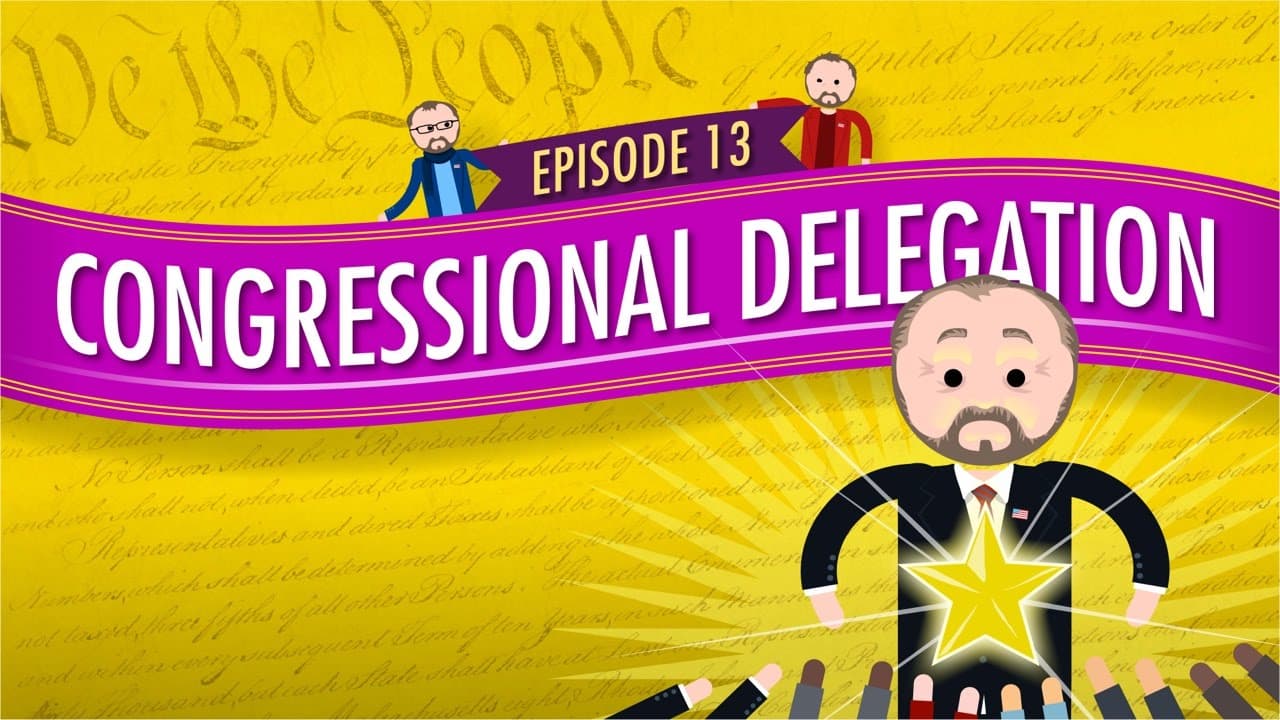
Congressional Delegation: Crash Course Government and Politics #13
TL;DR
Congress delegates powers to the Executive to manage extensive government functions.
Transcript
This episode of Crash Course is brought to you by Squarespace. Hi I'm Craig and this is Crash Course Government and Politics and today we're going to cross the streams of the legislative and executive branches and talk about delegation. I thought we weren't supposed to cross the streams Stan?! Ooh, that's Ghostbusting. Sorry about that. We're far a... Read More
Key Insights
- Delegation involves Congress granting powers to the Executive branch through legislation, allowing agencies to implement and manage government programs effectively.
- The discretion given to agencies by Congress varies; sometimes it's limited, as seen with the Tax Code, while other times it's broad, like with OSHA regulations.
- Delegation is necessary for practical reasons, as Congress cannot manage all government programs and requires specialized agencies to execute laws.
- Historically, delegation shifted power to the Executive, especially during the New Deal, when Congress created numerous agencies to address national issues.
- Politically, Congress delegates power to avoid blame for negative outcomes, allowing the Executive to take responsibility for implementation.
- Delegated powers can be checked by the Courts, which review laws and regulations, ensuring the separation of powers is maintained.
- The extent of delegation often depends on the political climate, such as unified government or national crises like post-9/11, leading to increased Executive authority.
- Overall, delegation reflects a shift of power from the Legislative to the Executive branch, raising discussions on its implications for democracy.
Install to Summarize YouTube Videos and Get Transcripts
Explore YouTube Video Summarizer or Get YouTube Transcript Extractor
Questions & Answers
Q: What is the main purpose of delegation in government?
The main purpose of delegation in government is to allow Congress to transfer specific powers to the Executive branch. This enables specialized agencies to manage and implement government programs effectively, as Congress cannot oversee every detail of law execution due to the vast scope of modern governance.
Q: How does Congress limit the discretion of agencies?
Congress limits the discretion of agencies by writing laws with specific instructions on what the agency can do and how it can do it. For example, the Tax Code is detailed and extensive, providing clear guidelines for the IRS, thus restricting its discretionary power in tax-related matters.
Q: Why is delegation necessary for Congress?
Delegation is necessary for Congress because it cannot manage all government programs due to the complexity and scope of modern governance. By delegating powers, Congress allows specialized agencies with the expertise to implement and enforce laws more effectively, ensuring the government functions smoothly.
Q: What historical events have influenced the delegation of powers?
Historical events like the New Deal significantly influenced the delegation of powers. During this period, Congress created numerous agencies to address economic challenges, leading to a shift of power to the Executive branch. This trend continued with events like post-9/11, where Congress delegated more authority to address national security concerns.
Q: What are the political reasons behind delegation?
Politically, Congress delegates power to avoid being blamed for negative outcomes. By granting broad discretion to the Executive branch, Congress can shift responsibility for policy implementation, allowing legislators to distance themselves from potential failures and focus on legislative duties.
Q: How do courts check delegated powers?
Courts check delegated powers by reviewing laws and bureaucratic rules to ensure they comply with constitutional standards. This judicial oversight maintains the separation of powers, preventing the Executive branch from exceeding its authority and ensuring that delegated powers are used appropriately.
Q: How does the political climate affect delegation?
The political climate significantly affects delegation, with unified government often leading to increased delegation to the Executive branch. When one party controls both Congress and the White House, there is more trust in the Executive, resulting in greater delegation. National crises also prompt increased delegation to address urgent issues.
Q: What is the impact of delegation on the separation of powers?
Delegation impacts the separation of powers by shifting authority from the Legislative to the Executive branch. While it allows for efficient governance, it raises concerns about the balance of power and the potential for Executive overreach. This shift necessitates ongoing discussions about its implications for democratic governance.
Summary & Key Takeaways
-
Delegation is the process by which Congress grants powers to the Executive branch, allowing agencies to manage and implement government programs. This is essential for handling the extensive responsibilities of modern governance, as Congress cannot oversee every detail of law execution.
-
The discretion given to agencies varies significantly, with some laws providing specific instructions and others allowing broad interpretation. This flexibility is crucial for agencies like OSHA, which require autonomy to enforce regulations effectively.
-
Delegation has historical roots, notably expanding during the New Deal when Congress created numerous agencies to address economic challenges. Today, delegation continues to reflect political realities, with Congress often seeking to avoid blame for potential policy failures.
Read in Other Languages (beta)
Share This Summary 📚
Summarize YouTube Videos and Get Video Transcripts with 1-Click
Try YouTube Summary with ChatGPT & Claude or YouTube Transcript Generator
Explore More Summaries from CrashCourse 📚




Summarize YouTube Videos and Get Video Transcripts with 1-Click
Try YouTube Summary with ChatGPT & Claude or YouTube Transcript Generator