How Did Georgia, Armenia, and Azerbaijan Gain Independence?
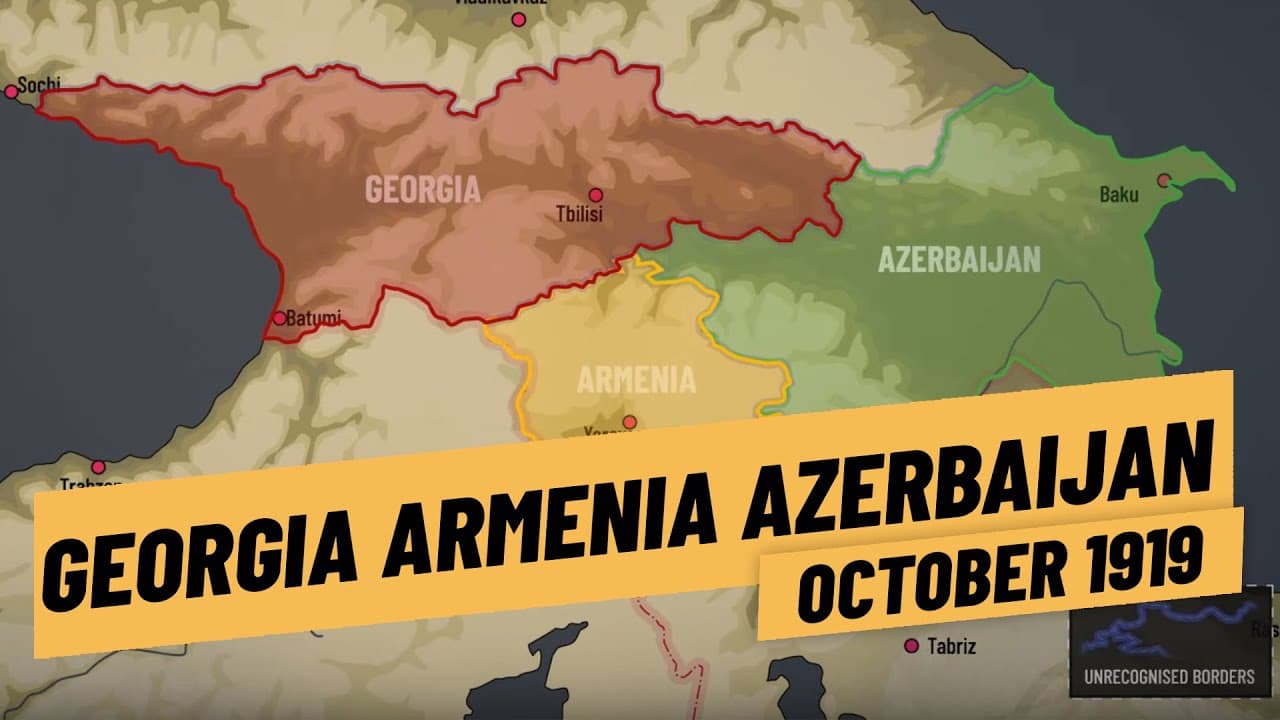
TL;DR
In 1918, Georgia, Armenia, and Azerbaijan declared independence amidst the chaos following the Russian Empire's collapse. Despite initial successes, they faced internal strife, ethnic conflicts, and external threats from Bolshevik Russia and Turkey. By 1921, all three republics were incorporated into the Soviet Union, marking the end of their brief independence.
Transcript
it's October 1919 and the three small republics of Georgia Armenia and Azerbaijan are struggling to survive in the post-revolutionary chaos it is still unclear whether they will be able to maintain their independence or whether the resurgent power of Kamala's turkey and Bolshevik Russia will return to the South Caucasus [Applause] hi I'm Jesse Alex... Read More
Key Insights
- Georgia, Armenia, and Azerbaijan declared independence in 1918 after the Russian Empire's collapse.
- The Transcaucasian Federation briefly united the three nations before dissolving due to ethnic and political tensions.
- Georgia relied on German and later British support to maintain its independence but faced internal revolts.
- Armenia, devastated by war and genocide, struggled with border conflicts and humanitarian crises.
- Azerbaijan experienced political instability and violence, with multiple governments in a short span.
- The British and other Allies recognized the republics but provided limited support, leading to their vulnerability.
- By 1921, the Red Army had reasserted control over the region, ending the independence of the three republics.
- The strategic importance of the Caucasus made it a target for both Bolshevik Russia and Turkey, contributing to the republics' downfall.
Install to Summarize YouTube Videos and Get Transcripts
Explore YouTube Video Summarizer or Get YouTube Transcript Extractor
Questions & Answers
Q: How did Georgia, Armenia, and Azerbaijan declare independence?
After the Russian Empire collapsed in 1917, Georgia, Armenia, and Azerbaijan initially formed the Transcaucasian Federation. However, due to internal ethnic and political tensions, the federation dissolved, and each nation declared independence in May 1918. They faced immediate challenges from neighboring powers and internal strife, impacting their ability to maintain sovereignty.
Q: What challenges did Georgia face in maintaining its independence?
Georgia faced several challenges, including internal revolts by minority groups and external threats from Bolshevik Russia and Turkey. Initially relying on German support, Georgia sought British assistance after Germany's defeat. Despite some military aid, internal ethnic tensions and political instability weakened Georgia's position, leading to its eventual incorporation into the Soviet Union by 1921.
Q: What were the main issues Armenia faced after declaring independence?
Armenia struggled with the aftermath of genocide and war, leading to a humanitarian crisis with refugees and near starvation. It faced border conflicts with Azerbaijan and Georgia, complicating its efforts to stabilize. Despite hopes for international support, Armenia was unable to withstand Turkish and Bolshevik advances, resulting in its incorporation into the Soviet Union by late 1920.
Q: How did Azerbaijan's political instability impact its independence?
Azerbaijan's political instability was marked by frequent government changes and internal divisions. The country's secular nationalist party struggled to maintain control amidst widespread illiteracy and violence. The chaotic environment left Azerbaijan vulnerable to external influences, and by 1920, the Red Army, with Turkish support, reasserted control, ending its independence.
Q: What role did the Allies play in the independence of the Caucasus republics?
The Allies, particularly the British, recognized the independence of Georgia, Armenia, and Azerbaijan but provided limited support. Their strategic interests in the region focused more on containing Bolshevik influence and securing resources rather than actively supporting the republics' sovereignty. This lack of substantial aid contributed to the republics' vulnerability to Bolshevik advances.
Q: Why was the South Caucasus strategically important during this period?
The South Caucasus was strategically important due to its geographic location as a buffer zone between Russia and the Middle East. It also held significant oil resources, making it a target for both Bolshevik Russia and Turkey. The region's instability presented opportunities for these powers to expand their influence, ultimately leading to the republics' loss of independence.
Q: How did ethnic tensions affect the stability of the Caucasus republics?
Ethnic tensions significantly impacted the stability of the Caucasus republics. Disputes over ethnically mixed regions and minority populations led to internal conflicts and violence. These tensions weakened the republics' ability to form cohesive governments and made them more susceptible to external pressures from larger powers like Bolshevik Russia and Turkey.
Q: What was the outcome of the brief independence of Georgia, Armenia, and Azerbaijan?
The brief independence of Georgia, Armenia, and Azerbaijan ended with their incorporation into the Soviet Union by 1921. Despite initial efforts to establish independent republics, internal conflicts and external threats from Bolshevik Russia and Turkey overwhelmed them. The strategic importance of the region and lack of substantial international support contributed to their downfall.
Summary & Key Takeaways
-
Georgia, Armenia, and Azerbaijan declared independence in 1918 following the Russian Empire's collapse. Despite initial efforts to establish stable governments, they faced internal ethnic conflicts and external threats from Bolshevik Russia and Turkey. By 1921, the Red Army had reasserted control, ending their brief period of independence.
-
The Transcaucasian Federation was a short-lived political entity that attempted to unite Georgia, Armenia, and Azerbaijan. Due to ethnic tensions and conflicting interests, it dissolved, leading each nation to pursue its own path to independence, which proved to be fraught with challenges and ultimately unsuccessful.
-
The Allies recognized the independence of the South Caucasus republics but failed to provide sufficient support to resist Bolshevik and Turkish advances. The strategic importance of the region meant that both external powers sought to re-establish control, resulting in the incorporation of the republics into the Soviet Union by 1921.
Read in Other Languages (beta)
Share This Summary 📚
Summarize YouTube Videos and Get Video Transcripts with 1-Click
Try YouTube Summary with ChatGPT & Claude or YouTube Transcript Generator
Explore More Summaries from The Great War 📚






Summarize YouTube Videos and Get Video Transcripts with 1-Click
Try YouTube Summary with ChatGPT & Claude or YouTube Transcript Generator