Are Cosmic Strings Cracks in the Universe?
TL;DR
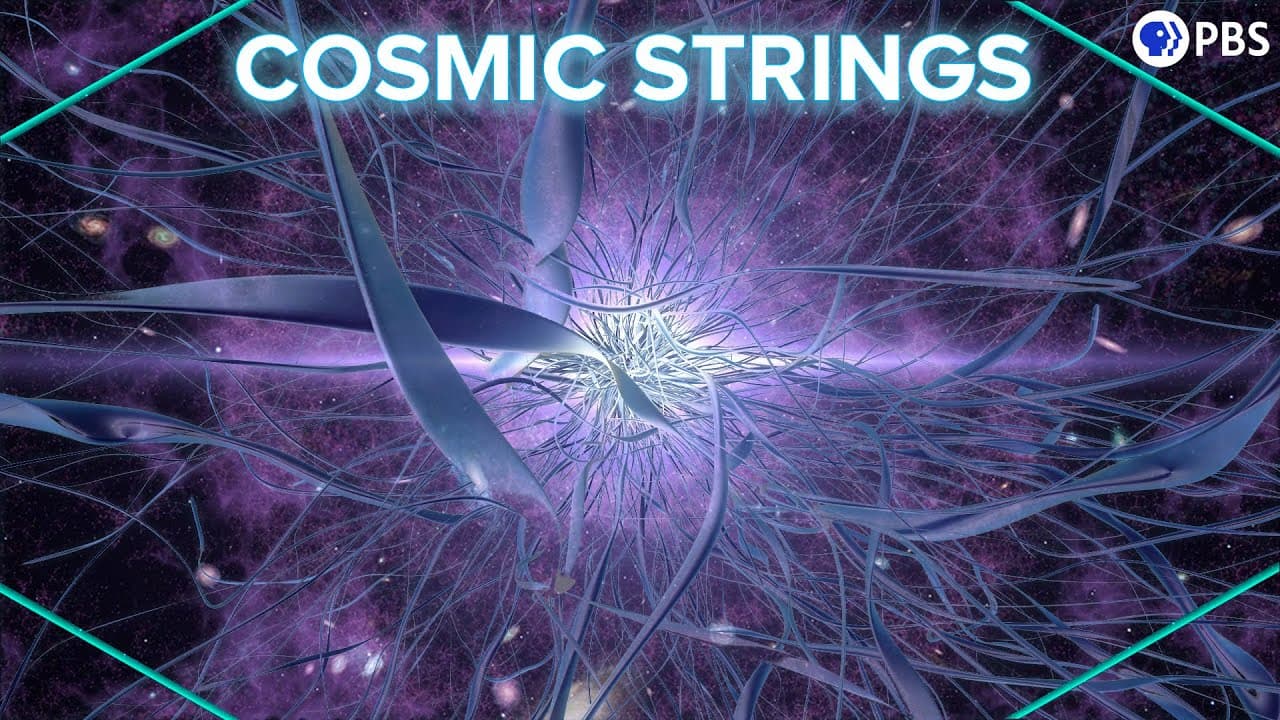
Cosmic strings are topological defects in the universe from the Big Bang.
Transcript
In order to make a nice, clear ice cube for your drinks, it’s important to consider quantum fields. First, boil to release dissolved gasses, then make sure the freezing extends through the cube from a single surface. If the crystallization process starts from multiple nucleation points then there’ll be imperfections in the lattice structure where... Read More
Key Insights
- Cosmic strings are theorized to be universe-spanning filaments formed from topological defects in quantum fields following the Big Bang.
- These strings are subatomic in thickness but possess immense mass, and they move at speeds close to light.
- Understanding cosmic strings involves exploring phase transitions in quantum fields, akin to how ice forms from water.
- The Higgs field's phase transition in the early universe may have led to the formation of cosmic strings.
- Cosmic strings could potentially be detected through gravitational waves and gravitational lensing effects.
- Cosmic superstrings, a concept from string theory, may resemble cosmic strings but have distinct properties like forming junctions.
- Detecting cosmic strings could provide insights into the universe's origins, quantum fields, and validate string theory.
- Despite no direct evidence yet, cosmic strings remain a key area of interest due to their potential to reveal fundamental truths about the universe.
Install to Summarize YouTube Videos and Get Transcripts
Explore YouTube Video Summarizer or Get YouTube Transcript Extractor
Questions & Answers
Q: What are cosmic strings and how are they formed?
Cosmic strings are theoretical one-dimensional topological defects in the universe, believed to have formed shortly after the Big Bang. They arise from imperfections in the quantum fields as the universe cooled and expanded, leading to phase transitions similar to how ice forms from water. These strings have immense mass and can stretch across the universe, moving at speeds close to light.
Q: How are cosmic strings related to the Higgs field?
Cosmic strings are thought to be linked to the Higgs field through phase transitions that occurred in the early universe. As the universe cooled, the Higgs field underwent changes that led to the formation of topological defects. These defects, manifesting as cosmic strings, are remnants of the universe's primordial vacuum state, holding significant energy and mass.
Q: What are the potential methods for detecting cosmic strings?
Cosmic strings could potentially be detected through their gravitational effects. They might produce gravitational waves detectable by future observatories like LISA. Additionally, cosmic strings could cause gravitational lensing, creating unique patterns like split images across the sky. These methods rely on observing the influence of cosmic strings on light and gravitational waves.
Q: What distinguishes cosmic strings from cosmic superstrings?
Cosmic superstrings, derived from string theory, are similar to cosmic strings but have distinct characteristics. While cosmic strings typically intercommute when they collide, superstrings often pass through each other and can form junctions. These differences affect their decay rates and gravitational wave signatures, offering potential ways to differentiate between the two.
Q: Why are cosmic strings significant in understanding the universe?
Cosmic strings are significant because they could provide insights into the universe's early conditions and the nature of quantum fields. Their discovery might validate theories like string theory and reveal fundamental truths about the universe's structure. Understanding cosmic strings could help us comprehend the universe's origins and the forces that govern it.
Q: What role do phase transitions play in the formation of cosmic strings?
Phase transitions in quantum fields are crucial to the formation of cosmic strings. As the universe cooled after the Big Bang, the Higgs field underwent a phase transition, leading to topological defects. These defects, formed at the boundaries of expanding bubbles of new vacuum states, resulted in the creation of cosmic strings, similar to how imperfections form in freezing ice.
Q: How do cosmic strings influence gravitational waves?
Cosmic strings influence gravitational waves through their immense mass and tension. As they vibrate and collide, they can create kinks that radiate gravitational waves. These waves are emitted in beams aligned with the strings' oscillations. Detecting these gravitational waves could provide evidence of cosmic strings and offer insights into their properties and behaviors.
Q: What challenges exist in detecting cosmic strings?
Detecting cosmic strings is challenging due to their subtle gravitational effects and the limitations of current technology. Gravitational waves from cosmic strings might be too weak for existing detectors like LIGO. Additionally, gravitational lensing by cosmic strings could be difficult to distinguish from other astrophysical phenomena. Future advancements in observational technology may improve our ability to detect these elusive structures.
Summary & Key Takeaways
-
Cosmic strings are theoretical constructs believed to be formed from topological defects in quantum fields shortly after the Big Bang. These strings, while subatomic in thickness, have a massive density and can stretch across the universe, moving at nearly the speed of light.
-
The formation of cosmic strings is linked to phase transitions in quantum fields, similar to how ice forms from water. As the universe cooled, the Higgs field underwent a phase transition, potentially leading to the creation of these strings.
-
Detecting cosmic strings could be achieved through their gravitational effects, such as gravitational waves and lensing. Although no cosmic strings have been observed yet, their discovery could offer profound insights into the universe's structure and the validity of theories like string theory.
Read in Other Languages (beta)
Share This Summary 📚
Summarize YouTube Videos and Get Video Transcripts with 1-Click
Try YouTube Summary with ChatGPT & Claude or YouTube Transcript Generator
Explore More Summaries from PBS Space Time 📚
Summarize YouTube Videos and Get Video Transcripts with 1-Click
Try YouTube Summary with ChatGPT & Claude or YouTube Transcript Generator