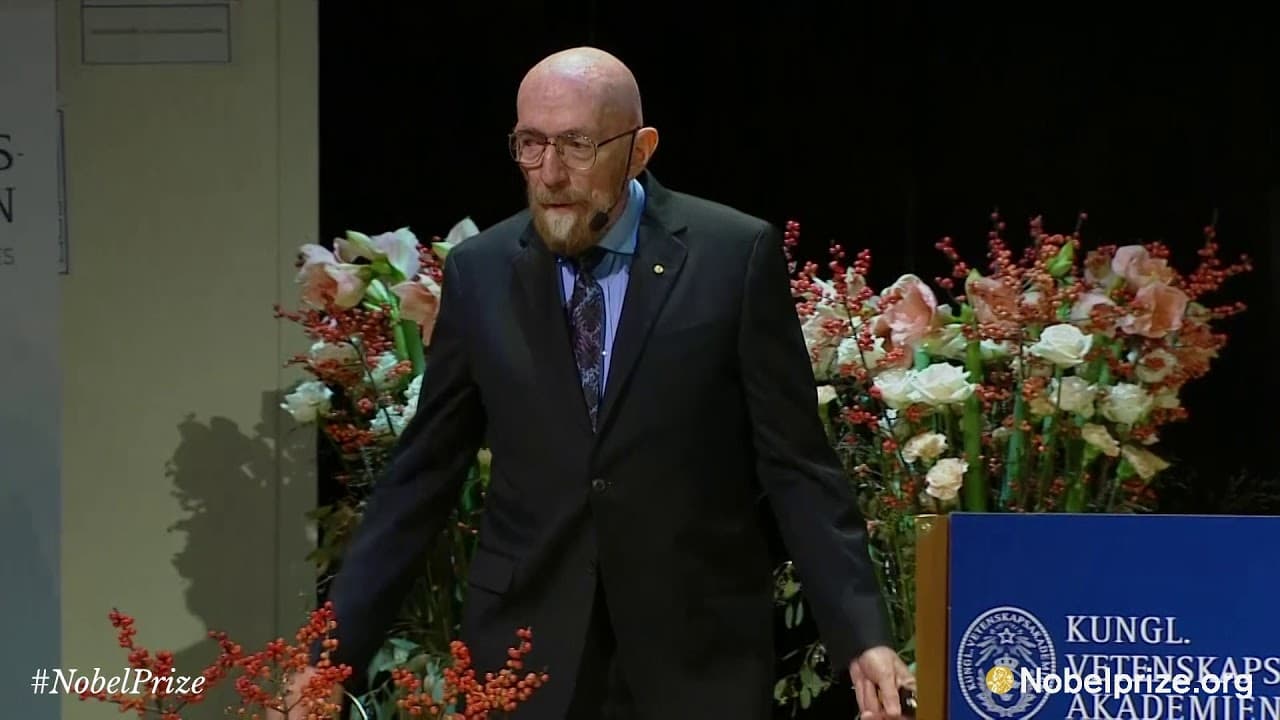
Nobel Lecture: Kip Thorne, Nobel Prize in Physics 2017
TL;DR
Gravitational waves reveal distant events through oscillations in space and time produced by coherent bulk motion of mass or energy. Unlike electromagnetic waves, they are not significantly absorbed or scattered, so they can expose sources with no electromagnetic signal, including colliding black holes, while numerical simulations help decode the information carried by their waveforms.
Transcript
thank you can you hear me I'm so pleased to see so many of my like over goal colleagues here I just want to thank you for making me look so good I really think of myself as more of an icon for this collaboration and this nobel prize is really something that i accept as a representative of you who have made this great success in the end i would like... Read More
Key Insights
- Gravitational-wave astronomy was built through several efforts lasting roughly half a century, including experimental detector development, data analysis, theoretical modeling of sources and waveforms, and research into quantum measurement methods.
- Gravitational waves are oscillations in the fabric or shape of space and time, while electromagnetic waves are oscillations of the electromagnetic field that propagate through space as time passes.
- Gravitational waves are produced by coherent bulk motion of large amounts of mass or energy, whereas astrophysical electromagnetic waves are generally incoherent combinations of emission from individual particles, atoms, and molecules.
- Gravitational waves are not significantly absorbed or scattered while traveling through the universe, even when emitted near the Big Bang, while electromagnetic observations can be obscured by gas and dust.
- Interferometric gravitational-wave detection required measuring extraordinarily small motions, including displacements described as one thousandth of an atomic nucleus's diameter and amplitudes 10^-12 times the wavelength of the measuring light.
- A strain sensitivity near 10^-21 was identified as the target by 1978, based on estimates for sources including supernovae and mergers involving two black holes, two neutron stars, or a black hole and neutron star.
- Binary black holes were expected by Thorne to be detected before neutron-star binaries because the observable distance was approximately proportional to mass, producing a much larger accessible volume for heavier objects.
- Numerical relativity is necessary for calculating waveforms from colliding black holes because pencil-and-paper analytical techniques could not solve Einstein's equations for such strongly nonlinear and rapidly changing events.
Install to Summarize YouTube Videos and Get Transcripts
Explore YouTube Video Summarizer or Get YouTube Transcript Extractor
Questions & Answers
Q: What information do gravitational waves carry?
Gravitational waves carry information about the sources that create them through the shapes of their waveforms. Those sources involve coherent bulk motion of large amounts of mass or energy. The theoretical task is to understand which sources produce the waves, calculate the resulting waveform shapes, and determine what properties of distant events can be extracted from those signals.
Q: How are gravitational waves different from electromagnetic waves?
Electromagnetic waves are oscillations of the electromagnetic field that propagate through space, while gravitational waves are oscillations of the fabric or shape of space and time. Electromagnetic radiation in astrophysics is generally an incoherent combination of emission from individual particles, atoms, and molecules. Gravitational radiation instead comes from coherent bulk motion involving large amounts of mass or energy.
Q: Why can gravitational waves reveal sources hidden from telescopes?
Electromagnetic waves are readily absorbed and scattered as they travel, and gas and dust obscure much of the universe from electromagnetic observation. Gravitational waves are not significantly absorbed or scattered, even when emitted near the Big Bang. Consequently, some gravitational-wave sources may have no observable electromagnetic signal, as described for the colliding black holes detected by that time.
Q: Why was detecting gravitational waves considered so difficult?
The proposed interferometric detectors had to measure extremely small movements. Thorne describes the required amplitude as 10^-12 times the wavelength of the light used for measurement. He also compares the displacement to one thousandth of an atomic nucleus's diameter, with the nucleus itself described as one hundred thousand times smaller than an atom.
Q: What detector sensitivity did early gravitational-wave researchers target?
By the 1978 workshop on gravitational-wave sources, researchers concluded that detectors should aim for a strain sensitivity of about 10^-21. Their source estimates considered supernovae and compact binary mergers involving black holes and neutron stars. The target became memorable enough for participants to make shirts stating “10^-21 or bust,” and the first observed signal reached about that strain.
Q: Why did Kip Thorne expect black-hole binaries to be detected first?
Thorne argued by 1983 that binary black holes were likely to be detected before neutron-star binaries. The observable distance for two orbiting objects was approximately proportional to their masses. Because the black holes then under consideration were perhaps ten times heavier than neutron stars, he estimated that detectors could survey a volume roughly one thousand times greater for black holes.
Q: Why are numerical simulations needed for black-hole collisions?
Numerical simulations are needed because analytical, pencil-and-paper methods could not solve Einstein's equations well enough to calculate the gravitational-wave shapes produced by colliding black holes. Researchers therefore had to develop numerical relativity, using computers to simulate strongly excited, nonlinear, rapidly changing geometry and obtain waveforms from which physical information could be extracted.
Q: How did early researchers develop numerical relativity?
The effort began in the 1950s under the influence of John Archibald Wheeler, who urged researchers to study rapidly changing, nonlinear storms in the geometry of space and time. Foundations for solving Einstein's equations numerically were developed from 1958 to 1964. In 1978, Larry Smarr and Kenneth F. Lee completed the first successful simulation of a head-on collision between two black holes.
Summary
In this video, the speaker discusses the development of gravitational wave astronomy and physics. They highlight the three main efforts that have led to the progress in this field, which include the experimental and data analysis effort, the theoretical effort on understanding gravitational wave sources and waveforms, and the combined theoretical and experimental effort on quantum non-demolition. The speaker also discusses the future of gravitational wave astronomy, including the different frequency bands that can be studied and the potential to study moments of the universe.
Questions & Answers
Q: When did the speaker first become involved in the field of gravitational wave detection?
The speaker became involved in the field of gravitational wave detection during his time as a graduate student at Princeton in the period 1962 to 1965. He worked with John Archibald Wheeler and also had some interaction with Ray Weiss, who was a member of Bob Nikki's experimental gravity research group.
Q: What are the two types of waves that can propagate across the universe according to the laws of physics?
The two types of waves that can propagate across the universe according to the laws of physics are electromagnetic waves and gravitational waves. Electromagnetic waves are oscillations of the electromagnetic field that propagate through space, while gravitational waves are oscillations of the fabric or shape of space and time.
Q: How do gravitational waves differ from electromagnetic waves?
Gravitational waves differ from electromagnetic waves in several ways. While electromagnetic waves are incoherent superpositions of emission from individual particles and are easily absorbed and scattered as they travel through the universe, gravitational waves are produced by the coherent bulk motion of large amounts of mass or energy and are never significantly absorbed or scattered. Additionally, electromagnetic waves are oscillations of the electromagnetic field, while gravitational waves are oscillations of the fabric or shape of space and time.
Q: How do scientists study the shapes of gravitational waves produced by colliding black holes?
Scientists study the shapes of gravitational waves produced by colliding black holes by using numerical relativity simulations. These simulations involve solving Einstein's equations on a computer to compute the shapes of the gravitational waves. Numerical relativity simulations have been crucial in extracting the information carried by gravitational waves and inferring the properties of black holes and the distance to the sources.
Q: What is quantum non-demolition technology and why is it important in advanced LIGO?
Quantum non-demolition technology is a field of technology that deals with monitoring the motions of mirrors in gravitational wave detectors to a precision of 10^-17 centimeters. This precision is necessary to circumvent the Heisenberg uncertainty principle and deal with quantum fluctuations of the mirror motions. In advanced LIGO, this technology is crucial for accurately measuring and studying gravitational waves and observing human-sized objects behaving quantum mechanically for the first time.
Q: What are the four frequency bands in gravitational wave astronomy and what can they study?
The four frequency bands in gravitational wave astronomy include the low-frequency band studied by Lisa, where gravitational waves from giant black holes spiraling, colliding, and merging can be observed with high precision. Pulsar timing arrays can study gravitational waves from supergiant black holes using the timing of pulsars. Indirect imaging can be used to study the gravitational waves produced by a small black hole orbiting a large black hole, providing information about the geometry of space and time around the large black hole. Lastly, there is the hunt for unexpected kinds of massive central bodies using gravitational wave observations.
Q: What are some potential future discoveries in gravitational wave astronomy?
There are several potential future discoveries in gravitational wave astronomy. For example, it is predicted that gravitational waves from first-order phase transitions and amplification by inflation during the early moments of the universe could be observed. This would provide insights into the birth of the laws of electromagnetism, as well as the laws of quantum gravity governing the birth of the universe. Additionally, the comparison between gravitational waves with different periods and polarization patterns from the Big Bang could potentially reveal new information about the nature of the universe.
Takeaways
Gravitational wave astronomy and physics have made significant progress in recent years, thanks to the collaborative efforts of researchers and the development of advanced detectors. The study of gravitational waves has the potential to revolutionize our understanding of the universe, providing insights into the nature of black holes, the birth of the universe, and the laws of quantum gravity. With the future advancements and observations in gravitational wave astronomy, the possibilities for new discoveries and breakthroughs are incredibly exciting.
Summary & Key Takeaways
-
Gravitational-wave astronomy resulted from roughly half a century of experimental work, data analysis, theoretical research, and quantum measurement studies. Thorne focuses on the theoretical effort to identify gravitational-wave sources, calculate the shapes of their signals, and determine what physical information can be extracted from those waveforms.
-
Electromagnetic and gravitational waves provide fundamentally different views of the universe. Electromagnetic waves are oscillations of a field and are often emitted incoherently by individual particles, atoms, or molecules. Gravitational waves are oscillations of space and time generated by coherent bulk motion, and they travel without significant absorption or scattering.
-
Early researchers estimated that detectors needed a strain sensitivity near 10^-21. Thorne expected binary black holes to be detected before neutron-star binaries because their greater masses would make them observable across a much larger volume. Interpreting black-hole collisions also required numerical solutions of Einstein's equations rather than analytical calculations alone.
Read in Other Languages (beta)
Share This Summary 📚
Summarize YouTube Videos and Get Video Transcripts with 1-Click
Try YouTube Summary with ChatGPT & Claude or YouTube Transcript Generator
Explore More Summaries from Nobel Prize 📚





Summarize YouTube Videos and Get Video Transcripts with 1-Click
Try YouTube Summary with ChatGPT & Claude or YouTube Transcript Generator