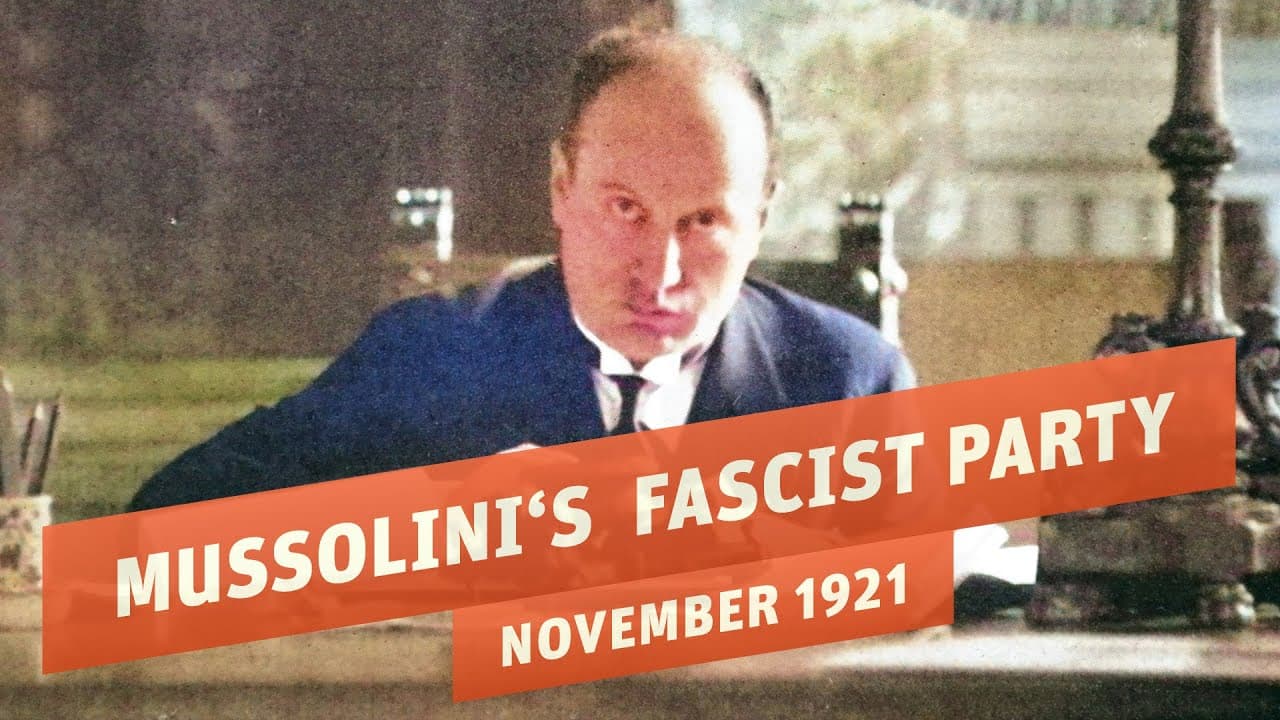
How Mussolini Founded The Italian Fascist Party I THE GREAT WAR 1921
TL;DR
Mussolini transitioned from socialism to fascism, leading Italy's post-war political violence.
Transcript
The First World War was a national trauma for Italy, but even though the country was on the winning side, Italian society and politics were more angry and divided than before. The post-armistice years were marked by economic problems, social unrest, political street violence, and terrorist attacks. In 1920 and 1921 Benito Mussolini’s new fascist mo... Read More
Key Insights
- Mussolini's initial socialist roots were overshadowed by his eventual embrace of fascism, influenced by his belief in action over doctrine.
- The post-World War I period in Italy was marked by economic turmoil, social unrest, and political violence, setting the stage for Mussolini's rise.
- Mussolini's break with socialism was catalyzed by his support for Italy's participation in World War I, which he saw as an opportunity for national rejuvenation.
- Fascism in Italy was characterized by a blend of nationalist and socialist rhetoric, emphasizing the role of veterans and the concept of a 'trenchocracy'.
- The Biennio Rosso was a period of intense social and political conflict in Italy, during which Mussolini's fascist movement gained traction through violent confrontations.
- Mussolini's fascist movement initially struggled in elections but gained momentum through alliances with conservative elements fearing socialist influence.
- The formation of the National Fascist Party in 1921 marked Mussolini's consolidation of power, positioning fascism as a viable political force against socialism.
- Mussolini's strategic use of violence and political alliances allowed him to outmaneuver rivals and establish fascism as a dominant force in Italian politics.
Install to Summarize YouTube Videos and Get Transcripts
Explore YouTube Video Summarizer or Get YouTube Transcript Extractor
Questions & Answers
Q: What factors contributed to Mussolini's break with socialism?
Mussolini's break with socialism was primarily influenced by his support for Italy's involvement in World War I. Initially a socialist, he saw the war as a means for national rejuvenation, which conflicted with the Socialist Party's stance on neutrality. This divergence in views led to his resignation from the party and the founding of his own newspaper, Il Popolo d’Italia, where he began promoting revolutionary nationalism.
Q: How did Mussolini's fascist movement gain traction in post-war Italy?
Mussolini's fascist movement gained traction through a combination of political violence, strategic alliances, and appealing rhetoric. During the Biennio Rosso, a period of widespread social unrest, Mussolini positioned his movement as a defender against socialism, gaining support from veterans and the middle class. His ability to blend nationalist and socialist rhetoric resonated with those disillusioned by the political status quo, allowing fascism to grow in influence.
Q: What role did veterans play in Mussolini's fascist movement?
Veterans played a crucial role in Mussolini's fascist movement, forming the backbone of his support. Disillusioned by the post-war settlement and feeling betrayed by the political system, many veterans were drawn to Mussolini's concept of a 'trenchocracy,' which emphasized their role as a new elite class. This appeal to shared wartime experiences and the promise of national renewal resonated with veterans, bolstering the fascist ranks.
Q: How did Mussolini reconcile nationalist and socialist rhetoric in his ideology?
Mussolini reconciled nationalist and socialist rhetoric by emphasizing themes of national rejuvenation and social rebirth, while rejecting class-based revolution. He adopted leftist vocabulary to appeal to workers, advocating for policies like an 8-hour workday and labor representation, but framed these within a nationalist context. This approach allowed him to attract support from both disillusioned socialists and nationalists seeking a strong, unified Italy.
Q: What strategies did Mussolini use to gain political power?
Mussolini employed a combination of political violence, strategic alliances, and charismatic leadership to gain power. He capitalized on the fear of socialism among the middle class and conservative elements, aligning with them to counter socialist influence. His use of the blackshirts to intimidate opponents and his ability to adapt his rhetoric to different audiences allowed him to outmaneuver rivals and establish a foothold in Italian politics.
Q: Why did Mussolini's fascist movement initially struggle in elections?
Mussolini's fascist movement initially struggled in elections due to its relatively small size and the dominance of the Socialist Party, which had strong support among workers and peasants. The fascists' radical nationalism and violent tactics did not immediately resonate with a broad electorate. However, the deteriorating social and economic conditions, coupled with Mussolini's strategic alliances, eventually helped the movement gain traction.
Q: What was the significance of the Biennio Rosso in Mussolini's rise?
The Biennio Rosso, a period of intense social and political conflict in Italy, was significant in Mussolini's rise as it created an environment of fear and instability. The threat of socialist revolution pushed many middle-class Italians and landowners towards fascism as a means of restoring order. Mussolini's fascists exploited this fear, using violence to suppress socialist influence and position themselves as defenders of traditional values.
Q: How did Mussolini consolidate his control over the fascist movement?
Mussolini consolidated his control over the fascist movement by founding the National Fascist Party in 1921, which formalized the movement's structure and ideology. He strategically tempered his rhetoric to appeal to a broader audience and sought to reduce internal violence to gain legitimacy. Despite challenges from within, Mussolini's charismatic leadership and ability to navigate political alliances solidified his position as the movement's central figure.
Summary & Key Takeaways
-
The video explores Mussolini's transformation from a socialist to a fascist leader, highlighting the socio-political chaos in post-World War I Italy. Mussolini's initial socialist beliefs gave way to a nationalist ideology, as he capitalized on the discontent of war veterans and the middle class.
-
Mussolini's rise was marked by his ability to blend nationalist and socialist rhetoric, appealing to disillusioned veterans and the middle class. His strategic use of violence and political maneuvering allowed him to gain influence, despite initial electoral failures.
-
The formation of the National Fascist Party in 1921 signaled Mussolini's consolidation of power. By aligning with conservative forces, he positioned fascism as a counter to socialism, leveraging political violence and alliances to establish a new political order in Italy.
Read in Other Languages (beta)
Share This Summary 📚
Summarize YouTube Videos and Get Video Transcripts with 1-Click
Try YouTube Summary with ChatGPT & Claude or YouTube Transcript Generator
Explore More Summaries from The Great War 📚
Summarize YouTube Videos and Get Video Transcripts with 1-Click
Try YouTube Summary with ChatGPT & Claude or YouTube Transcript Generator