L03.6 Independence Versus Conditional Independence
TL;DR
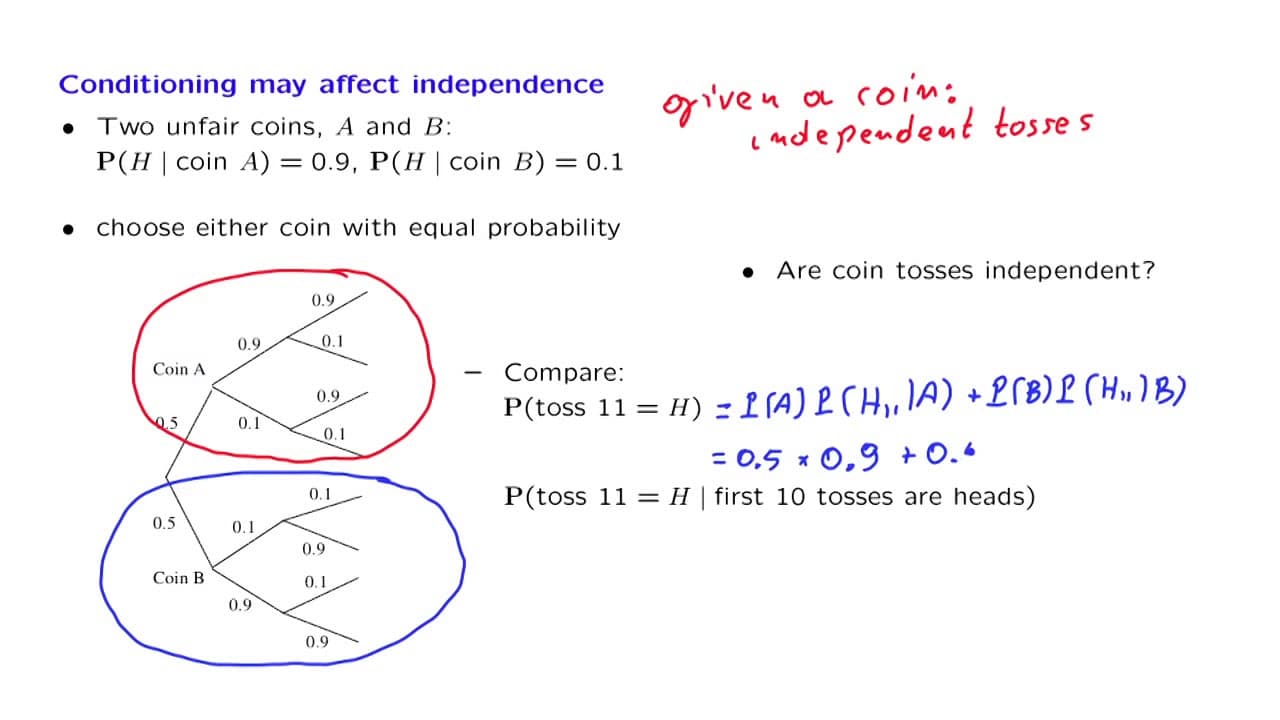
Coin tosses can be conditionally independent based on the chosen coin, but not independent in the overall model.
Transcript
We have already seen an example in which we have two events that are independent but become dependent in a conditional model. So that [independence] and conditional independence is not the same. We will now see another example in which a similar situation is obtained. The example is as follows. We have two possible coins, coin A and coin B. This is... Read More
Key Insights
- 🪙 Conditional independence occurs between coin tosses within each coin's model.
- 🖤 The overall model lacks independence in coin tosses, as the first 10 tosses can affect beliefs about the 11th toss.
- 💁 Prior knowledge about the outcome of previous tosses can provide information about the chosen coin.
- 🪙 The average bias in the overall model is 0.5 due to the equal probability of choosing either coin.
Install to Summarize YouTube Videos and Get Transcripts
Explore YouTube Video Summarizer or Get YouTube Transcript Extractor
Questions & Answers
Q: Are coin tosses independent in this conditional model?
Coin tosses are independent within the conditional models of coin A and coin B. However, when considering the overall model without prior knowledge of the chosen coin, the tosses are not independent.
Q: How does the information of 10 heads in a row affect beliefs about the 11th toss?
If we observe 10 heads in a row, it suggests a high likelihood that we are dealing with coin A. This information then affects our beliefs, as the probability of heads in the 11th toss would be 0.9 if it is indeed coin A.
Q: What is the average bias in the overall model?
The average bias in the overall model is 0.5. Since the two coins have different biases but are chosen with equal probability, the average probability of heads in any particular toss is 0.5.
Q: How is the total probability theorem used in the calculations?
The total probability theorem is used to calculate the probability of obtaining a particular coin (A or B) and the probability of heads in the 11th toss given that coin. These calculations involve multiplying the probabilities of the respective events.
Summary & Key Takeaways
-
There are two possible coins, A and B, with different probabilities of heads in each toss.
-
If we do not know which coin was chosen, the probability of heads in any particular toss is 0.5.
-
If the first 10 tosses are all heads, it affects our beliefs about the 11th toss, indicating a lack of independence.
Read in Other Languages (beta)
Share This Summary 📚
Summarize YouTube Videos and Get Video Transcripts with 1-Click
Try YouTube Summary with ChatGPT & Claude or YouTube Transcript Generator
Explore More Summaries from MIT OpenCourseWare 📚

Summarize YouTube Videos and Get Video Transcripts with 1-Click
Try YouTube Summary with ChatGPT & Claude or YouTube Transcript Generator