What’s On The Other Side Of A Black Hole?
TL;DR
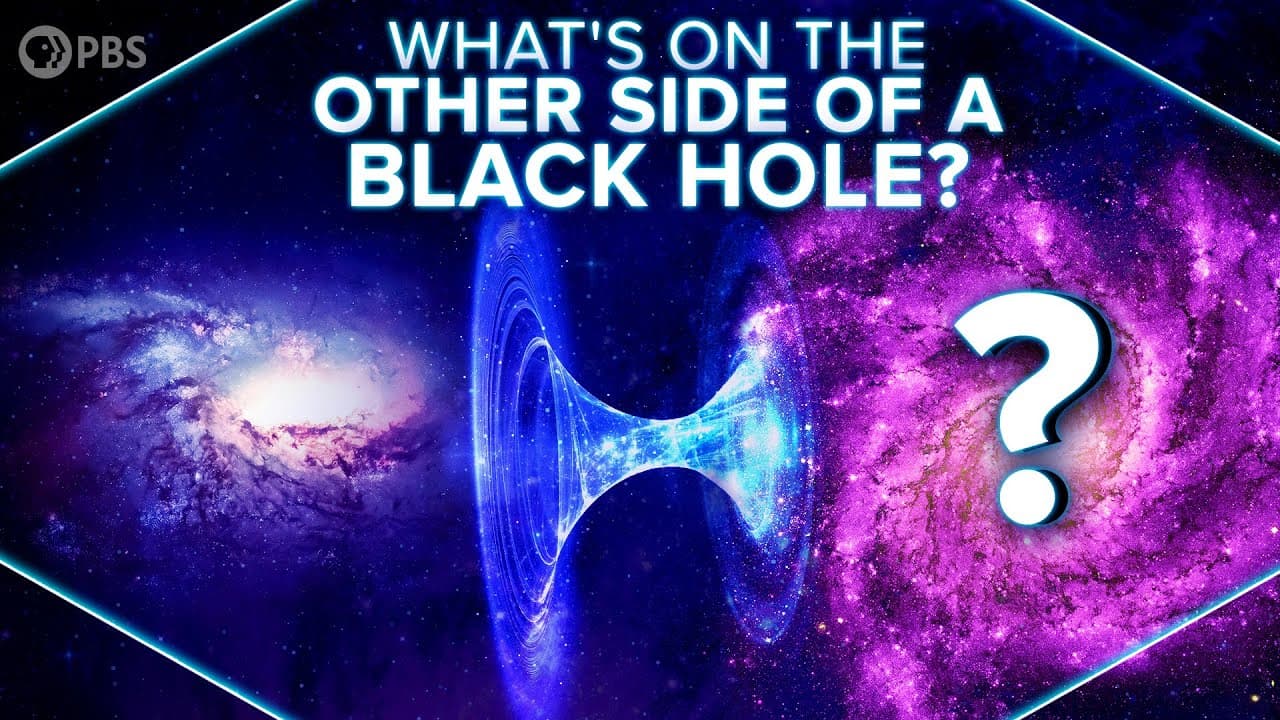
Black holes might connect to new universes via wormholes.
Transcript
Normal maps are useless inside black holes. At the event horizon - the ultimate point of no return as you approach a black hole
- time and space themselves change their character. We need new coordinate systems to trace paths into the black hole interior. But the maps we draw using those coordinates reveal something unexpected - they don’t simply e... Read More
Key Insights
- Black holes require new coordinate systems as traditional maps fail at the event horizon, where time and space alter drastically.
- The Schwarzschild metric, derived soon after Einstein's relativity, maps black holes but can't cross the event horizon due to time dilation effects.
- Eddington-Finkelstein and Kruskal-Szekeres coordinates smooth the transition across the event horizon, revealing it as a coordinate singularity.
- Penrose diagrams compact space and time, showing the universe on one diagram, but leaving some light paths unexplored.
- Maximally extended Schwarzschild solutions suggest black holes could lead to mirror universes or white holes, though these are theoretical constructs.
- Traveling faster than light could theoretically allow passage through wormholes, connecting different regions or universes.
- Real black holes form from collapsing stars, lacking white holes, but rotating black holes might offer traversable wormholes.
- Quantum entanglement and entropy are interconnected, influencing how quantum states relate to macroscopic observables.
Install to Summarize YouTube Videos and Get Transcripts
Explore YouTube Video Summarizer or Get YouTube Transcript Extractor
Questions & Answers
Q: What happens to space and time at the event horizon of a black hole?
At the event horizon, space and time undergo a fundamental shift in their properties. The traditional coordinate systems become ineffective, necessitating new ones to trace paths into the black hole's interior. This alteration is due to the extreme gravitational effects at the event horizon, where time appears to freeze for distant observers.
Q: How do Eddington-Finkelstein coordinates help in mapping black holes?
Eddington-Finkelstein coordinates allow for a smoother transition across the event horizon by fusing time with a 'tortoise coordinate.' This approach cancels the infinite stretching of time, permitting gridlines to pass smoothly through the event horizon, revealing it as a coordinate singularity rather than a physical barrier.
Q: What are the implications of Penrose diagrams for understanding black holes?
Penrose diagrams compact space and time, allowing the entire universe to fit on one diagram. They demonstrate how light rays can travel in relation to black holes, highlighting regions of spacetime that remain unexplored. These diagrams suggest the existence of mirror universes or white holes, although these are theoretical constructs.
Q: Can black holes connect to other universes?
Theoretical models propose that black holes might connect to other universes through wormholes, acting as bridges between different regions of spacetime. These connections are depicted in maximally extended Schwarzschild solutions, which reveal strange regions on Penrose diagrams. However, such connections require travel faster than light, which is currently considered impossible.
Q: What distinguishes real black holes from eternal Schwarzschild black holes?
Real black holes form from the collapse of stars and do not have white holes in their past. In contrast, eternal Schwarzschild black holes are theoretical constructs that exist indefinitely, requiring white holes and parallel universes to complete their geodesic maps. Real black holes are more complex and dynamic in nature.
Q: How might rotating black holes differ in terms of traversability?
Rotating black holes, described by the Kerr metric, might offer traversable wormholes that connect different regions of spacetime. Unlike non-rotating Schwarzschild black holes, these rotating variants could provide a means of passage through spacetime, although practical traversal remains speculative and would require overcoming significant physical challenges.
Q: What is the relationship between quantum entanglement and entropy?
Quantum entanglement and entropy are fundamentally connected, with entanglement influencing how quantum states relate to macroscopic observables. As quantum states become entangled with their environment, they exhibit behavior analogous to the second law of thermodynamics, where entropy increases over time. This relationship underscores the complexity of quantum systems.
Q: What are the challenges in using wormholes for travel?
Using wormholes for travel presents numerous challenges, primarily due to the need for faster-than-light travel, which is currently considered impossible. Additionally, maintaining a stable wormhole requires exotic matter with negative energy density, which has not been observed. These theoretical constructs remain speculative, with significant hurdles to practical implementation.
Summary & Key Takeaways
-
Black holes challenge traditional mapping, requiring new coordinate systems to understand their interior, potentially revealing wormholes and new universes.
-
Theoretical models like the Schwarzschild metric and Penrose diagrams offer insights into black holes, suggesting links to parallel universes.
-
Real-world black holes differ from eternal ones, forming from star collapse, but rotating black holes could offer pathways through spacetime.
Read in Other Languages (beta)
Share This Summary 📚
Summarize YouTube Videos and Get Video Transcripts with 1-Click
Try YouTube Summary with ChatGPT & Claude or YouTube Transcript Generator
Explore More Summaries from PBS Space Time 📚
Summarize YouTube Videos and Get Video Transcripts with 1-Click
Try YouTube Summary with ChatGPT & Claude or YouTube Transcript Generator