How Do Monopolies Affect Markets and Consumers?
TL;DR
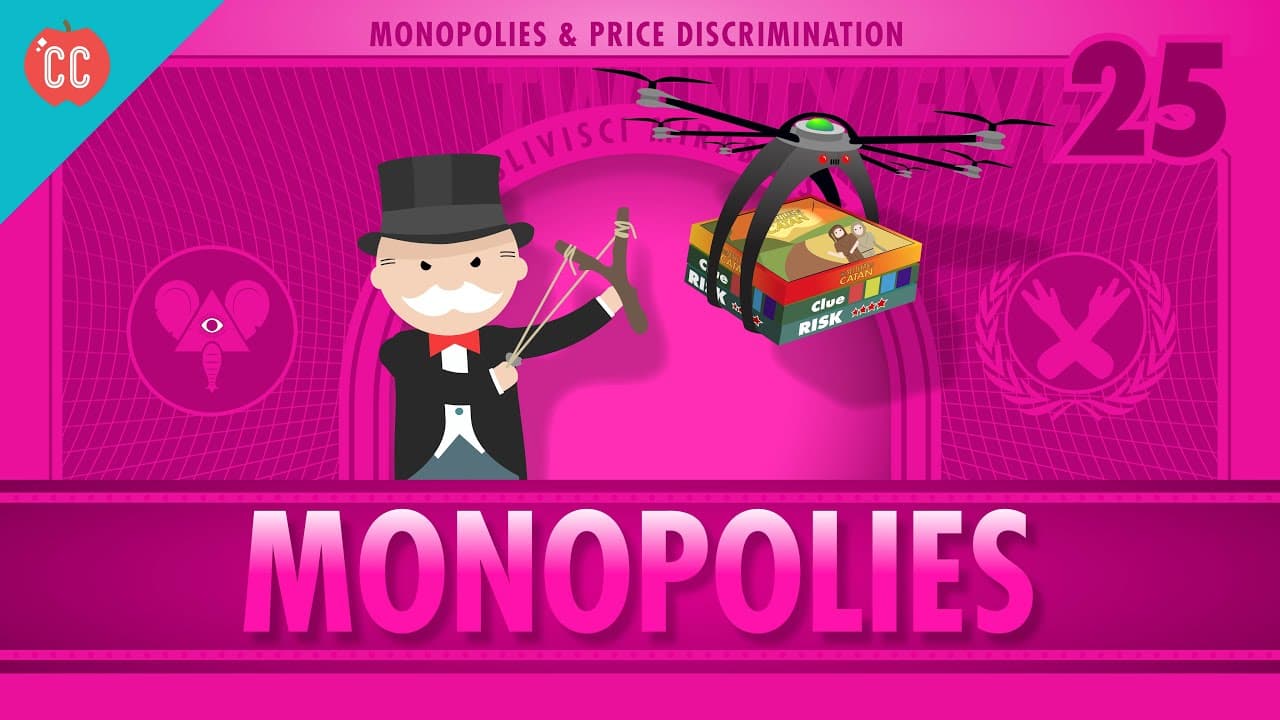
Monopolies can both harm and benefit markets and consumers. They restrict competition, leading to higher prices and limited choices, but in certain industries like utilities, they can provide services more efficiently. Anti-trust laws exist to prevent monopolistic behavior, ensuring fair competition and consumer protection.
Transcript
Jacob: Welcome to Crash Course Economics, my name is Jacob Clifford Adriene: and I’m Adriene Hill. Today we’re going to talk about monopolies! Which are terrible, illegal, and only serve to exploit helpless consumers, except when they’re delivering essential services that competitive free markets kind of fail to deliver. Jacob: So, are monopolies a... Read More
Key Insights
- Monopolies are markets controlled by one seller without close substitutes, allowing them to set prices and restrict output.
- Barriers to entry, such as government regulations or control of resources, help maintain monopolistic power.
- Anti-trust laws, like the Sherman Act, aim to prevent monopolization and promote competition.
- Natural monopolies occur in industries where a single producer is more cost-effective, such as utilities.
- Price discrimination allows companies to charge different prices to different consumers based on their willingness to pay.
- Monopolistic behavior can stifle innovation and lead to higher prices, but patents can encourage innovation by granting temporary monopolies.
- Oligopolies occur when a few firms dominate a market, wielding significant power similar to monopolies.
- Vertical and horizontal integration can lead to monopolistic practices, but they are not always illegal if they enhance efficiency.
Install to Summarize YouTube Videos and Get Transcripts
Explore YouTube Video Summarizer or Get YouTube Transcript Extractor
Questions & Answers
Q: What are the characteristics of a monopoly?
A monopoly is characterized by a single seller dominating a market with no close substitutes for its product or service. This allows the monopolist to set prices and restrict output without fear of competition. Barriers to entry, such as government regulations or control of resources, help maintain this power, preventing new competitors from entering the market.
Q: How do anti-trust laws prevent monopolies?
Anti-trust laws, such as the Sherman Act, are designed to prevent monopolistic behavior by promoting competition and preventing unfair business practices. They prohibit monopolization, attempted monopolization, and anti-competitive mergers. These laws empower government agencies to regulate mergers and acquisitions, preventing companies from gaining excessive market power that could harm consumers.
Q: What is a natural monopoly?
A natural monopoly occurs in industries where a single producer can supply the market more efficiently than multiple competing firms. This is often due to economies of scale, where the cost per unit decreases as production increases. Examples include utilities like electricity and water, where duplicating infrastructure would be inefficient and costly. Governments often regulate natural monopolies to prevent price abuse.
Q: How does price discrimination work in monopolistic markets?
Price discrimination involves charging different prices to different consumers for the same product, based on their willingness to pay. This strategy allows monopolists to maximize profits by capturing consumer surplus. It requires the ability to segment the market and prevent resale between consumers. Common examples include airline ticket pricing and discounts based on age or occupation.
Q: Why are monopolies considered harmful to consumers?
Monopolies are often harmful because they restrict competition, leading to higher prices and limited choices for consumers. Without competitive pressure, monopolists have less incentive to innovate or improve products. This can result in inefficient markets where consumer welfare is not maximized. Anti-trust laws exist to protect consumers by promoting fair competition and preventing monopolistic practices.
Q: How do patents encourage innovation despite granting monopolies?
Patents encourage innovation by granting inventors exclusive rights to profit from their inventions for a limited time, typically 20 years. This temporary monopoly allows companies to recover research and development costs and earn profits, incentivizing investment in new technologies. After the patent expires, competition increases, leading to lower prices and more choices for consumers.
Q: What is the difference between vertical and horizontal integration?
Vertical integration occurs when a company owns or controls its supply chain, from raw materials to final product distribution. Horizontal integration involves acquiring or merging with competitors to increase market share. While both can lead to monopolistic practices, vertical integration can enhance efficiency and reduce costs, whereas horizontal integration may face more regulatory scrutiny under anti-trust laws.
Q: How do oligopolies differ from monopolies?
Oligopolies differ from monopolies in that they involve a few firms dominating a market, rather than a single seller. While not a monopoly, firms in an oligopoly can still exercise significant market power, often collaborating or competing aggressively. Examples include the mobile device operating systems market, dominated by Google's Android and Apple's iOS. Oligopolies can lead to similar anti-competitive concerns as monopolies.
Summary & Key Takeaways
-
Monopolies are market structures where a single seller dominates, able to set prices and restrict output due to lack of competition. While generally viewed as harmful due to higher prices and limited consumer choices, they can be beneficial in industries where one producer is more efficient, like utilities.
-
Barriers to entry, such as high startup costs or government regulations, help maintain monopoly power. Anti-trust laws like the Sherman Act exist to prevent monopolization and protect consumer interests by promoting competition and regulating mergers and acquisitions.
-
Price discrimination is a common practice in monopolistic markets, allowing companies to maximize profits by charging different prices to different consumers based on their willingness to pay. While monopolies can stifle innovation, patents grant temporary monopolies to encourage research and development.
Read in Other Languages (beta)
Share This Summary 📚
Summarize YouTube Videos and Get Video Transcripts with 1-Click
Try YouTube Summary with ChatGPT & Claude or YouTube Transcript Generator
Explore More Summaries from CrashCourse 📚





Summarize YouTube Videos and Get Video Transcripts with 1-Click
Try YouTube Summary with ChatGPT & Claude or YouTube Transcript Generator