How Will Nvidia's H100 Chips Transform AI Hardware?
TL;DR
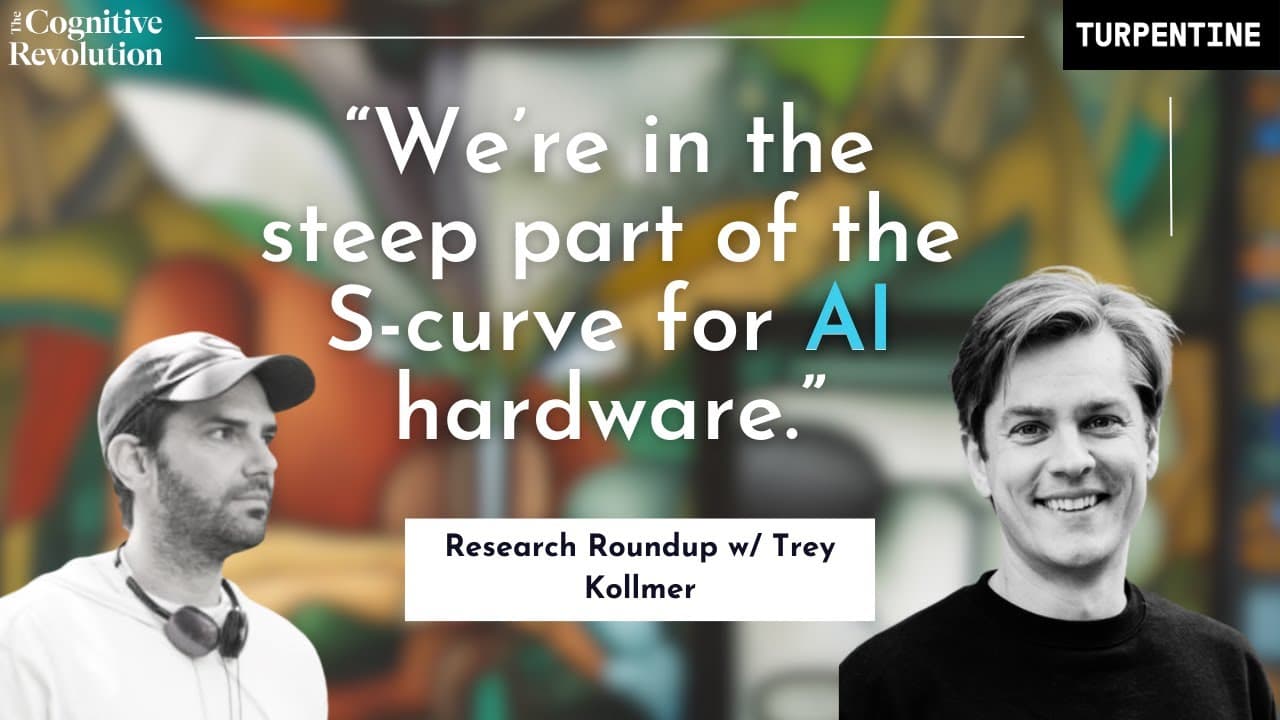
Nvidia's H100 chips offer unprecedented computational power, allowing AI models like GPT-4 to be trained at scale in significantly reduced time frames. With 22,000 H100s, training can be achieved in just five days, accelerating AI development and experimentation. This advancement enables researchers to explore new architectural and algorithmic improvements, potentially leading to more sophisticated AI systems.
Transcript
with your 22,000 h100s you could reach gbt 4 scale compute in five days they tried introducing a Sandbox flag into the code to be improved sure enough the you know the improver would do things like remove the sandbox flag and you know I don't want to anthropomorphize this too much but you can imagine a human doing this and I don't really know what ... Read More
Key Insights
- Nvidia's H100 chips can perform 100 trillion operations per second, greatly enhancing AI computational capabilities.
- Training a GPT-4 scale model with 22,000 H100s can be completed in five days, drastically reducing time from months.
- The availability of such compute power allows for more frequent and extensive experimentation with AI models.
- Researchers are exploring the integration of search engine data to address knowledge cutoffs in language models.
- Microsoft's Self-Taught Optimizer (STOP) framework demonstrates recursive self-improvement capabilities in AI.
- Language models like Llama 2 show emergent representations of space and time, suggesting conceptual understanding.
- Deep neural networks tend to revert to baseline predictions when faced with out-of-distribution data.
- Designing loss functions that encourage conservative predictions can help manage out-of-distribution uncertainties.
Install to Summarize YouTube Videos and Get Transcripts
Explore YouTube Video Summarizer or Get YouTube Transcript Extractor
Questions & Answers
Q: How do Nvidia's H100 chips impact AI training?
Nvidia's H100 chips significantly enhance AI training by offering 100 trillion operations per second, enabling the training of large models like GPT-4 in drastically reduced time frames. With 22,000 H100s, training can be completed in just five days, compared to months with previous hardware, thus accelerating AI development and experimentation.
Q: What is the role of search engines in addressing LLM knowledge cutoffs?
Search engines play a crucial role in addressing knowledge cutoffs in language models by providing up-to-date information. By integrating structured search results into prompts, models can access current data, improving their ability to answer questions accurately and remain relevant as new information becomes available.
Q: What is Microsoft's Self-Taught Optimizer (STOP) framework?
Microsoft's Self-Taught Optimizer (STOP) is a framework that demonstrates recursive self-improvement in AI models. It works effectively with GPT-4, allowing models to iteratively improve their performance by refining their own code. However, it does not work as effectively with GPT-3.5, indicating a threshold in model capabilities.
Q: How do language models represent space and time?
Language models, such as Llama 2, have been shown to represent space and time conceptually. Through internal activations, these models can map place names to geographical coordinates and historical figures to timelines, suggesting an emergent understanding of these concepts beyond mere text processing.
Q: What happens when deep neural networks encounter out-of-distribution data?
When deep neural networks encounter out-of-distribution data, they tend to revert to baseline predictions that minimize loss in a state of ignorance. This behavior highlights the importance of designing systems with loss functions that encourage conservative predictions, helping manage uncertainties when faced with unfamiliar inputs.
Q: How can loss functions influence model behavior out of distribution?
Loss functions can significantly influence model behavior out of distribution by determining the baseline prediction strategy. By designing loss functions that reward conservative guesses, models can be encouraged to exhibit low-confidence predictions when encountering unfamiliar data, reducing the risk of overconfident and potentially erroneous outputs.
Q: What is the significance of Nvidia's H100 chips for AI research?
Nvidia's H100 chips are significant for AI research as they provide unprecedented computational power, allowing researchers to train large models like GPT-4 more quickly and conduct extensive experimentation. This enables the exploration of new architectures and algorithms, potentially leading to breakthroughs in AI capabilities and applications.
Q: How do visualizations help in understanding AI model representations?
Visualizations help in understanding AI model representations by providing intuitive insights into how models process and organize information. For instance, visualizations of spatial and temporal representations in models like Llama 2 reveal how concepts like geography and time emerge across layers, aiding in the interpretation of model behavior and capabilities.
Summary & Key Takeaways
-
Nvidia's H100 chips drastically reduce the time required to train large AI models like GPT-4, enabling completion in just five days with 22,000 units. This increased compute power accelerates AI development and experimentation, allowing researchers to test new architectures and algorithms more frequently.
-
Researchers are addressing knowledge cutoffs in language models by integrating search engine data into prompts, enhancing their ability to provide up-to-date information. Microsoft's STOP framework showcases recursive self-improvement, while studies reveal that language models can represent space and time conceptually.
-
Deep neural networks exhibit predictable extrapolation behavior, reverting to baseline predictions when encountering unfamiliar data. This insight highlights the importance of designing loss functions that encourage conservative predictions to manage out-of-distribution uncertainties effectively.
Read in Other Languages (beta)
Share This Summary 📚
Summarize YouTube Videos and Get Video Transcripts with 1-Click
Try YouTube Summary with ChatGPT & Claude or YouTube Transcript Generator
Explore More Summaries from Cognitive Revolution "How AI Changes Everything" 📚



Summarize YouTube Videos and Get Video Transcripts with 1-Click
Try YouTube Summary with ChatGPT & Claude or YouTube Transcript Generator