Can AI Conduct Machine Learning Research Effectively?
TL;DR
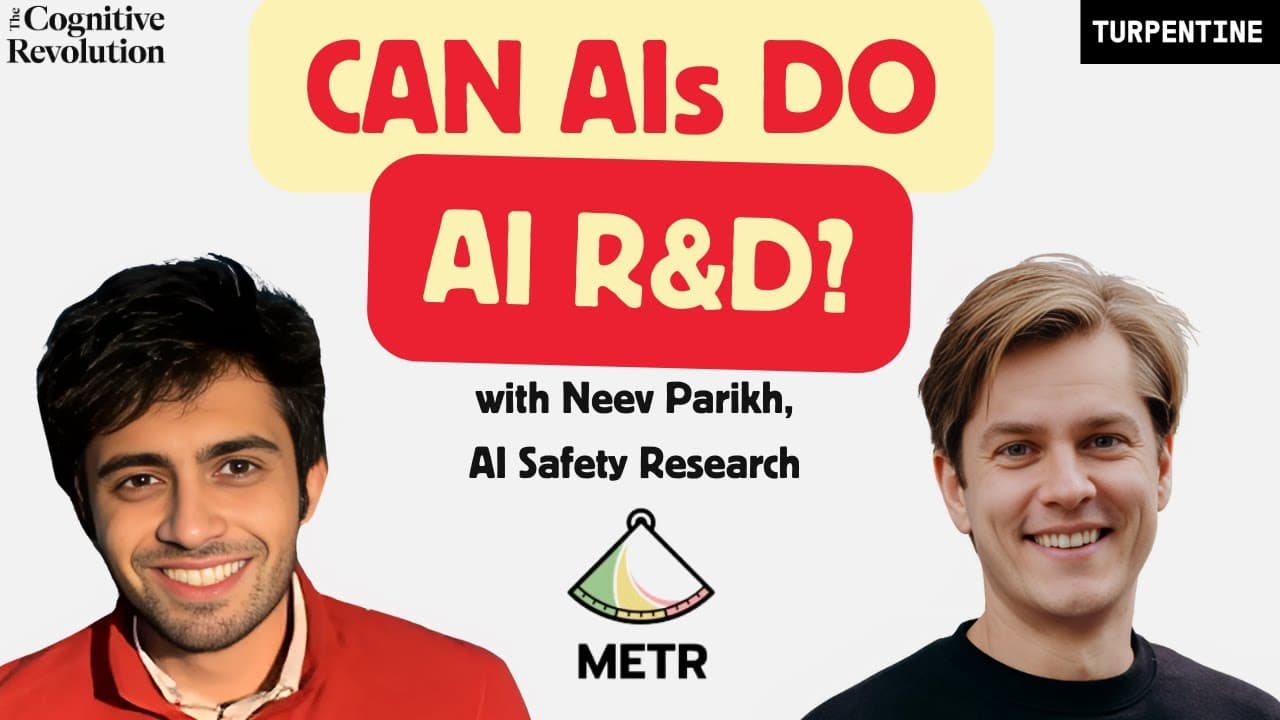
AI models like Claude 3.5 and GPT-4 are evaluated on their ability to perform real machine learning research tasks. While they show promise, achieving human expert-level performance remains challenging. Current AI performance ranges between the 10th and 40th percentile compared to human experts, with significant room for improvement through better elicitation and scaffolding techniques.
Transcript
meter as you said model of evaluation and threet research the overall goal is effectively to try and measure like catastrophic risk in a very scientifically rigorous way have the ability to really like get a handle on the kinds of risks that like AI models are very likely to oppose to us be able to measure that really like accurately precisely you ... Read More
Key Insights
- AI models are being evaluated on their ability to perform real machine learning research tasks, such as optimizing GPU kernels and fine-tuning language models.
- The REBench framework assesses AI systems across seven challenging tasks in three categories: optimizing run times, minimizing loss functions, and improving model win rates.
- Leading AI models like Claude 3.5 and GPT-4 currently perform between the 10th and 40th percentile compared to professional human baselines.
- AI models show significant improvement when given extended time budgets and multiple independent trials, though still not reaching top human expert levels.
- The evaluation framework emphasizes tasks that require reasoning over unfamiliar problems, effective tool use, and maintaining coherent plans over extended periods.
- Current models struggle with tasks that require long-term planning and tend to get stuck in loops, highlighting a need for improved elicitation techniques.
- The cost of running AI models is significantly lower than human labor costs, making them an attractive option for scaling research tasks.
- Future improvements in AI performance are expected with better scaffolding and prompting strategies, as well as ongoing advancements in AI model capabilities.
Install to Summarize YouTube Videos and Get Transcripts
Explore YouTube Video Summarizer or Get YouTube Transcript Extractor
Questions & Answers
Q: How are AI models evaluated in the REBench framework?
AI models are evaluated on their ability to perform real machine learning research tasks, such as optimizing GPU kernels and fine-tuning language models. The REBench framework assesses AI systems across seven challenging tasks in three categories: optimizing run times, minimizing loss functions, and improving model win rates. The evaluation emphasizes tasks that require reasoning over unfamiliar problems, effective tool use, and maintaining coherent plans over extended periods.
Q: What is the current performance level of AI models compared to human experts?
Leading AI models like Claude 3.5 and GPT-4 currently perform between the 10th and 40th percentile compared to professional human baselines. While they show promise, achieving human expert-level performance remains challenging. AI models show significant improvement when given extended time budgets and multiple independent trials, though still not reaching top human expert levels.
Q: What challenges do AI models face in performing machine learning research tasks?
Current AI models struggle with tasks that require long-term planning and tend to get stuck in loops. They often lack the ability to maintain coherent plans over extended periods and require improved elicitation techniques. Additionally, while they can make significant progress with extended time budgets, they still fall short of top human expert levels.
Q: How does the cost of running AI models compare to human labor costs?
The cost of running AI models is significantly lower than human labor costs, making them an attractive option for scaling research tasks. On average, AI models incur costs of around $123 for an eight-hour run, compared to $1,855 for human experts. This cost efficiency makes AI models a viable option for performing machine learning research at scale.
Q: What improvements are expected in AI performance on research tasks?
Future improvements in AI performance are expected with better scaffolding and prompting strategies, as well as ongoing advancements in AI model capabilities. The REBench framework emphasizes that these results come from a relatively limited effort to set up AI agents to succeed at the tasks, and better elicitation is anticipated to result in much better performance.
Q: What role does elicitation play in AI performance on research tasks?
Elicitation plays a crucial role in AI performance on research tasks. Current models often struggle with tasks that require long-term planning and tend to get stuck in loops. Improved elicitation techniques can help AI models better understand and execute complex tasks, potentially leading to performance levels closer to human experts.
Q: How does the REBench framework differ from traditional AI evaluation methods?
The REBench framework differs from traditional AI evaluation methods by focusing on real machine learning research tasks that require reasoning over unfamiliar problems, effective tool use, and maintaining coherent plans over extended periods. Unlike multiple-choice questions or structured problems, REBench tasks are open-ended and scored in a way that allows for incremental progress with extra effort.
Q: What insights can be drawn from the performance of AI models on REBench tasks?
Insights from AI model performance on REBench tasks include the significant potential for improvement with better elicitation and scaffolding techniques. While current models perform between the 10th and 40th percentile compared to human experts, they show promise with extended time budgets and multiple independent trials. The framework highlights the need for improved long-term planning capabilities in AI models.
Summary & Key Takeaways
-
AI models like Claude 3.5 and GPT-4 are evaluated on their ability to perform real machine learning research tasks. They currently perform between the 10th and 40th percentile compared to human experts, with significant room for improvement. The evaluation framework emphasizes tasks that require reasoning over unfamiliar problems, effective tool use, and maintaining coherent plans over extended periods.
-
AI models show significant improvement when given extended time budgets and multiple independent trials, though they still fall short of top human expert levels. Current models struggle with tasks that require long-term planning and tend to get stuck in loops, highlighting a need for improved elicitation techniques.
-
The cost of running AI models is significantly lower than human labor costs, making them an attractive option for scaling research tasks. Future improvements in AI performance are expected with better scaffolding and prompting strategies, as well as ongoing advancements in AI model capabilities.
Read in Other Languages (beta)
Share This Summary 📚
Summarize YouTube Videos and Get Video Transcripts with 1-Click
Try YouTube Summary with ChatGPT & Claude or YouTube Transcript Generator
Explore More Summaries from Cognitive Revolution "How AI Changes Everything" 📚






Summarize YouTube Videos and Get Video Transcripts with 1-Click
Try YouTube Summary with ChatGPT & Claude or YouTube Transcript Generator