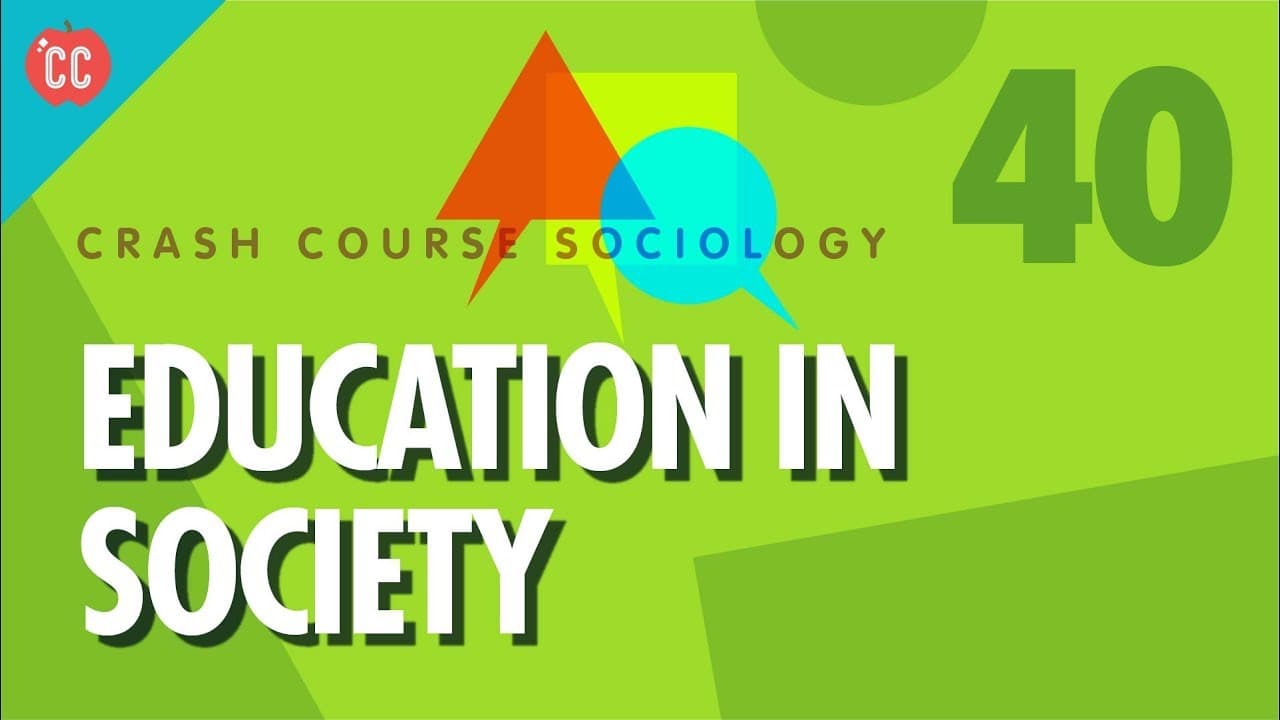
Education In Society: Crash Course Sociology #40
TL;DR
Explores the sociological perspectives on education in the US.
Transcript
The average American spends 13 and a half years of their life in school. And that's not counting the amount of time that you spend watching Crash Course. Getting a bachelor’s degree means spending upwards of 17 years as a student. And advanced degrees like medical degrees or PhDs can tack on another 4 to 6 years on top of that. So, why do we spend ... Read More
Key Insights
- Education in America spans over 13 years, with further years added for higher education, highlighting its significant role in societal development.
- Schools provide more than academic knowledge; they impart cultural norms and values that are crucial for social integration.
- The history of education in the US shows a transition from religious to public schooling, emphasizing the importance of a well-educated populace for democracy.
- Public schools in the US aim to serve the majority, while private and homeschooling options cater to specific educational needs and preferences.
- Post-secondary education in the US is primarily funded by students, creating financial barriers that affect access to higher education.
- Structural functionalism views education as essential for societal stability, focusing on manifest functions like socialization and workforce preparation.
- Latent functions of schooling include teaching discipline and providing childcare, which support working families and social interaction.
- Symbolic interactionism highlights how stereotypes in education can lead to self-fulfilling prophecies, impacting academic achievement and perpetuating inequalities.
Install to Summarize YouTube Videos and Get Transcripts
Explore YouTube Video Summarizer or Get YouTube Transcript Extractor
Questions & Answers
Q: Why do people spend so much time in school?
The time spent in school is crucial for acquiring not only academic knowledge but also cultural norms and values necessary for societal integration. Schools provide social functions that technology cannot replace, such as socialization and workforce preparation, which are essential for a well-functioning society.
Q: How has the US educational system evolved over time?
The US educational system has evolved from religiously affiliated institutions to publicly funded schools, driven by the belief that education is essential for democracy. Public schools became widespread in the 19th century, thanks to reformers like Horace Mann, who advocated for state-funded education to promote literacy and civic knowledge.
Q: What are the different types of schooling options available in the US?
In the US, educational options include public schools, private schools, and homeschooling. Public schools are government-funded and serve the majority, while private schools often provide specialized curricula. Homeschooling is another option where parents educate their children at home, catering to specific educational needs.
Q: What are the financial barriers to higher education in the US?
Higher education in the US is largely funded by students, with public colleges being joint ventures between taxpayers and students. This creates financial barriers that limit access to post-secondary education, as many students struggle to afford tuition and other associated costs, making college attendance not guaranteed for all.
Q: How does structural functionalism view education?
Structural functionalism views education as essential for maintaining societal stability. It emphasizes manifest functions like teaching basic facts, socialization, and workforce preparation. Education also serves latent functions, such as instilling discipline and providing childcare, which support societal needs beyond academic knowledge.
Q: What are the latent functions of education?
Latent functions of education include teaching students to adhere to schedules and authority, akin to preparing them for the workforce. Schools also provide childcare, easing the burden on working parents, and facilitate social interactions, helping students form friendships and meet potential romantic partners.
Q: How does symbolic interactionism explain educational outcomes?
Symbolic interactionism explains educational outcomes through the concept of self-fulfilling prophecies. Stereotypes in educational settings can influence how teachers interact with students, affecting their self-perception and academic performance. This can lead to disparities in achievement, particularly among different racial, gender, and class groups.
Q: What role does education play in social integration?
Education plays a crucial role in social integration by exposing students to diverse cultural norms and values, promoting a shared understanding of society. Schools help inculcate patriotic values and civic knowledge, essential for a cohesive society, and strive to integrate individuals from various backgrounds into a unified social framework.
Summary & Key Takeaways
-
The video explores the role of education as a social institution in the US, detailing how it is structured and its significance in imparting cultural norms and values. It delves into the historical context of education, from religious to public schooling, and its evolution to meet societal needs.
-
Sociological perspectives like structural functionalism and symbolic interactionism are discussed to understand education's functions and its impact on social integration and workforce preparation. The video highlights both intended and unintended consequences of schooling, such as socialization and discipline.
-
The video also addresses the financial barriers to higher education in the US and how stereotypes in educational settings can lead to self-fulfilling prophecies, affecting academic outcomes. It emphasizes the importance of education in shaping society and individual socioeconomic status.
Read in Other Languages (beta)
Share This Summary 📚
Summarize YouTube Videos and Get Video Transcripts with 1-Click
Try YouTube Summary with ChatGPT & Claude or YouTube Transcript Generator
Explore More Summaries from CrashCourse 📚



Summarize YouTube Videos and Get Video Transcripts with 1-Click
Try YouTube Summary with ChatGPT & Claude or YouTube Transcript Generator