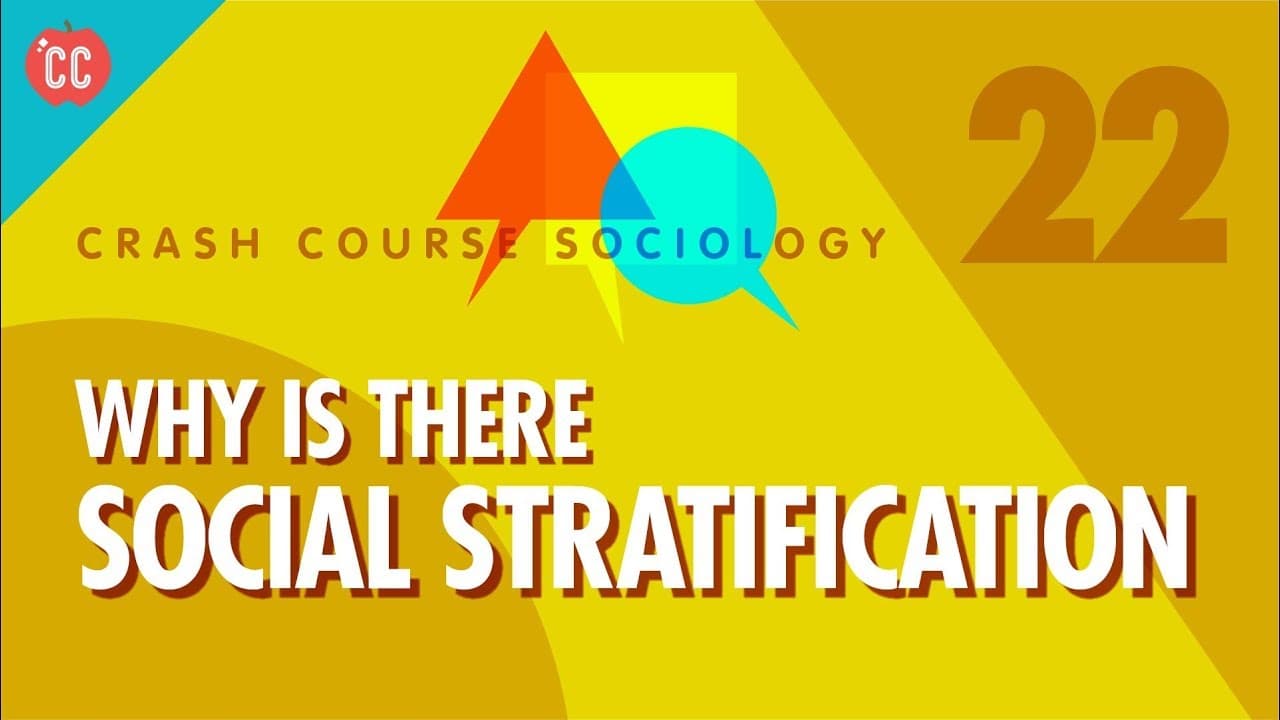
Why Does Social Stratification Exist?
TL;DR
Social stratification persists due to functional needs, ideological beliefs, and power dynamics. Structural functionalism suggests stratification is necessary for societal function, while social conflict theory highlights economic disparities and class struggles. Symbolic interactionism explains how everyday interactions and cultural symbols reinforce social hierarchies.
Transcript
If you asked a medieval peasant whether they liked working two days a week for their lord, while they barely made enough food for themselves, they’d probably say no. And if you ask a factory worker today whether they like making a tiny fraction of what their company’s CEO makes, they’d probably have a similar answer. But, even though huge numbers o... Read More
Key Insights
- Social stratification persists due to societal functions, ideological beliefs, and power dynamics.
- Structural functionalism argues stratification is necessary for societal function, as per the Davis-Moore Thesis.
- The Davis-Moore Thesis suggests economic and social rewards motivate individuals to fill important societal roles.
- Critics argue not all important jobs are highly rewarded and not all paths are equally accessible.
- Social conflict theory, rooted in Marxism, views stratification as a result of economic disparities and class struggles.
- Ralf Dahrendorf noted structural changes and worker protections have prevented Marx's predicted revolution.
- Max Weber expanded on Marx, identifying economic class, social status, and power as dimensions of stratification.
- Symbolic interactionism explores how everyday interactions and cultural symbols reinforce social hierarchies.
Install to Summarize YouTube Videos and Get Transcripts
Explore YouTube Video Summarizer or Get YouTube Transcript Extractor
Questions & Answers
Q: How does structural functionalism explain social stratification?
Structural functionalism explains social stratification as a necessary mechanism for societal function. According to the Davis-Moore Thesis, stratification ensures that important roles are filled by offering greater rewards to motivate individuals. This perspective argues that unequal rewards are essential for attracting people to jobs that require extensive training or personal sacrifice, thus promoting societal stability and efficiency.
Q: Why is the Davis-Moore Thesis criticized?
The Davis-Moore Thesis is criticized for its assumptions about the functional necessity of stratification. Critics point out that not all important jobs receive high rewards, and not all individuals have equal access to opportunities. Additionally, the thesis does not account for social mobility barriers and overlooks how societal structures may favor certain groups, leading to persistent inequalities that are not purely merit-based.
Q: What is Karl Marx's view on social stratification?
Karl Marx viewed social stratification as a product of economic disparities and class struggles. He believed that stratification arises from the control of production means by one class, enabling them to exploit the labor of another class. Marx predicted that as capitalism progressed, inequalities would intensify, leading to a proletariat revolution that would overthrow the bourgeoisie and dismantle the capitalist system.
Q: How did Ralf Dahrendorf explain the absence of a proletariat revolution?
Ralf Dahrendorf explained the absence of a proletariat revolution by highlighting structural changes and worker protections that have mitigated class conflict. He argued that the fragmentation of the capitalist class, increased worker organization through unions, and legal protections like worker compensation and unemployment insurance have improved workers' conditions, reducing the impetus for revolutionary change predicted by Marx.
Q: What are Max Weber's contributions to the understanding of stratification?
Max Weber expanded the understanding of stratification by identifying three dimensions: economic class, social status, and power, collectively known as socioeconomic status. Weber criticized Marx's focus on economic factors alone, arguing that social stratification is more complex and involves multiple layers of conflict and inequality, reflecting various aspects of an individual's position within society.
Q: How does symbolic interactionism explain social stratification?
Symbolic interactionism explains social stratification by examining how everyday interactions and cultural symbols convey social positions. It emphasizes the role of conspicuous consumption and cultural tastes in signaling social status. Through these symbols and interactions, individuals communicate their social standing, and others make judgments, reinforcing societal hierarchies and perpetuating stratification in daily life.
Q: What role does ideology play in maintaining social stratification?
Ideology plays a crucial role in maintaining social stratification by justifying societal inequalities. It encompasses cultural beliefs and values that legitimize the existing social order, making individuals perceive stratification as fair or natural. Ideology shapes perceptions of inequality, influencing what people consider acceptable to challenge, thus helping stratification reproduce itself across generations.
Q: How does conspicuous consumption relate to social stratification?
Conspicuous consumption relates to social stratification by serving as a means for individuals to signal their social status. By purchasing and displaying certain goods, people convey messages about their social position, which others interpret as indicators of class. This practice reinforces stratification by allowing individuals to differentiate themselves and judge others based on visible consumption patterns, perpetuating social hierarchies.
Summary & Key Takeaways
-
Social stratification is explained through structural functionalism, social conflict theory, and symbolic interactionism. Structural functionalism views stratification as necessary for societal function, rewarding important roles. However, critics highlight inconsistencies, such as vital jobs not being well-compensated. Social conflict theory attributes stratification to economic disparities, with Marx predicting eventual class revolution, though structural changes have prevented this.
-
Max Weber expanded on Marx's ideas, identifying economic class, social status, and power as key stratification dimensions. Symbolic interactionism further explains stratification by examining how everyday interactions and cultural symbols convey social positions. Conspicuous consumption and cultural tastes serve as markers of social status, influencing judgments and interactions within the social hierarchy.
-
Ideology plays a crucial role in maintaining stratification, justifying societal inequalities. Structural functionalism sees stratification as functional, ensuring crucial roles are filled, but critics argue it overlooks meritocracy and access issues. Social conflict theory highlights class struggles, while symbolic interactionism focuses on daily interactions and symbols that perpetuate social divisions.
Read in Other Languages (beta)
Share This Summary 📚
Summarize YouTube Videos and Get Video Transcripts with 1-Click
Try YouTube Summary with ChatGPT & Claude or YouTube Transcript Generator
Explore More Summaries from CrashCourse 📚




Summarize YouTube Videos and Get Video Transcripts with 1-Click
Try YouTube Summary with ChatGPT & Claude or YouTube Transcript Generator