Squares and Tilings - Numberphile
TL;DR
Understanding square tilings, harmonic functions, and geometric dual graphs in mathematics.
Transcript
We're looking for the, the math for the graphic design for the for the next ICM, there were tried many ideas, and I was personally very inspired by the work of El Lissitzky with his three-dimensional object, curved object. A lot of interesting geometry. But what eventually was selected is more inspired by Kazimir Malevich and his very simple shapes... Read More
Key Insights
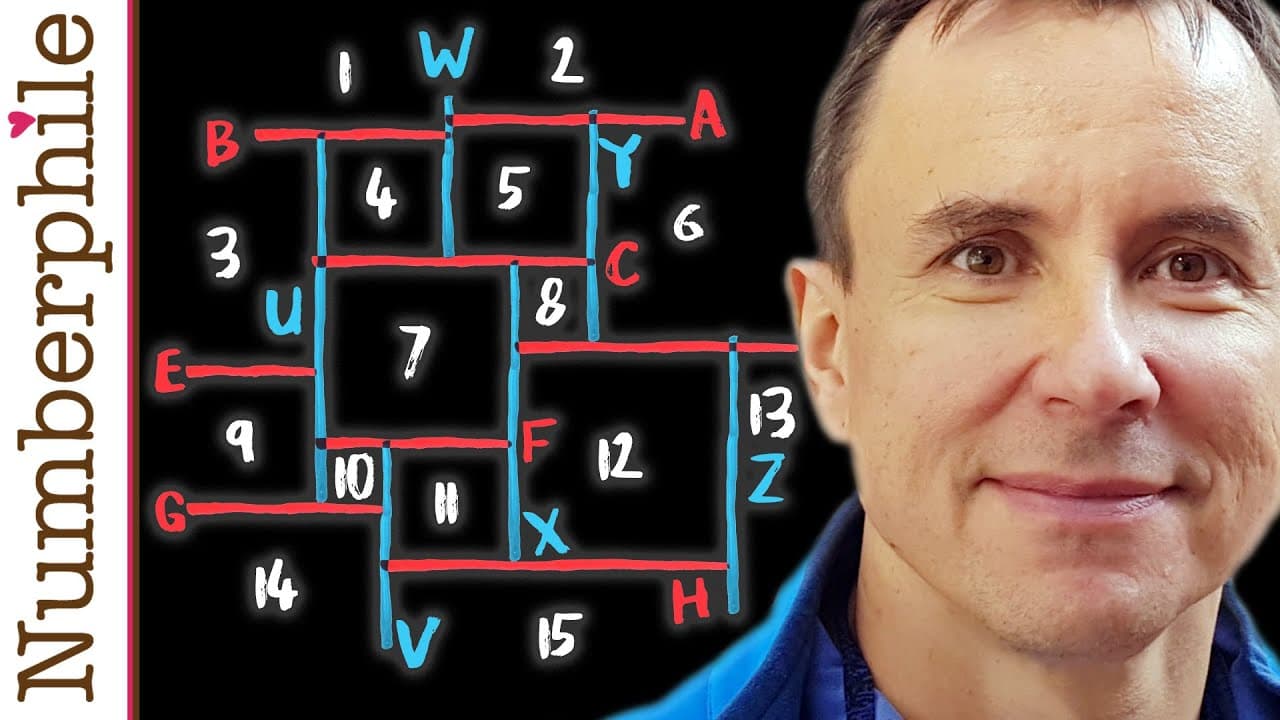
- ❎ Square tilings illustrate Pythagorean theorem principles with geometric shapes.
- 📈 Harmonic functions on graphs display average values of vertices for a harmonious relationship.
- 📈 Dual graphs embody symmetry between horizontal and vertical graph representations.
- 😫 Conjugate harmonic functions showcase interrelated functions with perpendicular level sets.
- 🌉 Harmonic functions bridge discreteness and continuity in mathematical physics.
- ❓ Mathematical accomplishments in exploring complex structures redefine mathematical possibilities.
- ❓ Geometric representations in mathematics offer insights into various mathematical concepts.
Install to Summarize YouTube Videos and Get Transcripts
Explore YouTube Video Summarizer or Get YouTube Transcript Extractor
Questions & Answers
Q: How do square tilings relate to the Pythagorean theorem?
Square tilings display Pythagorean theorem concepts through the relationship between square areas in a geometric pattern, illustrating a squared plus b squared equals c squared scenario.
Q: What is the significance of harmonic functions on graphs?
Harmonic functions on graphs represent the average values of vertices, showcasing a harmonious mathematical relationship that connects adjacent elements in a discrete structure.
Q: How are dual graphs and conjugate harmonic functions related?
Dual graphs showcase symmetry between horizontal and vertical graphical representations, while conjugate harmonic functions depict interrelated functions with perpendicular level sets.
Q: How do harmonic functions in mathematics connect discrete and continuous realms?
Harmonic functions bridge discrete and continuous mathematics by showcasing how microscopic combinatorial structures can converge to macroscopic continuous functions through the concept of harmonious averages.
Summary & Key Takeaways
-
Square tilings showcase Pythagorean theorem aspects through various geometric shapes.
-
Harmonic functions on graphs represent averages of values on vertices.
-
Dual graphs and conjugate harmonic functions reveal symmetry in geometric representations.
Read in Other Languages (beta)
Share This Summary 📚
Summarize YouTube Videos and Get Video Transcripts with 1-Click
Try YouTube Summary with ChatGPT & Claude or YouTube Transcript Generator
Explore More Summaries from Numberphile 📚





Summarize YouTube Videos and Get Video Transcripts with 1-Click
Try YouTube Summary with ChatGPT & Claude or YouTube Transcript Generator