Products
Features
YouTube Video Summarizer
Summarize YouTube videos
Web & PDF Highlighter
Highlight web pages & PDFs
Chat with PDF
Ask any PDF questions with AI
Ask AI Clone
Chat with your highlights & memories
Audio Transcriber
Transcribe audio files to text
Glasp Reader
Read and highlight articles
Kindle Highlight Export
Export your Kindle highlights
Idea Hatch
Hatch ideas from your highlights
Integrations
Obsidian Plugin
Notion Integration
Pocket Integration
Instapaper Integration
Medium Integration
Readwise Integration
Snipd Integration
Hypothesis Integration
Apps & Extensions
Chrome Extension
Safari Extension
Edge Add-ons
Firefox Add-ons
iOS App
Android App
Discover
Discover
Ideas
Discover new ideas and insights
Articles
Curated articles and insights
Books
Book recommendations by great minds
Posts
Essays and notes from readers
Quotes
Inspiring quotes collection
Videos
Curated videos and summaries
Explore Glasp
Glasp Newsletter
Weekly insights and updates
Glasp Talk
Interview series with great minds
Glasp Blog
Latest news and articles
Glasp Use Cases
Learn how others use Glasp
Build & Support
Glasp API
Access Glasp's API for developers
MCP Connector
Connect Glasp to Claude & ChatGPT
Community
Glasp Reddit Community
Students
Student discount and benefits
FAQs
Frequently Asked Questions
AboutPricing
DashboardLog inSign up

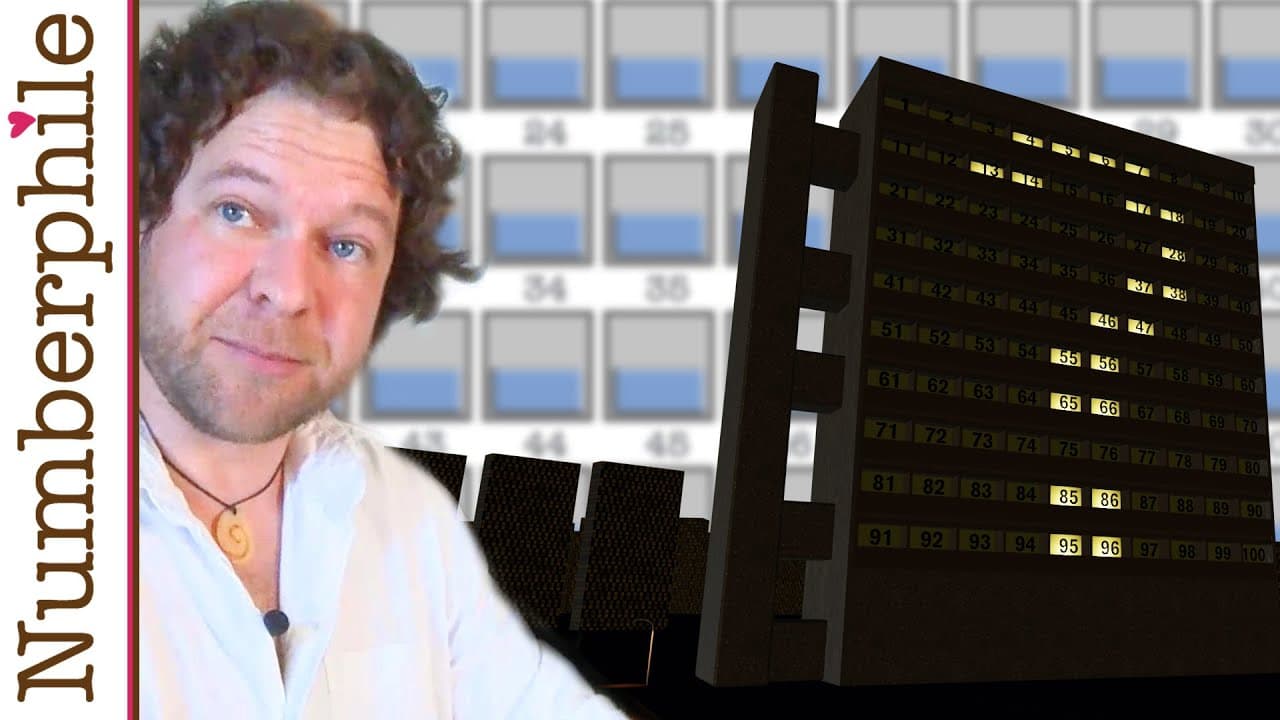
The Light Switch Problem - Numberphile
566.1K views
•
February 16, 2023
by
Numberphile
YouTube video player
The Light Switch Problem - Numberphile

TL;DR

After 100 individuals toggle light switches based on specific patterns, it is only the square numbers that remain on, as they have an odd number of factors.

Transcript

I'd like to tell you about a problem that's  very famous in some circles; I've seen it   used as like an interview question for uh  admissions tests, but I've also seen it just   as a puzzle. I would like you to imagine Brady  there are 100 light switches in front of you.  At the moment they're all off. The first  person comes along and turns them ... Read More

Key Insights

  • #️⃣ The light switches that remain on after the puzzle are the square numbers, which have an odd number of factors.
  • 🧑‍🏭 Factors come in pairs, except when there are duplicates, leading to an odd number of factors.
  • 🧑‍🏭 The Fundamental Theorem of Arithmetic provides insights into the unique prime factor decomposition of a number.
  • #️⃣ The number of factors a number has is crucial in determining whether a light switch is on or off.
  • 🥺 Prime numbers play a role in the puzzle, as their factors are only switched twice, leading to the switches being off.
  • #️⃣ Squares and numbers with an odd number of factors are associated with switches that remain on.
  • 🧑‍🏭 The puzzle showcases the concept of factors, divisors, and the impact of duplication on the number of factors.

Install to Summarize YouTube Videos and Get Transcripts

Explore YouTube Video Summarizer or Get YouTube Transcript Extractor

Questions & Answers

Q: What patterns do the individuals follow when toggling the light switches?

The first person turns on all the switches, while subsequent individuals toggle switches based on factors, turning them on or off.

Q: How do squares differ from other numbers in terms of factors?

Squares have an odd number of factors due to the duplication of certain factors, whereas other numbers have an even number of factors.

Q: Can any number have an odd number of factors?

Only square numbers have an odd number of factors, as they possess duplicates among their factors.

Q: What is the significance of the Fundamental Theorem of Arithmetic in understanding factors?

The theorem states that every number has a unique prime factor decomposition, which can help identify factors and prime factors of a given number.

Summary & Key Takeaways

  • The light switch puzzle involves 100 individuals toggling switches according to specific patterns.

  • The switches that remain on at the end are the square numbers, indicating that they have an odd number of factors.

  • Factors come in pairs, but squares have additional factors that are duplicates, resulting in an odd number of factors.


Read in Other Languages (beta)

English

Share This Summary 📚

Summarize YouTube Videos and Get Video Transcripts with 1-Click

Download browser extensions on:

Try YouTube Summary with ChatGPT & Claude or YouTube Transcript Generator

Explore More Summaries from Numberphile 📚
Cow-culus and Elegant Geometry - Numberphile thumbnail
Cow-culus and Elegant Geometry - Numberphile
Numberphile
Brown Numbers - Numberphile thumbnail
Brown Numbers - Numberphile
Numberphile
29 and Leap Years - Numberphile thumbnail
29 and Leap Years - Numberphile
Numberphile
Statistics, Storks, and Babies - Numberphile thumbnail
Statistics, Storks, and Babies - Numberphile
Numberphile
The Girl with the Hyperbolic Helicoid Tattoo - Numberphile thumbnail
The Girl with the Hyperbolic Helicoid Tattoo - Numberphile
Numberphile
The man with 1,000 Klein Bottles UNDER his house - Numberphile thumbnail
The man with 1,000 Klein Bottles UNDER his house - Numberphile
Numberphile

Summarize YouTube Videos and Get Video Transcripts with 1-Click

Download browser extensions on:

Try YouTube Summary with ChatGPT & Claude or YouTube Transcript Generator

Apps & Extensions

  • Chrome Extension
  • Safari Extension
  • Edge Add-ons
  • Firefox Add-ons
  • iOS App
  • Android App

Key Features

  • YouTube Video Summarizer
  • Web & PDF Summarizer
  • Web & PDF Highlighter
  • Chat with PDF
  • Ask AI Clone
  • Audio Transcriber
  • Glasp Reader
  • Kindle Highlight Export
  • Idea Hatch

Integrations

  • Obsidian Plugin
  • Notion Integration
  • Pocket Integration
  • Instapaper Integration
  • Medium Integration
  • Readwise Integration
  • Snipd Integration
  • Hypothesis Integration

More Features

  • APIs
  • MCP Connector
  • Blog & Post
  • Embed Links
  • Image Highlight
  • Personality Test
  • Quote Shots

Company

  • About us
  • Blog
  • Community
  • FAQs
  • Job Board
  • Newsletter
  • Pricing
Terms

•

Privacy

•

Guidelines

© 2026 Glasp Inc. All rights reserved.