Products
Features
YouTube Video Summarizer
Summarize YouTube videos
Web & PDF Highlighter
Highlight web pages & PDFs
Chat with PDF
Ask any PDF questions with AI
Ask AI Clone
Chat with your highlights & memories
Audio Transcriber
Transcribe audio files to text
Glasp Reader
Read and highlight articles
Kindle Highlight Export
Export your Kindle highlights
Idea Hatch
Hatch ideas from your highlights
Integrations
Obsidian Plugin
Notion Integration
Pocket Integration
Instapaper Integration
Medium Integration
Readwise Integration
Snipd Integration
Hypothesis Integration
Apps & Extensions
Chrome Extension
Safari Extension
Edge Add-ons
Firefox Add-ons
iOS App
Android App
Discover
Discover
Ideas
Discover new ideas and insights
Articles
Curated articles and insights
Books
Book recommendations by great minds
Posts
Essays and notes from readers
Quotes
Inspiring quotes collection
Videos
Curated videos and summaries
Explore Glasp
Glasp Newsletter
Weekly insights and updates
Glasp Talk
Interview series with great minds
Glasp Blog
Latest news and articles
Glasp Use Cases
Learn how others use Glasp
Build & Support
Glasp API
Access Glasp's API for developers
MCP Connector
Connect Glasp to Claude & ChatGPT
Community
Glasp Reddit Community
Students
Student discount and benefits
FAQs
Frequently Asked Questions
AboutPricing
DashboardLog inSign up

Brown Numbers - Numberphile
324.7K views
•
August 31, 2012
by
Numberphile
YouTube video player
Brown Numbers - Numberphile

TL;DR

Brown numbers are pairs of integers where n factorial plus 1 equals m squared.

Transcript

PROFESSOR ED COPELAND: I know that from looking at Numberphiles how many of the viewer comment all the time about the brown paper that you use. So I thought it'd be appropriate to introduce the Brown numbers. This is short but sweet. And I think it could be a challenge for the mathematically inclined Numberphile viewers. It's really straightforward... Read More

Key Insights

  • ❎ Brown numbers are defined by the equation n factorial plus 1 equals m squared.
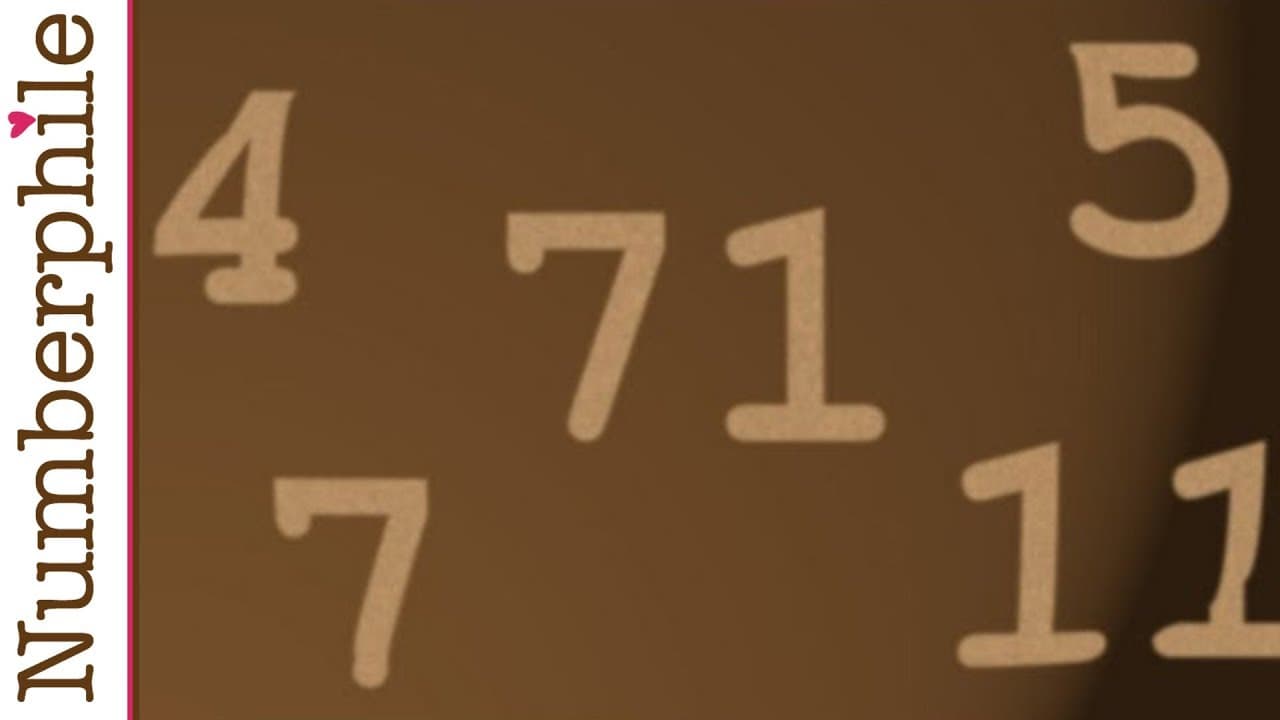
  • #️⃣ Examples of Brown numbers include (5, 4), (11, 5), and (71, 7).
  • 🤎 Paul Erdos conjectured that there are only three Brown numbers, but it lacks a formal proof.
  • 👨‍⚕️ Erdos was a unique and eccentric mathematician who made significant contributions to the field.
  • #️⃣ The rarity and properties of Brown numbers make them captivating subjects of mathematical exploration.
  • 👶 Finding new Brown numbers could potentially challenge Erdos's conjecture.
  • #️⃣ Understanding the relationship between factorials and perfect squares is key to studying Brown numbers.

Install to Summarize YouTube Videos and Get Transcripts

Explore YouTube Video Summarizer or Get YouTube Transcript Extractor

Questions & Answers

Q: What are Brown numbers?

Brown numbers are pairs of integers (m and n) that satisfy the equation n factorial plus 1 equals m squared. For example, (5, 4) is a Brown number because 4 factorial plus 1 equals 5 squared.

Q: How many Brown numbers are there?

The mathematician Paul Erdos conjectured that there are only three Brown numbers, but this has not been proven. So far, (5, 4), (11, 5), and (71, 7) are known Brown numbers.

Q: Why are Brown numbers significant?

Brown numbers have a special property that connects factorials and perfect squares. Their rarity and uniqueness make them intriguing to mathematicians and enthusiasts. Understanding the properties of Brown numbers could lead to further insights in number theory.

Q: How did Paul Erdos make his conjecture?

Paul Erdos was a highly respected mathematician known for his collaborations and contributions. While there is no proof for his conjecture about Brown numbers, Erdos likely based it on extensive exploration and analysis of various integers.

Summary & Key Takeaways

  • Brown numbers are defined as pairs of integers (m and n) that satisfy the equation n factorial plus 1 equals m squared.

  • Examples of Brown numbers include (5, 4), (11, 5), and (71, 7).

  • Paul Erdos, a renowned mathematician, conjectured that there are only three Brown numbers, but this has not been proven.


Read in Other Languages (beta)

English

Share This Summary 📚

Summarize YouTube Videos and Get Video Transcripts with 1-Click

Download browser extensions on:

Try YouTube Summary with ChatGPT & Claude or YouTube Transcript Generator

Explore More Summaries from Numberphile 📚

29 and Leap Years - Numberphile thumbnail
29 and Leap Years - Numberphile
Numberphile
The Z Factor - Numberphile thumbnail
The Z Factor - Numberphile
Numberphile
Cow-culus and Elegant Geometry - Numberphile thumbnail
Cow-culus and Elegant Geometry - Numberphile
Numberphile
The Light Switch Problem - Numberphile thumbnail
The Light Switch Problem - Numberphile
Numberphile
What Is Pascal's Triangle and Its Mathematical Patterns? thumbnail
What Is Pascal's Triangle and Its Mathematical Patterns?
Numberphile
The man with 1,000 Klein Bottles UNDER his house - Numberphile thumbnail
The man with 1,000 Klein Bottles UNDER his house - Numberphile
Numberphile

Summarize YouTube Videos and Get Video Transcripts with 1-Click

Download browser extensions on:

Try YouTube Summary with ChatGPT & Claude or YouTube Transcript Generator

Apps & Extensions

  • Chrome Extension
  • Safari Extension
  • Edge Add-ons
  • Firefox Add-ons
  • iOS App
  • Android App

Key Features

  • YouTube Video Summarizer
  • Web & PDF Summarizer
  • Web & PDF Highlighter
  • Chat with PDF
  • Ask AI Clone
  • Audio Transcriber
  • Glasp Reader
  • Kindle Highlight Export
  • Idea Hatch

Integrations

  • Obsidian Plugin
  • Notion Integration
  • Pocket Integration
  • Instapaper Integration
  • Medium Integration
  • Readwise Integration
  • Snipd Integration
  • Hypothesis Integration

More Features

  • APIs
  • MCP Connector
  • Blog & Post
  • Embed Links
  • Image Highlight
  • Personality Test
  • Quote Shots

Company

  • About us
  • Blog
  • Community
  • FAQs
  • Job Board
  • Newsletter
  • Pricing
Terms

•

Privacy

•

Guidelines

© 2026 Glasp Inc. All rights reserved.