What Is Pascal's Triangle and Its Mathematical Patterns?
TL;DR
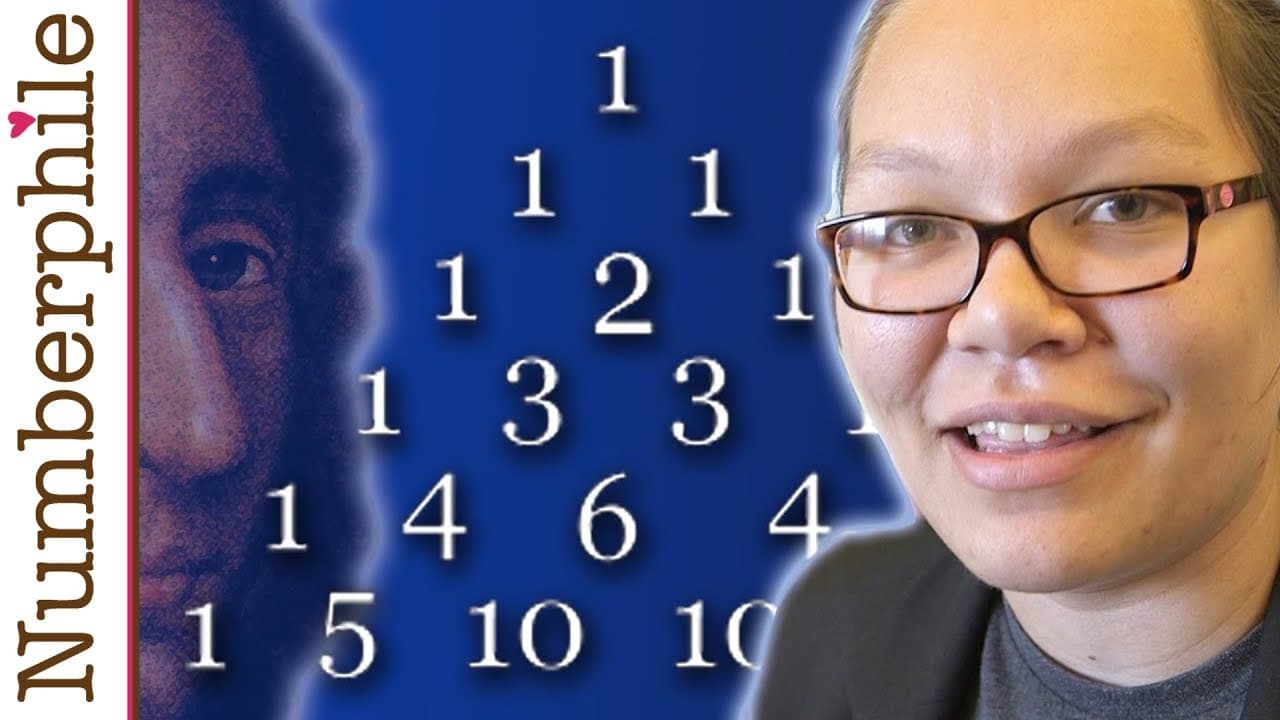
Pascal's Triangle is formed by starting with one at the top and creating rows where each number is the sum of the two numbers above it. It encodes combinations, exhibits patterns like sums of rows equal to powers of two, and relates to the Fibonacci sequence through shallow diagonals. Converting it to mod 2 reveals binary patterns and can help generate prime numbers.
Transcript
So today we're going to talk about Pascal's triangle. It's one of my favorite things in math - particularly because whenever I talk to other mathematicians they always have some interesting patterns they like talking about. It's almost never the same one. So Pascal's triangle is sort of like an addition triangle. So we start with the number one and... Read More
Key Insights
- 👶 Pascal's Triangle is a fascinating mathematical object that continues to reveal new patterns and applications.
- 😫 It encodes combinations and provides a visual representation of the number of ways to choose items from a set.
- 📳 By converting Pascal's Triangle into mod 2, it demonstrates a binary pattern where primes can be generated.
- 🤨 The sum of each row in Pascal's Triangle is equal to 2 raised to the power of the row number.
- 🫤 The Fibonacci sequence can be found by adding the numbers in shallow diagonals of Pascal's Triangle.
Install to Summarize YouTube Videos and Get Transcripts
Explore YouTube Video Summarizer or Get YouTube Transcript Extractor
Questions & Answers
Q: What is the purpose of Pascal's Triangle?
Pascal's Triangle is a mathematical tool used to calculate combinations and find the number of ways to choose items from a set.
Q: How can Pascal's Triangle be used to determine combinations?
To find the number of ways to choose K items from a set of N, one can look at the Nth row, move K positions to the right, and find the corresponding number.
Q: What patterns can be observed in Pascal's Triangle?
Pascal's Triangle exhibits patterns such as consecutive sums (e.g., +1, +2, +3), powers of two, and the formation of Sierpinski's Triangle.
Q: Are there any applications of Pascal's Triangle in other areas of mathematics?
Yes, Pascal's Triangle is used in various mathematical fields, including combinatorics, probability, and number theory.
Summary & Key Takeaways
-
Pascal's Triangle starts with the number one and each row is formed by adding numbers on the left and right of each element.
-
The triangle represents combinations (N choose K) and shows the number of ways to choose K items from a set of N.
-
The triangle exhibits patterns such as consecutive sums, powers of two, and the formation of Sierpinski's Triangle.
Read in Other Languages (beta)
Share This Summary 📚
Summarize YouTube Videos and Get Video Transcripts with 1-Click
Try YouTube Summary with ChatGPT & Claude or YouTube Transcript Generator
Explore More Summaries from Numberphile 📚



Summarize YouTube Videos and Get Video Transcripts with 1-Click
Try YouTube Summary with ChatGPT & Claude or YouTube Transcript Generator