Performing a basic t-test and linear regression in R
TL;DR
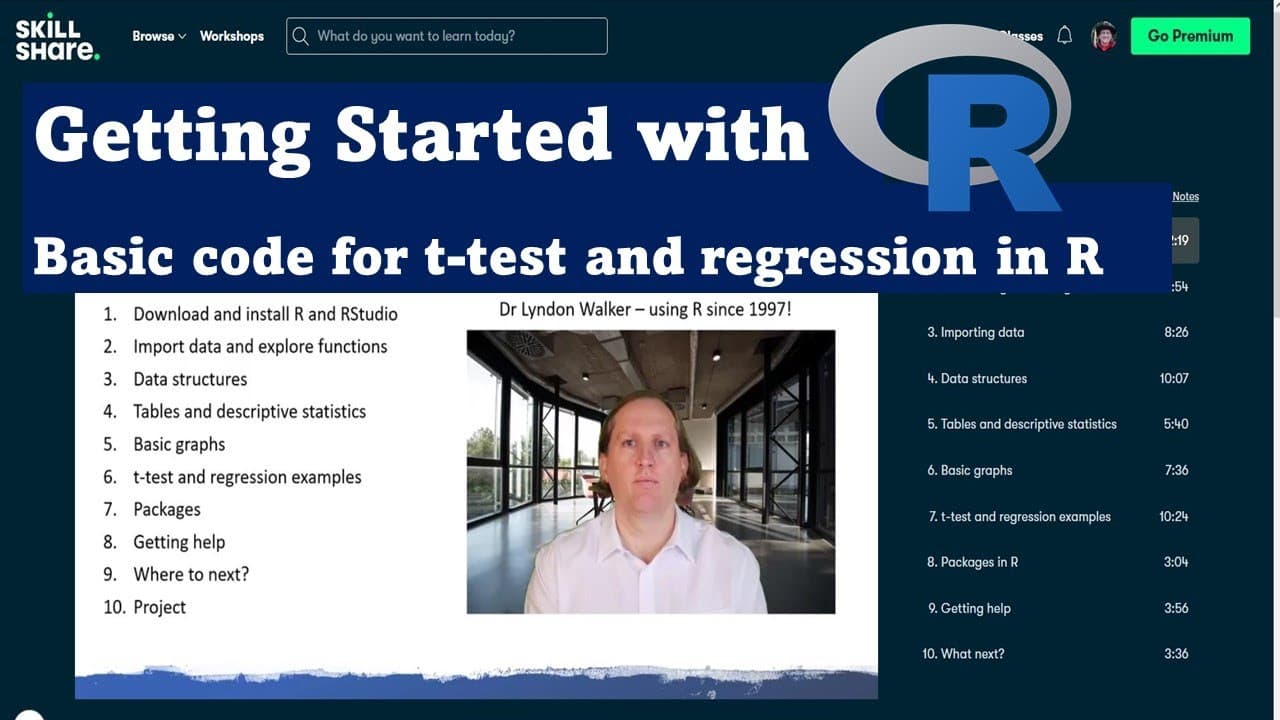
Learn how to perform t-tests and linear regression in R.
Transcript
hi i'm dr lyndon walker the following video is part of my skillshare course getting started with r here behind me you can see the various different chapters of the skillshare course you can click on the link below the video to take you to the skillshare course and you'll be able to download the data that i use in this video and work along with it i... Read More
Key Insights
- 👨💻 R programming language enables effective statistical analysis, including t-tests and linear regression, through simple coding syntax.
- 👻 An independent samples t-test allows comparison between two groups under conditions of independence, crucial for understanding significant differences.
- 🎥 The video illustrates using R functions like
t.testandlmfor running statistical tests and building regression models, emphasizing ease of coding. - 👨💻 Despite focusing on coding, it's important to understand statistical principles, such as assumptions underlying tests, for accurate interpretation.
- 💁 The output from linear regression includes coefficients, p-values, and adjusted R-squared, all of which inform the robustness of the model.
- 😀 Regression modeling in R not only predicts outcomes but also indicates which independent variables significantly contribute to explaining variation in the dependent variable.
- 👤 Users are encouraged to explore additional resources for deeper statistical understanding, particularly regarding assumptions and interpretations of results.
Install to Summarize YouTube Videos and Get Transcripts
Explore YouTube Video Summarizer or Get YouTube Transcript Extractor
Questions & Answers
Q: What is the purpose of an independent samples t-test?
An independent samples t-test compares the means of two distinct groups to determine if there is a statistically significant difference between them. In this case, it was used to compare the average weight of athletes based on sex. A significant p-value from the t-test indicates that the weight difference between the groups is unlikely due to chance.
Q: How do you interpret the p-value from a t-test in R?
In R, a very small p-value, particularly expressed in scientific notation such as 2.2e-16, suggests a significant difference between the two means being compared. This implies that we reject the null hypothesis, leading to the conclusion that a substantial difference exists between the groups being analyzed—female and male athletes in this instance.
Q: What are the basics of linear regression as explained in the video?
Linear regression aims to model the relationship between a dependent variable and one or more independent variables. In the video, it demonstrates how to predict weight using height and lean body mass as predictors, showcasing R's lm function to build the model and interpret the results, including p-values and regression coefficients.
Q: Why is checking assumptions important in a t-test?
Checking assumptions for a t-test, such as normality and equal variances, is vital to ensure the validity of the test results. Although the video does not dive deep into these assumptions, neglecting them can lead to inaccurate conclusions from the statistical tests. Ideally, further statistical resources would cover these underlying principles.
Q: How does one specify multiple predictors in a linear regression model in R?
To specify multiple predictors in a linear regression model in R, you use the syntax dependent_variable ~ predictor1 + predictor2 + .... This combination uses the tilde ~ to denote the relationship and plus signs + to separate multiple independent variables, allowing you to include several factors in your analysis.
Q: What is the significance of the adjusted R-squared value?
The adjusted R-squared value indicates the proportion of variance in the dependent variable that can be explained by the independent variables in the model, adjusting for the number of predictors. In the video, an adjusted R-squared of 0.868 suggests that almost 87% of the variability in weight can be predicted by height and lean body mass, indicating a strong model fit.
Summary & Key Takeaways
-
The video introduces viewers to basic statistical analysis techniques using R, specifically focusing on independent samples t-tests and linear regression.
-
Dr. Lyndon Walker demonstrates how to write and interpret R code for conducting a t-test comparing athletes' weights by sex, emphasizing coding over statistical depth.
-
The regression analysis models weight using height and lean body mass, highlighting significant predictors and providing a clear overview of interpreting regression outputs.
Read in Other Languages (beta)
Share This Summary 📚
Summarize YouTube Videos and Get Video Transcripts with 1-Click
Try YouTube Summary with ChatGPT & Claude or YouTube Transcript Generator
Explore More Summaries from Dr Lyndon Walker 📚





Summarize YouTube Videos and Get Video Transcripts with 1-Click
Try YouTube Summary with ChatGPT & Claude or YouTube Transcript Generator