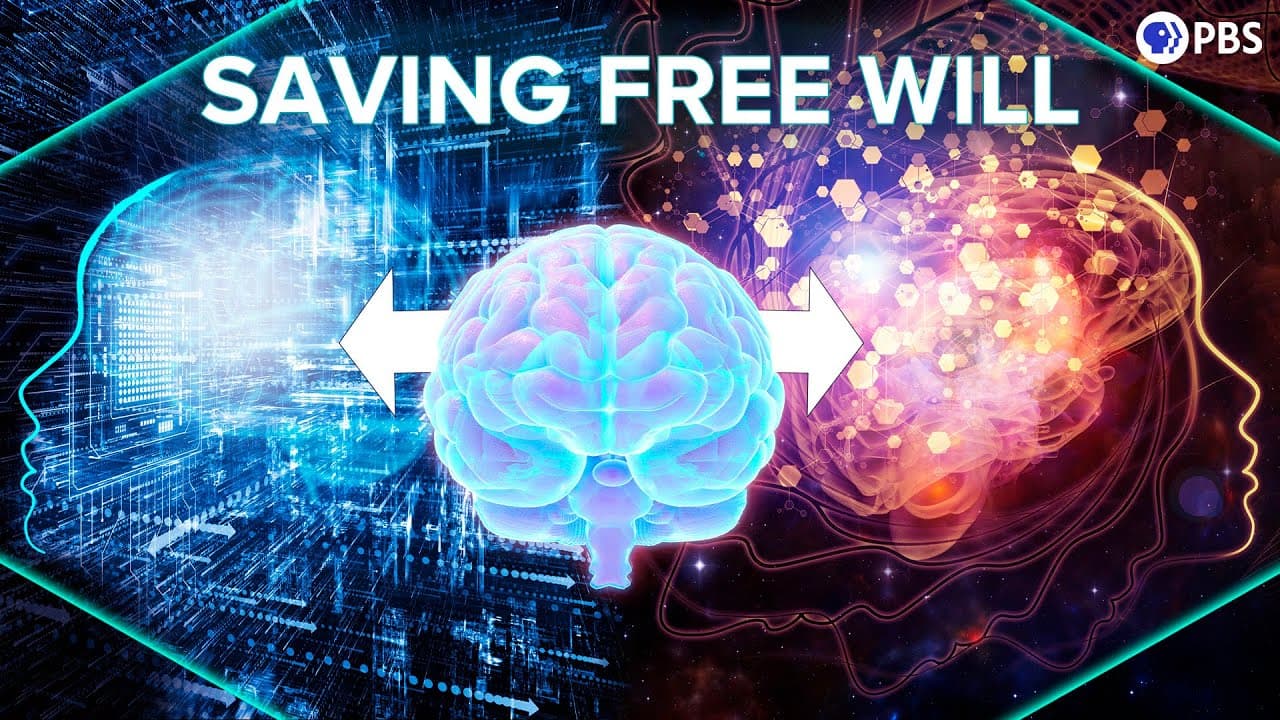
Can Free Will be Saved in a Deterministic Universe?
TL;DR
Explores the relationship between determinism and free will in physics.
Transcript
- Physicists have a long history of sticking our noses where they don't belong, and one of our favorite places to step beyond our expertise is the question of consciousness and free will. Sometimes our musings are insightful, sometimes incoherent, and usually at least somewhat naive, which is a fair description of this show. So of course, "Space Ti... Read More
Key Insights
- The concept of determinism in physics, particularly through the lens of the block universe and Laplace's demon, suggests that all events, including human actions, are predetermined.
- Quantum mechanics introduces a debate about whether outcomes are fundamentally random or determined, impacting the notion of free will.
- Quantum information conservation suggests that new information cannot be created or destroyed, challenging the idea of free will as creating new choices.
- The Heisenberg uncertainty principle limits the ability to perfectly predict states of matter, including brain states, which complicates deterministic views.
- Brain activity may utilize random neuronal fluctuations, suggesting randomness is a feature, not a bug, in decision-making processes.
- Interpretations of quantum mechanics, like Copenhagen and many-worlds, offer different perspectives on the singularity and determinism of the future.
- Emergent phenomena, like consciousness and free will, may arise from mechanistic processes, challenging reductionist views that deny their reality.
- The debate on free will involves semantic challenges, questioning definitions of free, will, and illusion, highlighting the complexity of the topic.
Install to Summarize YouTube Videos and Get Transcripts
Explore YouTube Video Summarizer or Get YouTube Transcript Extractor
Questions & Answers
Q: What is the block universe concept?
The block universe concept, derived from Einstein's relativity, suggests that past, present, and future events exist simultaneously in a four-dimensional space-time block. From a god-like observer's perspective, time is an illusion, and all events are predetermined and unchangeable, challenging the notion of free will.
Q: How does Laplace's demon relate to determinism?
Laplace's demon is a theoretical construct that posits a vast intellect capable of knowing all positions and velocities of particles in the universe, allowing it to predict all future states. This idea supports a deterministic view where every action, including human decisions, is predetermined by past events.
Q: What role does quantum mechanics play in the free will debate?
Quantum mechanics challenges deterministic views by introducing the possibility of randomness at the quantum level. It suggests that either outcomes are fundamentally random or determined by hidden variables, impacting predictability and the philosophical implications for free will and decision-making processes.
Q: What is the principle of conservation of quantum information?
The conservation of quantum information principle states that quantum information cannot be created or destroyed. This challenges the idea of free will as creating new choices, as it implies that all information, including that related to decisions, must be conserved and cannot emerge from nothing.
Q: How does the Heisenberg uncertainty principle affect predictability?
The Heisenberg uncertainty principle limits the ability to measure certain pairs of properties, like position and momentum, with perfect accuracy. This introduces a fundamental limit to predictability, suggesting that perfect knowledge of a system, such as a brain, is impossible, complicating deterministic views.
Q: What is the significance of randomness in brain activity?
Randomness in brain activity suggests that neuronal fluctuations may be integral to decision-making processes. This challenges deterministic perspectives by proposing that randomness is not a flaw but a feature of the brain, potentially contributing to the unpredictability and complexity of human choices.
Q: How do different quantum mechanics interpretations view the future?
Different interpretations of quantum mechanics offer varied views on future determinism. The Copenhagen interpretation sees the future as singular but unpredictable, while the many-worlds interpretation posits a plural, determined future where all possibilities exist, each developing according to quantum laws.
Q: What is the emergent phenomenon argument against reductionism?
The emergent phenomenon argument against reductionism suggests that complex properties, like consciousness and free will, arise from simpler mechanistic processes. It challenges reductionist views by asserting that these phenomena possess properties not found in their parts, similar to how a red apple is more than just atoms.
Summary & Key Takeaways
-
The video explores the intersection of physics and philosophy, particularly focusing on free will and determinism. It examines how concepts like the block universe and Laplace's demon suggest a predetermined universe, challenging the notion of free will. Quantum mechanics is introduced as a potential disruptor to deterministic views.
-
Quantum mechanics suggests randomness or hidden determinism at the quantum level, impacting notions of predictability and free will. The conservation of quantum information challenges the creation of new choices, while the Heisenberg uncertainty principle limits predictability, complicating deterministic interpretations.
-
The video discusses how brain activity may involve random processes, suggesting randomness is integral to decision-making. Different quantum mechanics interpretations offer varied views on future determinism. Emergent phenomena like consciousness challenge reductionist views, questioning the semantics of free will and its philosophical implications.
Read in Other Languages (beta)
Share This Summary 📚
Summarize YouTube Videos and Get Video Transcripts with 1-Click
Try YouTube Summary with ChatGPT & Claude or YouTube Transcript Generator
Explore More Summaries from PBS Space Time 📚
Summarize YouTube Videos and Get Video Transcripts with 1-Click
Try YouTube Summary with ChatGPT & Claude or YouTube Transcript Generator