Software Deployment Strategies Used by Netflix, Amazon, Facebook
TL;DR
Explores deployment strategies for seamless software updates.
Transcript
deployment refers to the process of making software available for users to access and use this typically means moving the software from a developer environment where it is built and tested to a production environment which is a live system where real users interact with it imagine you're running a popular pizza delivery app called Pizza Hub... Read More
Key Insights
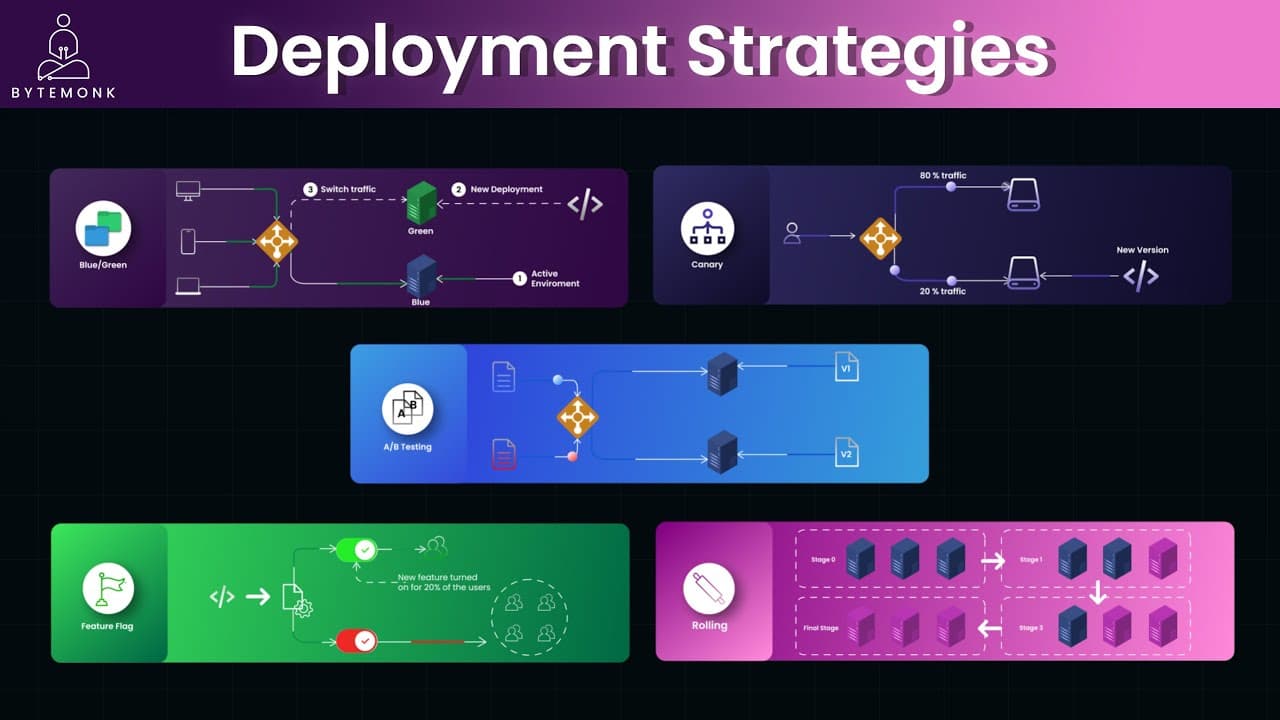
- Rolling deployment gradually updates servers, ensuring minimal downtime and risk, making it ideal for large-scale systems like Netflix.
- Blue-Green deployment maintains two environments, allowing instant rollback if issues arise, used by companies like Shopify for stable updates.
- Canary deployment tests new versions with a small user subset, minimizing risk and enabling real-world testing, as used by Netflix.
- Feature Flags allow feature activation without redeployment, facilitating gradual rollouts and testing, extensively used by Facebook and Amazon.
- A/B Testing compares two system versions to optimize performance based on user engagement, a strategy employed by Amazon for product recommendations.
- Rolling deployment ensures zero downtime but may result in users interacting with different app versions during rollout.
- Blue-Green deployment offers quick rollback and environment isolation but requires resource-intensive maintenance of two environments.
- Choosing a deployment strategy depends on application architecture, risk tolerance, and resource availability, balancing speed, isolation, and flexibility.
Install to Summarize YouTube Videos and Get Transcripts
Explore YouTube Video Summarizer or Get YouTube Transcript Extractor
Questions & Answers
Q: What is rolling deployment and how does it work?
Rolling deployment is a strategy where new software versions are incrementally deployed to servers, gradually replacing old versions. This ensures minimal downtime as some servers always run the older version until the process completes. It involves updating one or two servers first, checking for errors, and then expanding to other servers, ensuring traffic is managed with a load balancer.
Q: How does blue-green deployment ensure quick rollback?
Blue-green deployment maintains two identical environments: one running the live version (blue) and the other hosting the new version (green). Traffic is switched to green once the new version is ready. If issues arise, traffic can be instantly switched back to blue, ensuring zero disruption. This strategy allows quick rollback and environment isolation but requires maintaining two environments.
Q: What is the advantage of using canary deployment?
Canary deployment gradually rolls out a new version to a small subset of users while the majority continue using the old version. This approach minimizes risk by testing the new version in production with real user traffic. Metrics like error rates and user behavior are monitored, allowing companies to identify issues before a full rollout, as practiced by Netflix.
Q: How do feature flags provide flexibility in deployments?
Feature flags allow deploying new features to production with the ability to keep them off by default. Features can be activated for specific user groups without redeploying the code. This enables gradual rollouts and testing, offering flexibility and agility in enabling or disabling features. Managing multiple feature flags can complicate code maintenance, requiring careful management.
Q: What is A/B testing in deployment strategies?
A/B testing, also known as split testing, involves deploying two versions of a system feature or UI simultaneously to different user groups. The goal is to compare their performance based on metrics like user engagement or conversion rates. This strategy helps determine which version performs better, enabling data-driven decisions for deploying the more effective version, as used by Amazon.
Q: Why is selecting a deployment strategy important?
Selecting a deployment strategy is crucial as it determines how software updates are delivered without disrupting user experience. It depends on the application's architecture, risk tolerance, and resource availability. Strategies like blue-green deployment offer quick rollback, while rolling deployment ensures zero downtime. The right choice balances speed, isolation, flexibility, and resource management.
Q: How do tech giants like Netflix and Amazon use deployment strategies?
Tech giants like Netflix and Amazon use various deployment strategies to ensure seamless updates and high availability. Netflix uses rolling and canary deployments to update its streaming services and test new features. Amazon leverages A/B testing and feature flags to optimize product recommendations and enable flexible feature rollouts, ensuring data-driven enhancements to user experience.
Q: What are the trade-offs of using feature flags?
Feature flags offer flexibility in enabling or disabling features without redeployment and allow gradual rollouts to specific user groups. However, managing multiple feature flags can complicate the code base, making it harder to maintain. Unused or old feature flags can accumulate if not cleaned up properly, requiring careful management to avoid technical debt.
Summary & Key Takeaways
-
The video explores various deployment strategies used by tech giants like Netflix, Amazon, and Facebook to ensure seamless software updates. It covers rolling deployments, blue-green deployments, canary releases, feature flags, and A/B testing, highlighting their advantages and trade-offs in minimizing downtime and disruptions.
-
Rolling deployment updates servers incrementally, allowing seamless transitions without downtime, while blue-green deployment maintains two environments for quick rollback. Canary deployment tests new versions with a small user subset, and feature flags enable feature activation without redeployment, offering flexibility and agility.
-
A/B testing compares two versions of a system to optimize performance based on specific metrics. The video emphasizes the importance of selecting a deployment strategy based on application architecture, risk tolerance, and resource availability, ensuring value delivery without disrupting user experience.
Read in Other Languages (beta)
Share This Summary 📚
Summarize YouTube Videos and Get Video Transcripts with 1-Click
Try YouTube Summary with ChatGPT & Claude or YouTube Transcript Generator
Explore More Summaries from ByteMonk 📚
Summarize YouTube Videos and Get Video Transcripts with 1-Click
Try YouTube Summary with ChatGPT & Claude or YouTube Transcript Generator