What Was the Market Revolution in America?
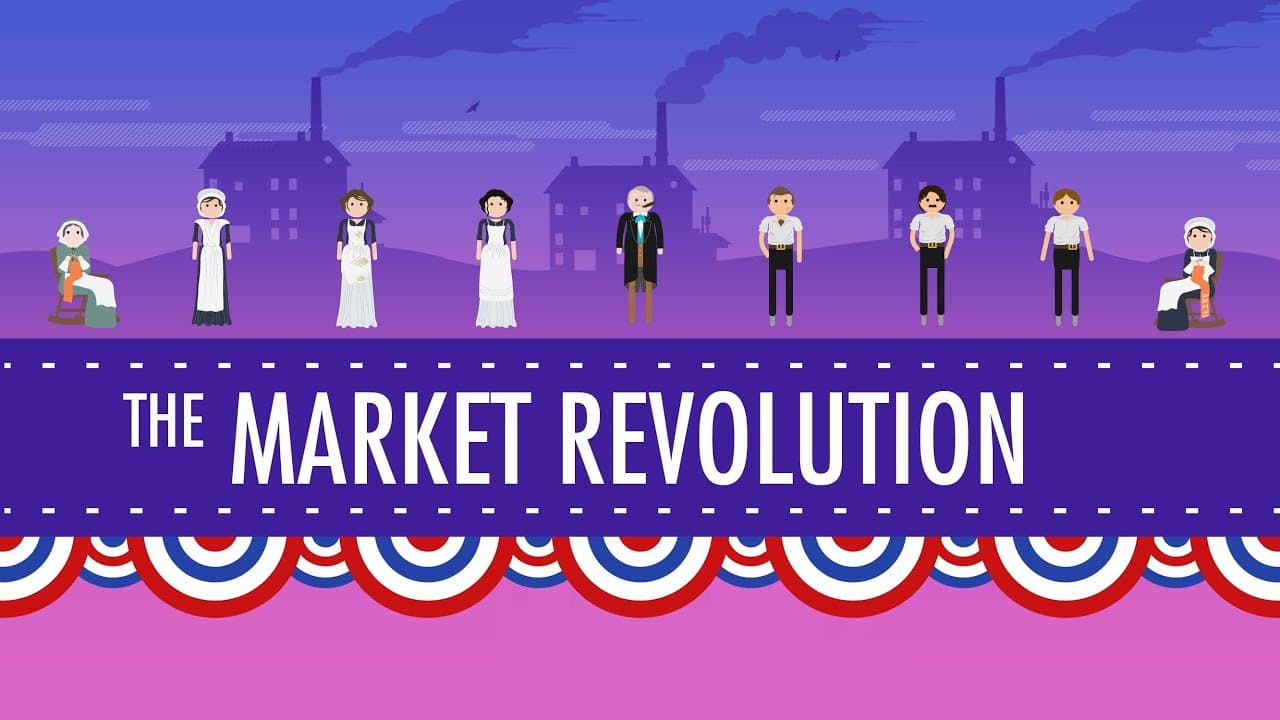
TL;DR
The Market Revolution in the early 19th century transformed the U.S. economy from a Jeffersonian ideal of self-sustaining farms to a Hamiltonian model of manufacturing and trade. This shift was driven by new technologies in transportation and communication, fundamentally changing how Americans worked and thought about labor, leading to urbanization and wage-based employment.
Transcript
Hi, I'm John Green, this is Crash Course US History and today we return to one of my favorite subjects: economics. Mr. Green, Mr. Green, I don't wanna brag, but economics is actually my best subject. Like, I got the bronze medal at the state academic decathlon tournament...among C students. Yeah, I remember, Me from the Past. By the way, thanks for... Read More
Key Insights
- The Market Revolution was a transformative period in early 19th-century America, shifting the economy from agrarian to industrial.
- Technological advancements in transportation, like canals and railroads, drastically reduced the cost and time of moving goods.
- Factories emerged as key centers of production, utilizing mass-production techniques and interchangeable parts.
- The rise of modern banking systems and limited liability corporations facilitated large-scale investments.
- Government played a crucial role in economic growth by building infrastructure and protecting business interests.
- The revolution changed work dynamics, with more Americans working in factories for wages instead of on farms.
- Westward expansion and the concept of 'manifest destiny' were fueled by the desire for economic opportunities.
- Intellectual responses, like Transcendentalism, emerged as critiques of the loss of individual freedom in a market-driven society.
Install to Summarize YouTube Videos and Get Transcripts
Explore YouTube Video Summarizer or Get YouTube Transcript Extractor
Questions & Answers
Q: How did the Market Revolution change the U.S. economy?
The Market Revolution transformed the U.S. economy by shifting it from an agrarian model to an industrial one, characterized by manufacturing and trade. This change was facilitated by advancements in transportation and communication, such as railroads and telegraphs, which connected distant markets and reduced costs. It led to urbanization and the rise of factories, where people worked for wages instead of producing goods at home.
Q: What role did technology play in the Market Revolution?
Technology played a crucial role in the Market Revolution by enabling faster and cheaper transportation and communication. Innovations like canals, steam-powered boats, and railroads drastically reduced the cost and time of moving goods. The telegraph allowed for instant communication over long distances, facilitating more efficient markets. These advancements helped create a national economy and supported the growth of cities and factories.
Q: How did the Market Revolution affect American workers?
The Market Revolution significantly affected American workers by shifting the nature of work from home-based production to factory-based wage labor. Many workers moved to cities to work in factories, where they were paid by the hour rather than by the volume of goods produced. This change led to a more regimented work schedule and contributed to the rise of labor movements advocating for better wages and working conditions.
Q: What was the government's role in the Market Revolution?
The government played a supportive role in the Market Revolution by investing in infrastructure projects like roads and canals, which facilitated economic growth. It also provided legal protections for businesses, such as upholding the creation of corporations and encouraging competition through court rulings. These actions helped create a favorable environment for industrial expansion and investment.
Q: How did the Market Revolution lead to urbanization?
The Market Revolution led to urbanization by creating economic opportunities in cities, where factories and industries were located. As transportation and communication technologies improved, people moved from rural areas to urban centers in search of jobs. This migration was driven by the demand for wage labor in factories, contributing to the growth of cities and the decline of rural, agrarian lifestyles.
Q: What were the intellectual responses to the Market Revolution?
Intellectual responses to the Market Revolution included movements like Transcendentalism, which critiqued the loss of individual freedom and the rise of consumerism. Transcendentalists like Emerson and Thoreau emphasized self-reliance and personal growth as counterpoints to the regimented, market-driven society. These ideas highlighted tensions between economic progress and individual autonomy.
Q: How did the Market Revolution impact women in the workforce?
The Market Revolution impacted women in the workforce by providing new employment opportunities in factories, especially in the textile industry. Women, particularly young farm girls, were employed in mills where they worked for lower wages than men. This shift challenged traditional gender roles and contributed to the early labor movement, as women began advocating for better working conditions and pay.
Q: What were the consequences of the Market Revolution on American society?
The consequences of the Market Revolution on American society included economic growth, urbanization, and changes in work dynamics. It created wealth disparities and led to the formation of labor unions advocating for workers' rights. The period also sparked debates about individual freedom and the role of government in the economy, influencing political and intellectual discourse throughout the 19th century.
Summary & Key Takeaways
-
The Market Revolution marked a shift from agrarian self-sufficiency to an industrial economy in early 19th-century America. Driven by new transportation technologies, it connected distant markets and fostered urbanization. Factories became central to production, employing mass-production techniques and creating a wage-based labor force.
-
Government support was instrumental, with infrastructure projects and legal protections for businesses. This period also saw the rise of modern banking systems and corporations, enabling large-scale investments. The revolution transformed work dynamics, as more Americans moved to cities and worked in factories.
-
Intellectual movements like Transcendentalism critiqued the loss of individual freedoms and the rise of consumerism. Despite economic growth, disparities in wealth and labor conditions persisted, leading to the formation of early labor unions and political movements advocating for workers' rights.
Read in Other Languages (beta)
Share This Summary 📚
Summarize YouTube Videos and Get Video Transcripts with 1-Click
Try YouTube Summary with ChatGPT & Claude or YouTube Transcript Generator
Explore More Summaries from CrashCourse 📚






Summarize YouTube Videos and Get Video Transcripts with 1-Click
Try YouTube Summary with ChatGPT & Claude or YouTube Transcript Generator