Will The Big Bang Happen AGAIN (and Again)?
TL;DR
Exploration of cyclic universe theories and their implications.
Transcript
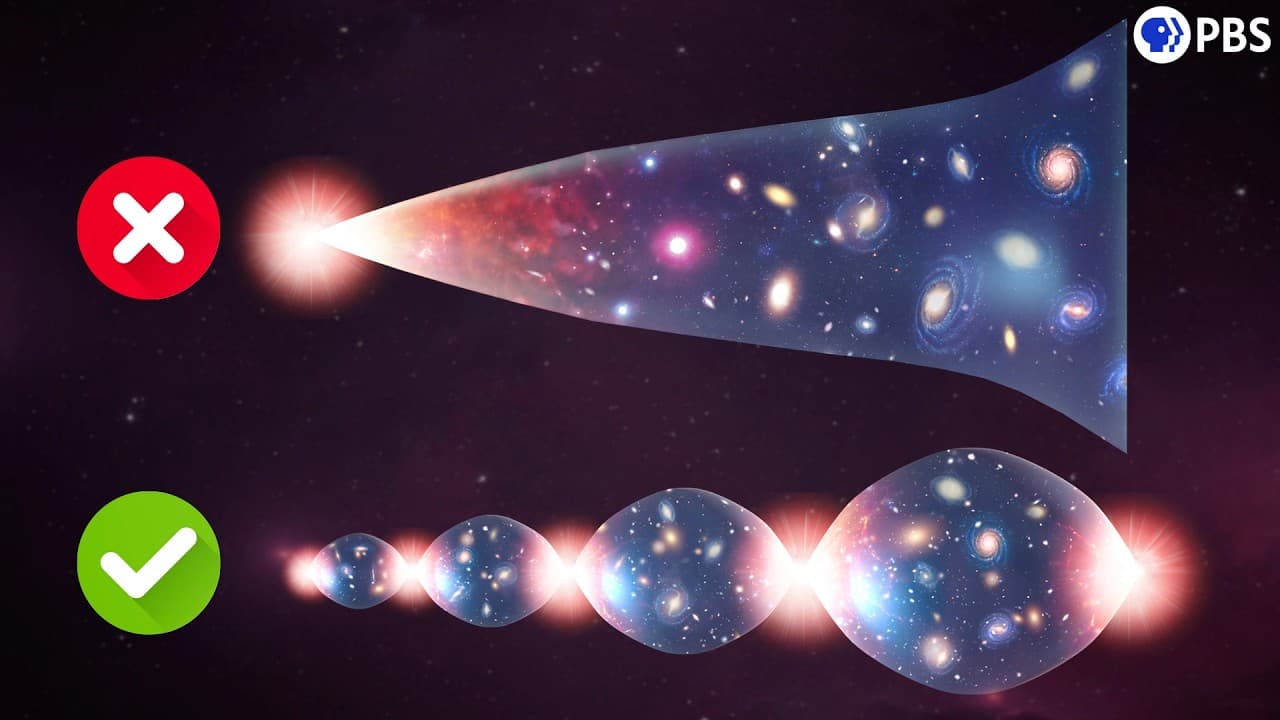
Before we get started, just wanted to let you know we have some new merch at the merch store celebrating 10 years of Space Time. How did the universe begin? How can something come from nothing? One way to “solve” this most difficult of philosophical conundrums is to avoid it altogether. Maybe the universe didn’t begin at all. Maybe the Big Bang... Read More
Key Insights
- The concept of a cyclic universe proposes that the universe undergoes endless cycles of expansion and contraction, challenging the traditional Big Bang theory.
- Cyclic cosmologies are present in many ancient cultures, reflecting humanity's tendency to see cycles in nature and apply them to the universe.
- Mainstream cosmology supports the Big Bang theory, where the universe began from an infinitesimal point and continues expanding indefinitely.
- The horizon, flatness, and magnetic monopole problems in the Big Bang model are addressed by the theory of cosmic inflation.
- Cyclic models, such as the ekpyrotic universe, propose that the universe can regenerate without a singular beginning, using a modified inflaton field.
- M-theory suggests our universe might be a brane within a higher-dimensional space, where collisions with other branes could trigger cyclic Big Bang events.
- Cyclic and inflationary models predict similar observable phenomena, making it challenging to distinguish between them with current technology.
- Future advancements in detecting gravitational waves or cosmic microwave background polarization may provide insights into the universe's origins.
Install to Summarize YouTube Videos and Get Transcripts
Explore YouTube Video Summarizer or Get YouTube Transcript Extractor
Questions & Answers
Q: What is the main idea behind a cyclic universe?
The main idea behind a cyclic universe is that the universe undergoes endless cycles of expansion and contraction. This theory challenges the traditional Big Bang model by suggesting that the universe does not have a singular beginning or end, but instead regenerates through these cycles.
Q: How do cyclic cosmologies relate to ancient cultures?
Cyclic cosmologies are present in many ancient cultures, such as Hinduism, Buddhism, and Greek mythology. These cultures often viewed the universe as undergoing endless cycles, reflecting humanity's tendency to observe cycles in nature, like day and night or the seasons, and apply them to the cosmos.
Q: What are the main problems with the Big Bang model that cyclic theories address?
The Big Bang model faces several challenges, including the horizon problem, flatness problem, and magnetic monopole problem. Cyclic theories, like the ekpyrotic universe, propose solutions to these issues without requiring cosmic inflation, suggesting that the universe can regenerate without a singular beginning.
Q: What role does cosmic inflation play in mainstream cosmology?
Cosmic inflation is a key component of mainstream cosmology, addressing issues like the horizon, flatness, and magnetic monopole problems. It proposes an exponential expansion phase in the early universe, smoothing out irregularities and explaining the large-scale structure of the universe we observe today.
Q: How does the ekpyrotic universe model differ from the inflationary model?
The ekpyrotic universe model differs from the inflationary model by proposing a regenerating universe without a singular beginning. It uses a modified inflaton field and suggests that the universe undergoes cycles of expansion and contraction, potentially involving higher-dimensional spaces and brane collisions.
Q: What is M-theory, and how does it relate to cyclic cosmologies?
M-theory is an encompassing framework for string theory, proposing that our universe is a brane within a higher-dimensional space. In cyclic cosmologies, brane collisions within this space could trigger Big Bang events, providing a mechanism for the universe's cycles of expansion and contraction.
Q: What are the challenges in distinguishing between cyclic and inflationary models?
Both cyclic and inflationary models predict similar observable phenomena, making it challenging to distinguish between them with current technology. Future advancements, such as detecting gravitational waves or cosmic microwave background polarization, may provide insights into the universe's origins and help differentiate these models.
Q: What future advancements could help test cyclic cosmologies?
Future advancements in detecting gravitational waves or cosmic microwave background polarization could help test cyclic cosmologies. These technologies may reveal differences in the spectrum of density fluctuations or gravitational waves produced in inflationary versus ekpyrotic Big Bangs, providing insights into the universe's origins.
Summary & Key Takeaways
-
The video explores the idea of a cyclic universe, where the universe undergoes endless cycles of expansion and contraction, challenging the traditional Big Bang theory. It delves into ancient cosmologies and modern scientific theories like the ekpyrotic universe, which suggests a regenerating universe without a singular beginning.
-
Mainstream cosmology supports the Big Bang theory, where the universe began from an infinitesimal point and continues expanding indefinitely. However, cyclic models propose solutions to the horizon, flatness, and magnetic monopole problems without requiring cosmic inflation.
-
The ekpyrotic universe model involves a modified inflaton field and M-theory, suggesting our universe might be a brane within a higher-dimensional space. Future advancements in detecting gravitational waves or cosmic microwave background polarization may help distinguish between cyclic and inflationary models.
Read in Other Languages (beta)
Share This Summary 📚
Summarize YouTube Videos and Get Video Transcripts with 1-Click
Try YouTube Summary with ChatGPT & Claude or YouTube Transcript Generator
Explore More Summaries from PBS Space Time 📚
Summarize YouTube Videos and Get Video Transcripts with 1-Click
Try YouTube Summary with ChatGPT & Claude or YouTube Transcript Generator