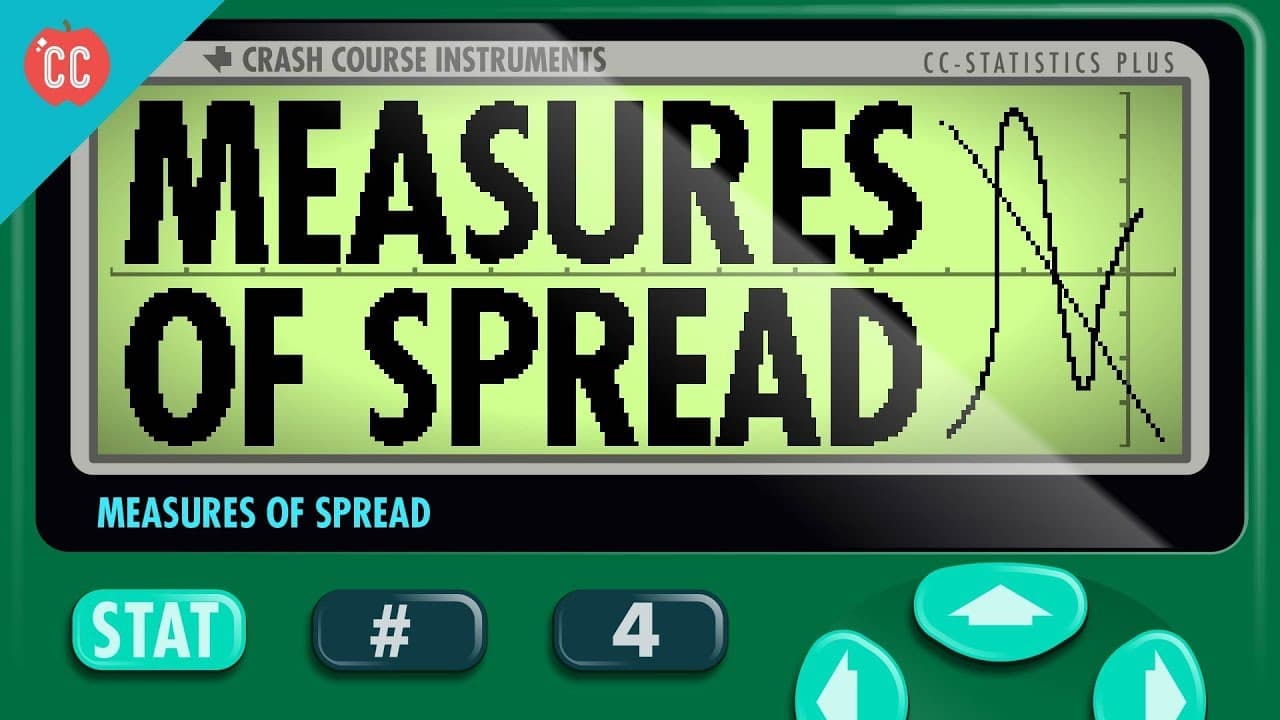
Measures of Spread: Crash Course Statistics #4
TL;DR
Explains statistical measures of spread and their real-life applications.
Transcript
Hi I’m Adriene Hill, and welcome to Crash Course Statistics. So in the last episode we talked about the “middle” of sets of data, what statisticians call the central tendency. Today...we’re heading to the data on both sides of that middle. What statisticians call “measures of spread”. Not to be confused with how I gauge the quality of my peanut but... Read More
Key Insights
- Measures of spread, such as range, interquartile range, variance, and standard deviation, help us understand data dispersion around the mean or median.
- These measures are used in various fields like economics, investing, gambling, and polling to assess data variability and reliability.
- The range provides the distance between the smallest and largest data points, indicating overall data spread but not core audience insights.
- The interquartile range (IQR) focuses on the middle 50% of data, offering a clearer picture of the core audience or data group.
- Variance considers all data points to gauge overall data spread, but its units are squared, making interpretation less intuitive.
- Standard deviation, the square root of variance, offers a more understandable unit, showing average deviation from the mean.
- Extreme values or outliers can significantly affect measures like mean, variance, and standard deviation, skewing data interpretation.
- Comparing oneself to an average can be misleading; understanding data spread provides a more accurate self-assessment.
Install to Summarize YouTube Videos and Get Transcripts
Explore YouTube Video Summarizer or Get YouTube Transcript Extractor
Questions & Answers
Q: What are measures of spread?
Measures of spread, also known as measures of dispersion, describe how data is distributed around a central value, such as the mean or median. They help determine how well these central values represent the data and how reliable conclusions drawn from the data might be. Common measures include range, interquartile range, variance, and standard deviation.
Q: Why are measures of spread important in real life?
Measures of spread are crucial in real life because they provide insights into data variability and reliability. They are used by economists to study income inequality, by investors to identify price bubbles, by gamblers to assess potential gains or losses, and by pollsters to calculate margins of error. Understanding data spread helps in making informed decisions based on statistical analysis.
Q: How does the range measure data spread?
The range measures data spread by calculating the difference between the largest and smallest values in a dataset. It provides a simple way to understand the extent of data dispersion. However, it only considers the two extreme values and does not provide information about the distribution of the remaining data points, which can limit its usefulness in some analyses.
Q: What is the interquartile range and how is it used?
The interquartile range (IQR) measures the spread of the middle 50% of data points by calculating the difference between the first quartile (Q1) and the third quartile (Q3). It helps identify the core group within a dataset, providing insights into the primary audience or main data cluster. Unlike the range, the IQR is less affected by outliers and extreme values.
Q: How does variance help in understanding data spread?
Variance provides a measure of data spread by considering the squared deviations of each data point from the mean. It gives an overall sense of data variability, with larger variances indicating more spread out data. However, since variance uses squared units, its interpretation can be less intuitive, necessitating the use of standard deviation for clearer understanding.
Q: What role does standard deviation play in data analysis?
Standard deviation is a key measure of spread that indicates the average amount by which data points deviate from the mean. It is the square root of variance, providing a more intuitive measure with the same units as the original data. Standard deviation helps assess the reliability of the mean as a representative value and is commonly used in statistical analysis.
Q: How do outliers affect measures of spread?
Outliers, or extreme values, can significantly impact measures of spread such as mean, variance, and standard deviation. They can skew the mean, inflate variance, and increase standard deviation, leading to potentially misleading interpretations of data. It is important to identify and consider the influence of outliers when analyzing data to ensure accurate conclusions.
Q: What is the episode's takeaway on comparing oneself to averages?
The episode suggests that comparing oneself to averages can be misleading because averages alone do not account for data variability. Measures of spread provide a more complete picture by showing how data is distributed around the average. Understanding data spread can prevent false perceptions of success or failure and encourage more accurate self-assessment.
Summary & Key Takeaways
-
This episode of Crash Course Statistics explores measures of spread, such as range, interquartile range, variance, and standard deviation, which help describe how data is dispersed around a central point. These measures are crucial for understanding the reliability of statistical conclusions.
-
Real-life applications of measures of spread include analyzing test scores, income inequality, stock price bubbles, and gambling outcomes. The episode emphasizes the importance of these measures in providing a deeper understanding of data beyond just central tendencies.
-
The episode also discusses the impact of outliers on statistical measures and highlights the potential pitfalls of comparing oneself to averages. It encourages a more nuanced understanding of data by considering measures of spread alongside mean or median values.
Read in Other Languages (beta)
Share This Summary 📚
Summarize YouTube Videos and Get Video Transcripts with 1-Click
Try YouTube Summary with ChatGPT & Claude or YouTube Transcript Generator
Explore More Summaries from CrashCourse 📚




Summarize YouTube Videos and Get Video Transcripts with 1-Click
Try YouTube Summary with ChatGPT & Claude or YouTube Transcript Generator