How Far Beyond Earth Could Humanity Spread?
TL;DR
Exploring humanity's potential spread across the universe and its limitations.
Transcript
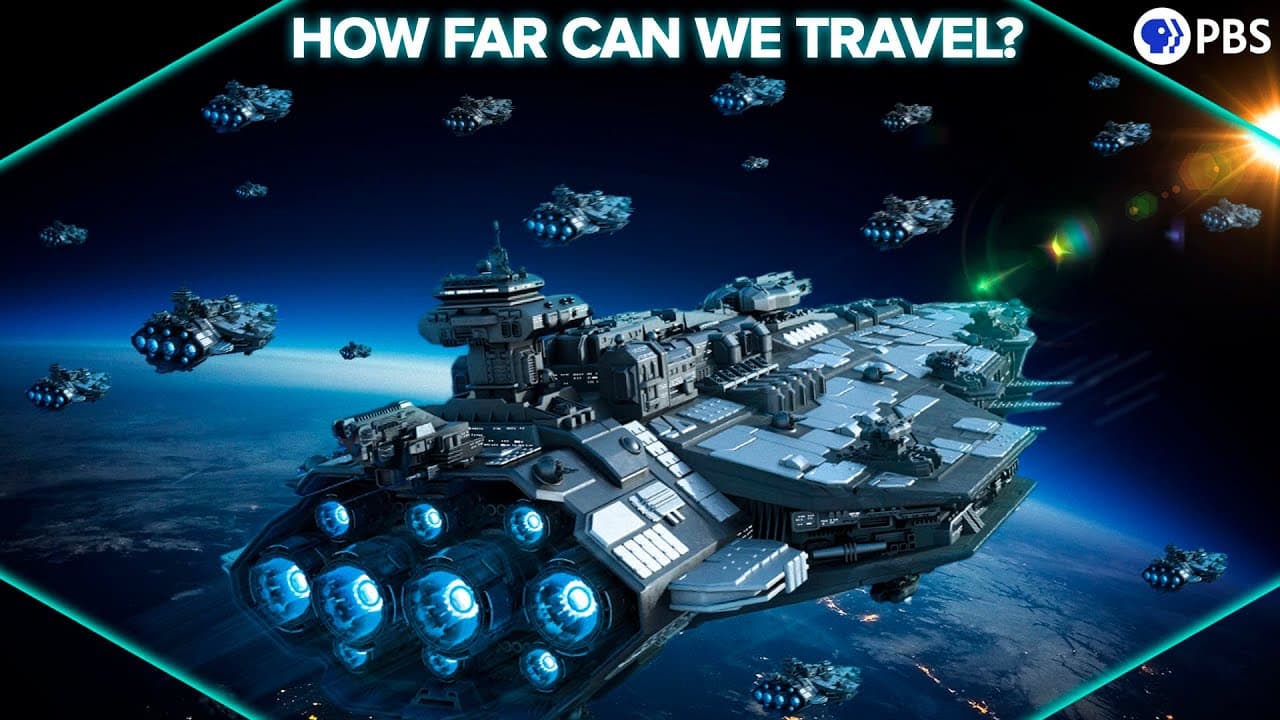
We humans have always been explorers. The great civilizations that have arisen across the world are owed to our restless ancestors. These days, there’s not much of Earth left to explore. But if we look up, there’s a whole universe out there waiting for us. Future generations may one day explore the cosmos and even settle entire other galaxies. ... Read More
Key Insights
- Humanity's exploration history reflects a deep-rooted drive to discover new frontiers, now extending to the cosmos.
- Intergalactic travel at significant fractions of light speed is assumed possible, allowing expansion across galaxies.
- The universe's accelerating expansion limits how far humanity can spread, defining an 'affectable universe.'
- The 'affectable universe' could potentially include 20 billion galaxies and a sextillion stars.
- Procrastination in space exploration leads to a shrinking 'affectable universe,' with galaxies slipping beyond reach.
- The era of isolation will eventually confine humanity to a local cluster of galaxies, limiting further expansion.
- Future human explorers will occupy causally disconnected regions, leading to cultural and evolutionary divergence.
- Effective communication across expanding civilizations decreases over time, emphasizing the need for strategic planning.
Install to Summarize YouTube Videos and Get Transcripts
Explore YouTube Video Summarizer or Get YouTube Transcript Extractor
Questions & Answers
Q: What is the 'affectable universe'?
The 'affectable universe' refers to the maximum region of space that humanity could potentially influence or colonize. It is defined by the current cosmological event horizon, which is about 16.5 billion light years in radius. This sphere includes approximately 20 billion galaxies and a sextillion stars, assuming near light-speed travel is possible.
Q: How does the universe's expansion affect humanity's potential spread?
The universe's accelerating expansion, driven by dark energy, limits humanity's potential spread by causing galaxies to move away from each other at increasing speeds. This expansion defines the cosmological event horizon, beyond which galaxies become permanently unreachable. Every year of delay in space exploration results in three galaxies slipping beyond our reach.
Q: What is the 'era of isolation' in cosmic exploration?
The 'era of isolation' refers to a future period when humanity's ability to spread across the universe is severely limited. As the universe continues to expand, the cosmological event horizon shrinks, eventually confining humanity to a local cluster of galaxies. This isolation will prevent further expansion and limit communication between distant regions.
Q: How does intergalactic travel impact future human civilizations?
Intergalactic travel will lead to human civilizations occupying causally disconnected regions of space. As explorers spread across the universe, they will be beyond each other's event horizons, preventing communication. Over billions of years, these isolated outposts will likely diverge culturally and evolutionarily, resulting in distinct civilizations.
Q: What challenges do expanding civilizations face in maintaining communication?
Expanding civilizations face significant challenges in maintaining communication due to the vast distances and the universe's expansion. As colonies spread, the ability to send and receive messages decreases. For settlers traveling at near light speed, most will never hear back from Earth. Effective communication strategies are crucial for successful expansion.
Q: What role does strategic planning play in humanity's cosmic future?
Strategic planning is essential for maximizing humanity's potential spread across the universe. Given the challenges of communication and the shrinking 'affectable universe,' careful consideration of when and how to launch interstellar missions is crucial. Planning ensures that humanity's cosmic legacy is sustainable and successful, avoiding premature isolation.
Q: How does the 'ultimately observable universe' differ from the 'affectable universe'?
The 'ultimately observable universe' encompasses all regions that future human explorers could potentially observe, combining the past light cones of all possible explorers. It is nearly 160 billion light years across, much larger than the 'affectable universe,' which is limited to the regions humanity could influence or colonize. However, communication across these vast distances remains impossible.
Q: What is the significance of the cosmological event horizon?
The cosmological event horizon marks the boundary beyond which galaxies become permanently unreachable due to the universe's expansion. It defines the limits of the 'affectable universe' and influences humanity's potential spread across the cosmos. Crossing this horizon allows for infinite travel, but communication and influence remain constrained within its boundaries.
Summary & Key Takeaways
-
Humanity's innate desire to explore new frontiers has led to the consideration of intergalactic travel. Assuming we can travel at near light speed, humanity could potentially spread across a vast 'affectable universe' of 20 billion galaxies. Yet, the universe's accelerating expansion imposes limits on this potential spread.
-
The 'affectable universe' is defined by the current cosmological event horizon, beyond which galaxies will slip away due to cosmic expansion. While light-speed travel would allow reaching these galaxies, procrastination in launching interstellar missions results in lost opportunities, with three galaxies becoming unreachable every year.
-
In the distant future, humanity will face an era of isolation, restricted to a local cluster of galaxies. As explorers spread, they will occupy causally disconnected regions, leading to cultural divergence. Communication challenges emphasize the importance of strategic planning for a successful cosmic legacy.
Read in Other Languages (beta)
Share This Summary 📚
Summarize YouTube Videos and Get Video Transcripts with 1-Click
Try YouTube Summary with ChatGPT & Claude or YouTube Transcript Generator
Explore More Summaries from PBS Space Time 📚




Summarize YouTube Videos and Get Video Transcripts with 1-Click
Try YouTube Summary with ChatGPT & Claude or YouTube Transcript Generator