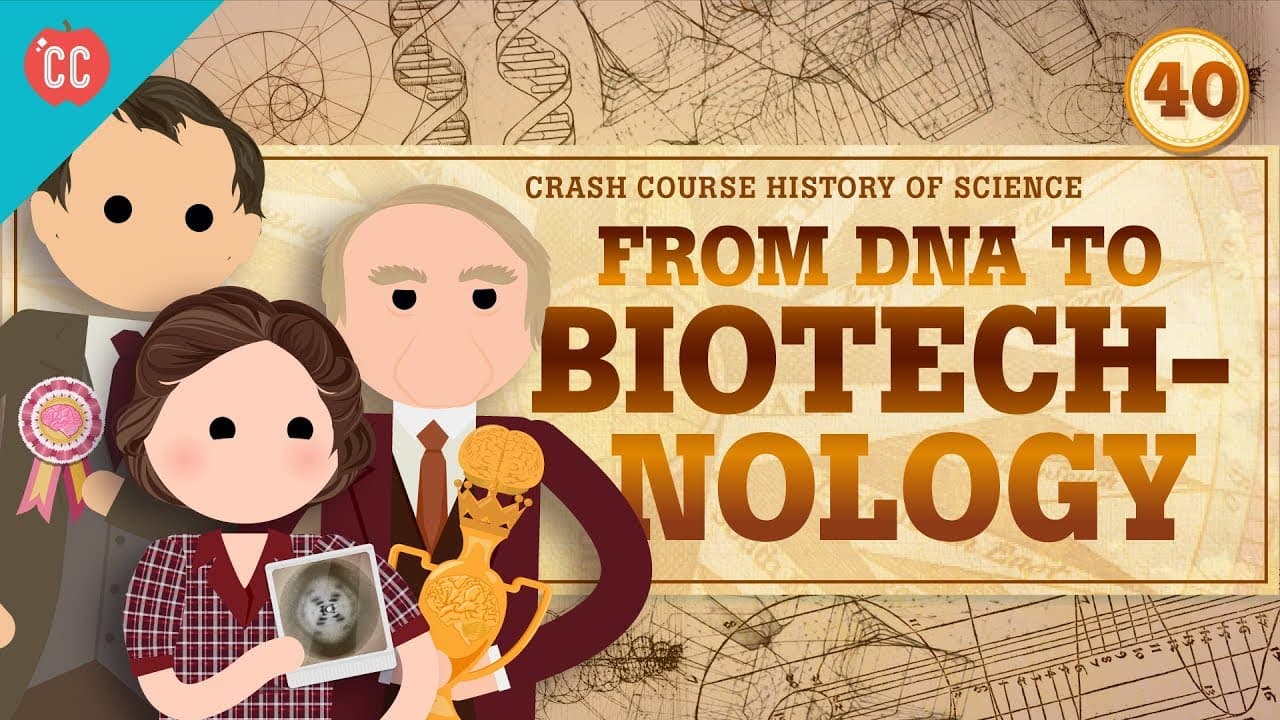
Biotechnology: Crash Course History of Science #40
TL;DR
Scientists in the mid-1900s made significant discoveries about DNA, its structure, and the genetic code, leading to advancements in biotechnology.
Transcript
As some scientists worked to control life at the scale of global agriculture, others worked in a different direction. The mid-1900s was a period of reexamination of one of our big questions: what, exactly, is life? Let's talk DNA and Biotech!!! [Intro Music Plays] Although the story is complex, it’s often simplified to one big “discovery” of DNA ma... Read More
Key Insights
- ❓ The discovery of DNA's structure in 1953 revolutionized biology and provided a molecular basis for understanding evolution.
- 👻 The deciphering of the genetic code allowed scientists to identify the relationship between DNA and the production of proteins.
- 🥺 Biotechnology emerged in the early 1970s with the ability to splice and transfer genes, leading to advancements in medicine and agriculture.
- ❓ The Supreme Court ruling in Diamond v. Chakrabarty solidified the recognition of genetically modified organisms as patentable technologies.
Install to Summarize YouTube Videos and Get Transcripts
Explore YouTube Video Summarizer or Get YouTube Transcript Extractor
Questions & Answers
Q: Who were the key scientists involved in the discovery of DNA's structure?
James Watson and Francis Crick are often credited with the discovery of DNA's double helix structure. However, other scientists such as Rosalind Franklin and Maurice Wilkins also played significant roles in providing crucial experimental evidence.
Q: How do mutations in DNA contribute to evolution?
Mutations in DNA are copy errors that occur during cell division. These mutations introduce genetic variations, which can lead to the evolution of new traits over time. Natural selection then acts on these variations, determining which traits are advantageous for survival and reproduction.
Q: How did the discovery of DNA impact the field of biotechnology?
The discovery of DNA's structure and the deciphering of the genetic code paved the way for biotechnology. Scientists could now identify specific genes responsible for certain traits and manipulate and transfer those genes between organisms. This led to the production of synthetic insulin, the creation of GMOs, and other advancements in the field.
Q: How did the Supreme Court ruling in Diamond v. Chakrabarty impact biotechnology?
The Supreme Court ruling in Diamond v. Chakrabarty allowed for the patenting of bioengineered lifeforms. This decision acknowledged that genetically modified organisms were a technology and opened up opportunities for industries and investors to capitalize on biotechnology advancements.
Summary & Key Takeaways
-
In the mid-1900s, scientists sought to understand the structure and function of DNA, a molecule responsible for transmitting genetic information.
-
The discovery of DNA's double helix structure by James Watson and Francis Crick in 1953 revolutionized biology and provided a basis for understanding evolution.
-
Advances in biotechnology allowed for the manipulation and transfer of genes, leading to the production of synthetic insulin and the creation of genetically modified organisms (GMOs).
Read in Other Languages (beta)
Share This Summary 📚
Summarize YouTube Videos and Get Video Transcripts with 1-Click
Try YouTube Summary with ChatGPT & Claude or YouTube Transcript Generator
Explore More Summaries from CrashCourse 📚

Summarize YouTube Videos and Get Video Transcripts with 1-Click
Try YouTube Summary with ChatGPT & Claude or YouTube Transcript Generator