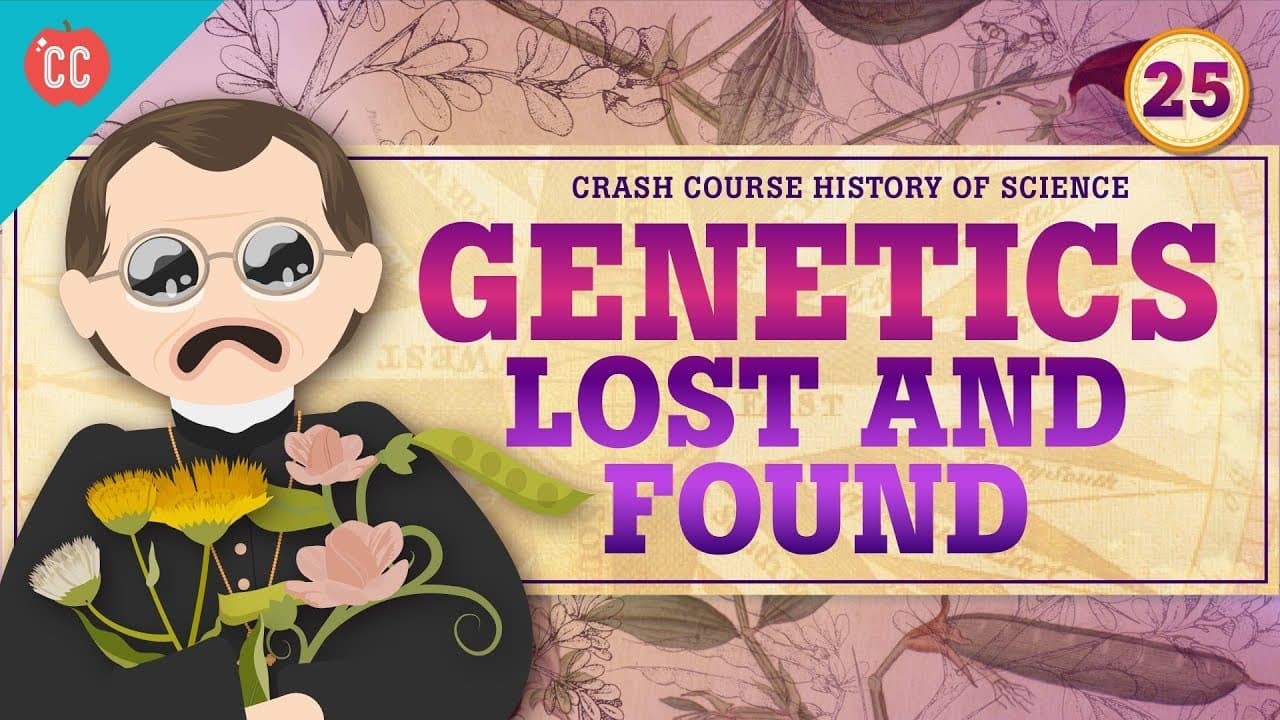
Genetics - Lost and Found: Crash Course History of Science #25
TL;DR
Gregor Mendel's genetic discoveries were initially overlooked but later revolutionized science.
Transcript
Sometimes, scientists realize they are doing revolutionary work, and the world agrees. Darwin and Pasteur, for example, were massive celebrities. Other times, revolutionaries toil quietly for decades, leaving behind work that the rest of us appreciate only much later. This is the story of Gregor Mendel and the birth, loss, and rebirth of classical ... Read More
Key Insights
- Gregor Mendel, a monk, conducted groundbreaking experiments on pea plants, establishing foundational principles of genetics, including dominance and recessiveness.
- Mendel's work was initially ignored due to his isolation, lack of promotion, and bad luck with hawkweed experiments that didn't support his theories.
- Mendel's findings were rediscovered around 1900 by multiple scientists, leading to the establishment of genetics as a scientific field.
- The rediscovery of Mendel's work coincided with the rise of geneticists who challenged the blending theory of inheritance, promoting Mendelian inheritance instead.
- Thomas Hunt Morgan's Fly Room experiments at Columbia University further advanced genetics by developing linkage maps and using fruit flies as model organisms.
- Barbara McClintock made significant contributions to genetics, discovering gene transposition and creating the first genetic map for maize, though her work was initially met with skepticism.
- McClintock was later recognized with a Nobel Prize for her discovery of jumping genes, highlighting the importance of her contributions to genetics.
- Despite Mendel's initial obscurity, his work laid the foundation for modern genetics, influencing subsequent research and discoveries in the field.
Install to Summarize YouTube Videos and Get Transcripts
Explore YouTube Video Summarizer or Get YouTube Transcript Extractor
Questions & Answers
Q: What were the main principles established by Gregor Mendel's experiments?
Gregor Mendel's experiments established several key principles of genetics, including the concepts of dominant and recessive traits. He discovered that certain traits are inherited independently of others, leading to the formulation of the Laws of Mendelian Inheritance: the Law of Segregation, the Law of Independent Assortment, and the Law of Dominance. These principles provided a foundation for the field of genetics.
Q: Why was Mendel's work initially overlooked by the scientific community?
Mendel's work was initially overlooked due to several factors: his isolation in a remote abbey, his focus on practical plant breeding rather than grand theories, and bad luck with hawkweed experiments that didn't support his theories. Additionally, Mendel's promotion to abbot limited his ability to engage in scientific debates or publish further work, contributing to the neglect of his findings.
Q: How was Mendel's work rediscovered, and what impact did it have?
Mendel's work was rediscovered around 1900 by four different researchers who independently recognized the significance of his experiments on trait heritability. This rediscovery led to the establishment of genetics as a scientific field, challenging the prevailing blending theory of inheritance and promoting Mendelian inheritance. It laid the groundwork for future research and discoveries in genetics.
Q: What contributions did Thomas Hunt Morgan make to the field of genetics?
Thomas Hunt Morgan made significant contributions to genetics through his experiments with fruit flies in the Fly Room at Columbia University. His work led to the development of genetic linkage maps, which helped identify the order of genes on chromosomes. Morgan's research on mutations and genetic inheritance in fruit flies was instrumental in advancing the understanding of heredity, earning him a Nobel Prize in 1933.
Q: What was Barbara McClintock's role in advancing genetic research?
Barbara McClintock played a crucial role in advancing genetic research through her discovery of gene transposition, or the ability of genes to change positions on chromosomes. She created the first genetic map for maize and explained how genes control physical traits across generations. Despite initial skepticism from her peers, McClintock's work was later recognized with a Nobel Prize, highlighting her significant contributions to genetics.
Q: How did Mendel's rediscovery influence the scientific community's understanding of heredity?
Mendel's rediscovery influenced the scientific community by challenging the blending theory of inheritance and promoting Mendelian inheritance, which emphasized discrete units of heredity, or genes. This shift in understanding paved the way for the development of genetics as a scientific discipline, influencing subsequent research and discoveries in the field and providing a framework for studying genetic inheritance.
Q: Why did Mendel's experiments with hawkweed fail to support his theories?
Mendel's experiments with hawkweed failed to support his theories because hawkweed reproduces asexually, unlike peas, humans, or other organisms that reproduce sexually. Asexual reproduction does not involve the crossing of two parents' traits, which meant that Mendel could not observe the same patterns of dominant and recessive traits that he had identified in his pea plant experiments. This led to difficulties in reproducing his earlier results.
Q: What role did model organisms play in the advancement of genetic research?
Model organisms, like the fruit fly Drosophila melanogaster, played a crucial role in advancing genetic research by providing a standardized and easily manipulated system for studying genetic inheritance. Researchers like Thomas Hunt Morgan used model organisms to conduct experiments on mutations and genetic linkage, facilitating the development of genetic maps and enhancing the understanding of heredity. Model organisms continue to be valuable tools in genetic research today.
Summary & Key Takeaways
-
Gregor Mendel's pioneering work on pea plants established key principles of genetics, including the concepts of dominant and recessive traits. Despite his significant findings, Mendel's work was largely ignored during his lifetime due to his isolation and lack of promotion.
-
Around 1900, Mendel's research was rediscovered by several scientists, leading to the establishment of genetics as a scientific discipline. This rediscovery challenged the prevailing blending theory of inheritance and promoted Mendelian inheritance.
-
Further advancements in genetics were made by researchers like Thomas Hunt Morgan and Barbara McClintock. Morgan's work on fruit flies helped develop genetic linkage maps, while McClintock's discovery of gene transposition earned her a Nobel Prize, underscoring her contributions to the field.
Read in Other Languages (beta)
Share This Summary 📚
Summarize YouTube Videos and Get Video Transcripts with 1-Click
Try YouTube Summary with ChatGPT & Claude or YouTube Transcript Generator
Explore More Summaries from CrashCourse 📚




Summarize YouTube Videos and Get Video Transcripts with 1-Click
Try YouTube Summary with ChatGPT & Claude or YouTube Transcript Generator