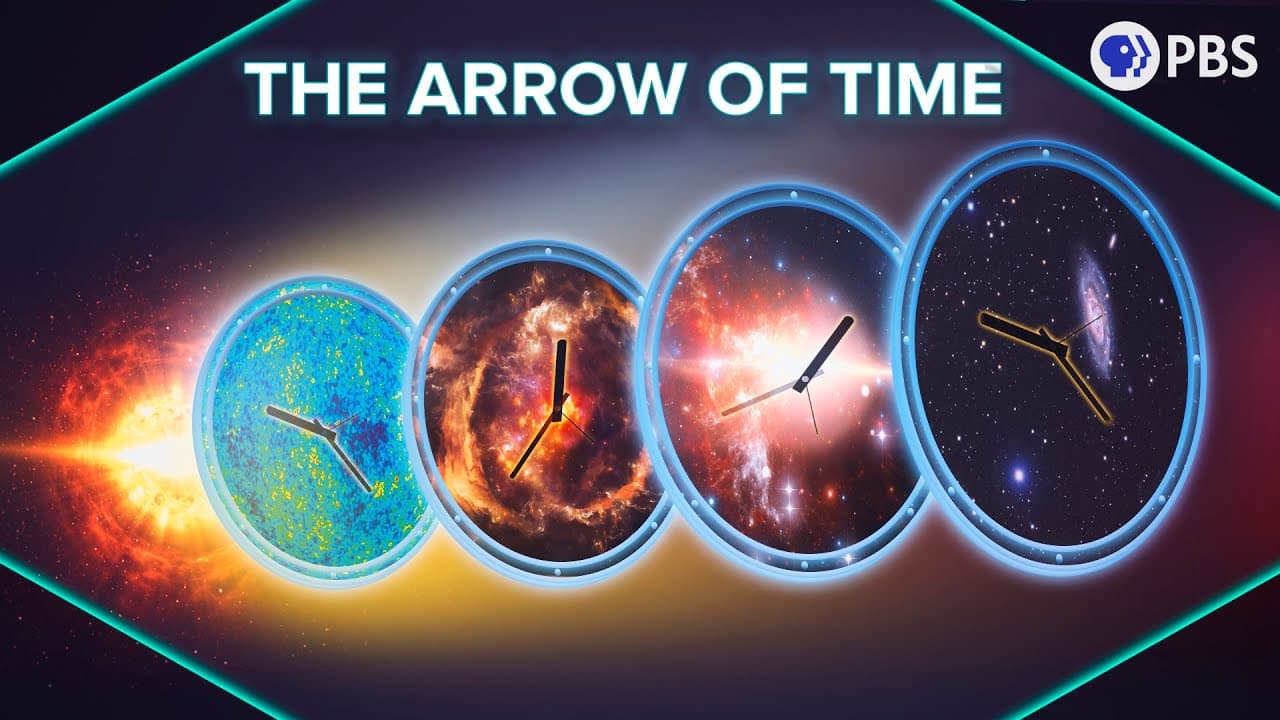
The Arrow of Time and How to Reverse It
TL;DR
Explores why time seems to flow in one direction due to entropy.
Transcript
Ever wish you could travel backwards in time and do things differently? Good news: the laws of physics seem to say traveling backwards in time is the same as traveling forwards. So why do we seem to be stuck in this inexorable flow towards the future? It's time to begin our journey towards really understanding time. The laws of physics describe how... Read More
Key Insights
- The laws of physics are time-symmetric, meaning they do not prefer a direction of time, allowing for theoretical time reversal.
- Entropy, as described by the second law of thermodynamics, dictates a preferred direction of time by always increasing or remaining constant.
- Entropy measures the randomness of energy distribution in a system, and tends to increase over time, leading to more disorder.
- The block universe concept visualizes time as a dimension similar to space, where time slices exist a-temporally.
- The arrow of time emerges from an entropy minimum, with the universe evolving towards higher entropy on either side of this point.
- The expansion of the universe, seen in galaxies moving apart, reflects increasing entropy on a cosmic scale.
- The Big Bang represents a low-entropy state, providing a starting point for the universe's entropy increase.
- The connection between entropy and human perception of time involves deeper concepts like information theory and quantum entanglement.
Install to Summarize YouTube Videos and Get Transcripts
Explore YouTube Video Summarizer or Get YouTube Transcript Extractor
Questions & Answers
Q: Why do the laws of physics not distinguish between past and future?
The laws of physics, including those governing quantum mechanics and general relativity, are time-symmetric, meaning they work the same whether time is moving forwards or backwards. This symmetry implies that, theoretically, reversing the motion of all particles would allow them to retrace their steps perfectly, indicating no inherent preference for a time direction in these laws.
Q: What role does entropy play in determining the direction of time?
Entropy, as explained by the second law of thermodynamics, always increases or stays constant over time, providing a statistical arrow of time. It measures how energy is distributed within a system, with higher entropy indicating a more random distribution. This tendency for entropy to increase dictates a preferred direction of time, as systems evolve from ordered to disordered states.
Q: How does the block universe concept relate to time?
The block universe concept treats time as a dimension similar to space, where the universe exists as a series of time slices. This perspective suggests that time does not flow but is experienced as sequences of these slices. The concept helps illustrate how time's arrow emerges from the arrangement of these slices, particularly when considering entropy and its effects on system evolution.
Q: Why is the Big Bang considered a low-entropy state?
The Big Bang is considered a low-entropy state because it represents a highly ordered and dense arrangement of particles. As the universe expanded from this initial state, entropy increased, leading to the current state of the universe with galaxies moving apart. This initial low-entropy condition sets the stage for the observed increase in entropy and the perceived direction of time.
Q: What is an entropy fluctuation and its significance?
An entropy fluctuation refers to a temporary decrease in entropy within a system, which can occur due to random alignments of particles. Although rare and typically small-scale, these fluctuations highlight the statistical nature of entropy changes. They illustrate how, despite local decreases, the overall trend in a large system is towards increasing entropy, reinforcing the arrow of time.
Q: How does the universe's expansion relate to entropy?
The universe's expansion is a manifestation of increasing entropy on a cosmic scale. As galaxies move apart, the universe becomes less ordered, reflecting the second law of thermodynamics. This expansion from a denser, more ordered state, such as the Big Bang, aligns with the concept of increasing entropy and supports the observed direction of time.
Q: What is the connection between entropy and human perception of time?
The connection between entropy and human perception of time involves how we process and remember events. As entropy increases, it aligns with our experience of time flowing forwards, where we remember past events but not future ones. This relationship may involve deeper concepts like information theory and quantum entanglement, which require further exploration to fully understand.
Q: What are some potential implications of a symmetric universe?
In a symmetric universe, where entropy increases in both time directions from a low-entropy point, time could appear to run in reverse before the Big Bang. This scenario suggests a universe where both forward and backward time directions are possible, challenging our conventional understanding of time's arrow. However, this remains speculative without evidence of such a symmetric universe.
Summary & Key Takeaways
-
The video discusses the concept of time's arrow, explaining that while the laws of physics do not inherently favor a direction of time, the second law of thermodynamics introduces a preferred direction through increasing entropy.
-
Entropy is a measure of energy distribution randomness, and the tendency for entropy to increase over time leads to the perception of time flowing forwards, with the universe expanding as an example of this process on a cosmic scale.
-
The video also introduces the block universe concept, where time is viewed as a dimension, and explores the implications of a low-entropy starting point, such as the Big Bang, on the directionality of time.
Read in Other Languages (beta)
Share This Summary 📚
Summarize YouTube Videos and Get Video Transcripts with 1-Click
Try YouTube Summary with ChatGPT & Claude or YouTube Transcript Generator
Explore More Summaries from PBS Space Time 📚


Summarize YouTube Videos and Get Video Transcripts with 1-Click
Try YouTube Summary with ChatGPT & Claude or YouTube Transcript Generator