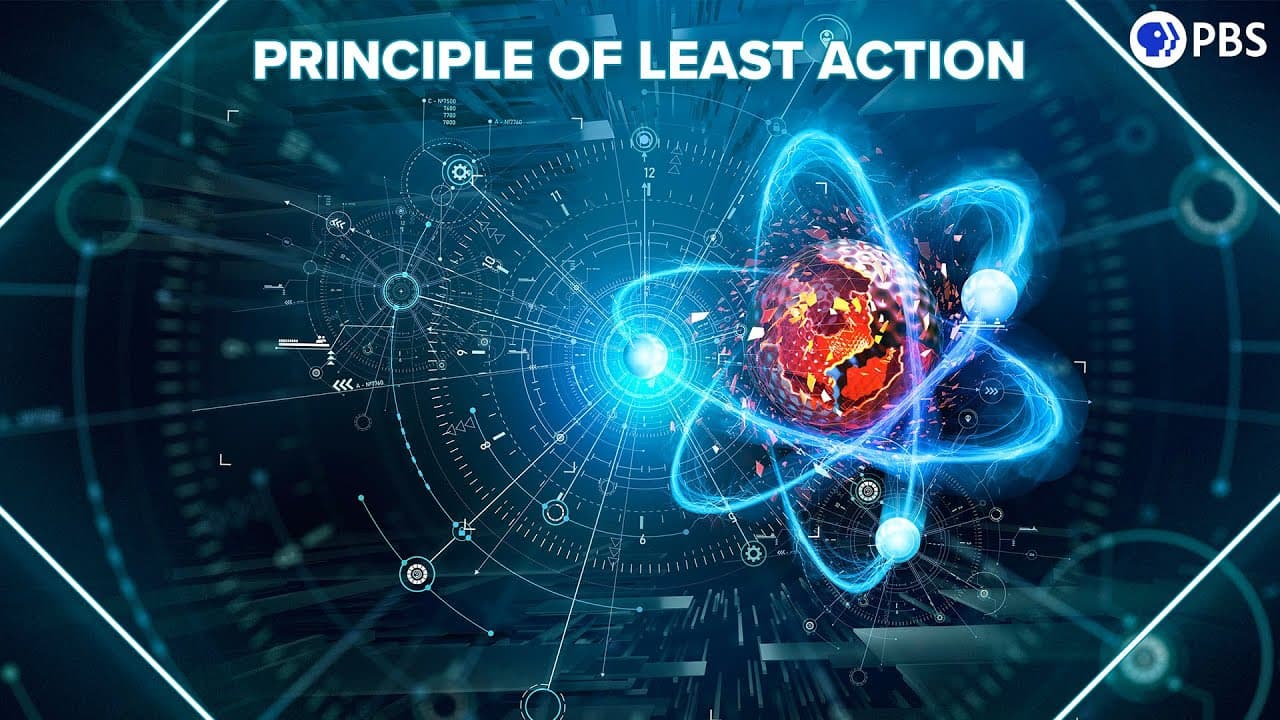
Is ACTION The Most Fundamental Property in Physics?
TL;DR
Explores the role of Action in physics and its implications.
Transcript
Thank you to NORD VPN for supporting PBS. It’s about time we discussed an obscure concept in physics that may be more fundamental than energy and entropy and perhaps time itself. Ready? Action. In order to wrench the laws of physics from the reluctant clutches of nature, we need to watch for clues - patterns in its behavior that can reveal deeper t... Read More
Key Insights
- The concept of Action in physics may be more fundamental than energy, entropy, or even time, providing a new perspective on natural laws.
- Heron of Alexandria's observation on light's path led to the development of minimizing principles, crucial in understanding physics.
- Joseph-Louis Lagrange introduced the Principle of Least Action, simplifying complex Newtonian mechanics by focusing on energy rather than forces.
- The Principle of Least Action extends to Einstein's General Relativity, showing its compatibility with modern physics through proper time.
- In quantum mechanics, Richard Feynman's path integral formulation uses the quantum analog of Action to predict particle behavior.
- Configuration space ties different physics realms together, representing all possible trajectories for an object given its constraints.
- The Standard Model Lagrangian, derived from quantum fields, helps predict the behavior of particles, rooted in the principles of Action.
- The exploration of Action's role in physics continues to inspire new discoveries, highlighting its potential as a fundamental property of the universe.
Install to Summarize YouTube Videos and Get Transcripts
Explore YouTube Video Summarizer or Get YouTube Transcript Extractor
Questions & Answers
Q: What is the Principle of Least Action?
The Principle of Least Action is a fundamental concept in physics, proposing that the path taken by a system between two states is the one for which the action is minimized or stationary. This principle simplifies the complex equations of motion by focusing on energy rather than forces, unifying classical and modern physics.
Q: How does the Principle of Least Action relate to Einstein's General Relativity?
In Einstein's General Relativity, the Principle of Least Action remains applicable by incorporating relativistic corrections, such as proper time. This adaptation shows the principle's consistency across classical and modern physics, allowing for the accurate prediction of planetary orbits and demonstrating its fundamental role in understanding the universe.
Q: What role does Action play in quantum mechanics?
In quantum mechanics, Action is integral to Feynman's path integral formulation, which predicts particle behavior by considering all possible paths a particle could take. This quantum analog of Action calculates phase shifts along paths, with the most likely paths resulting in constructive interference, highlighting Action's fundamental role in quantum theory.
Q: What is configuration space in physics?
Configuration space represents all possible trajectories an object can take given its constraints, such as potential and kinetic energies. It serves as a unifying concept across different physics realms, from classical mechanics to quantum mechanics, demonstrating the interconnectedness of physical laws and the potential of Action as a fundamental property.
Q: How did Heron of Alexandria contribute to the understanding of light's path?
Heron of Alexandria observed that light follows the shortest path between two points, proposing a Principle of Least Distance. This observation laid the groundwork for minimizing principles in physics, leading to Fermat's Principle of Least Time and eventually the broader Principle of Least Action, influencing the understanding of natural laws.
Q: What is the significance of Feynman's path integral formulation?
Feynman's path integral formulation revolutionized quantum mechanics by using the quantum analog of Action to predict particle behavior. It considers all possible paths a particle could take, with the most probable paths resulting from constructive interference. This approach unifies classical and quantum physics, highlighting Action's fundamental importance.
Q: How does the Standard Model Lagrangian relate to Action?
The Standard Model Lagrangian, derived from quantum fields, describes the evolution of all known particles, rooted in the principles of Action. It allows for the prediction of particle behavior across different physics realms, emphasizing the fundamental role of Action in understanding the universe's underlying structure and laws.
Q: What insights does the concept of Action provide about the universe?
The concept of Action offers a unifying perspective on natural laws, suggesting it may be more fundamental than energy, entropy, or time. Its applicability across classical, relativistic, and quantum physics highlights its potential as a fundamental property, guiding the understanding of space-time and the behavior of particles in the universe.
Summary & Key Takeaways
-
The video discusses the concept of Action in physics, suggesting it may be more fundamental than other known properties like energy or time. It traces the historical development of minimizing principles, from Heron of Alexandria to Lagrange's Principle of Least Action, and its applications in classical and modern physics.
-
The Principle of Least Action is explored in the context of Einstein's General Relativity, showing its relevance and adaptability in modern physics. By incorporating relativistic corrections, the principle remains consistent, furthering our understanding of the universe and the nature of Action.
-
In quantum mechanics, the path integral formulation by Richard Feynman uses the quantum analog of Action to predict particle behavior. This approach, along with the concept of configuration space, unifies different physics realms, highlighting the potential of Action as a fundamental property of the universe.
Read in Other Languages (beta)
Share This Summary 📚
Summarize YouTube Videos and Get Video Transcripts with 1-Click
Try YouTube Summary with ChatGPT & Claude or YouTube Transcript Generator
Explore More Summaries from PBS Space Time 📚
Summarize YouTube Videos and Get Video Transcripts with 1-Click
Try YouTube Summary with ChatGPT & Claude or YouTube Transcript Generator