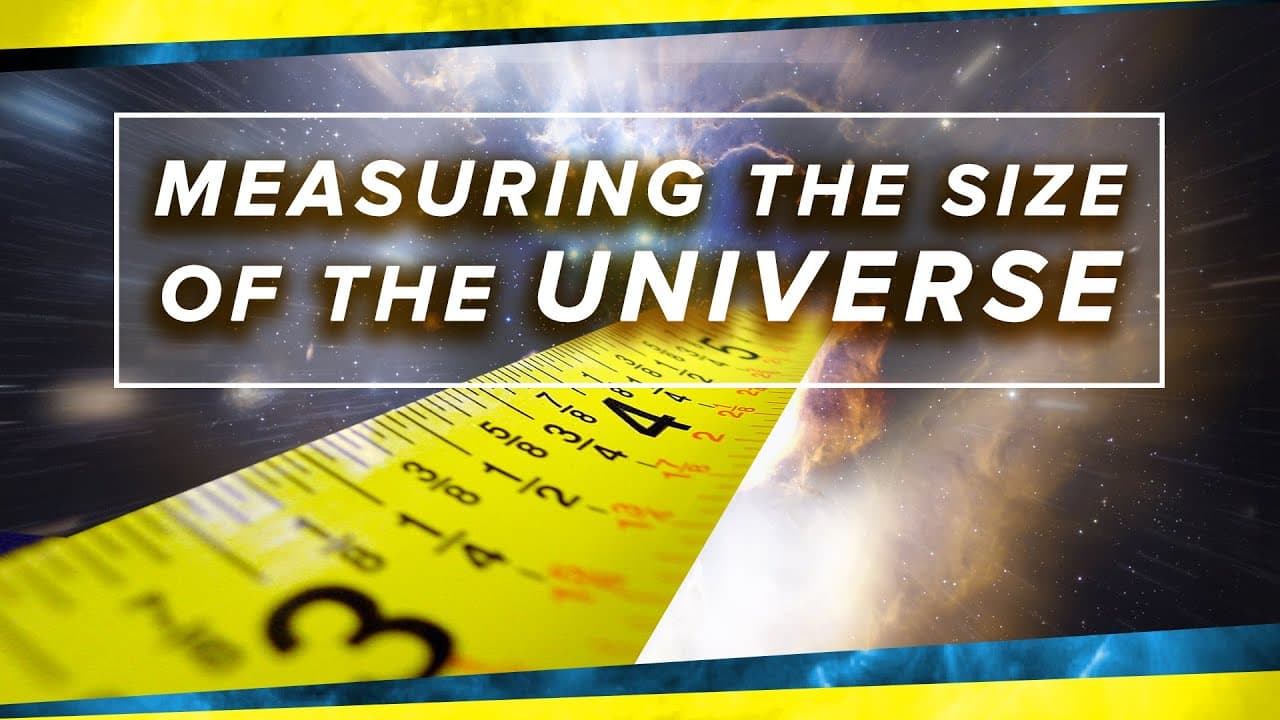
How Do You Measure the Size of the Universe?
TL;DR
Explains how we measure the universe's size using light and expansion.
Transcript
[MUSIC PLAYING] The universe is huge. We know this. But how huge and how can we possibly measure the size of the universe? Put it like this. It's common to put astronomical distances in light years. That's the distance light travels in a year or about 9 trillion kilometers. Given that, here's some facts to blow your mind. The diameter of the solar ... Read More
Key Insights
- Astronomical distances are often expressed in light years, with the observable universe spanning about 90 billion light years in diameter.
- The universe's size is calculated based on the age of the universe, approximately 13.8 billion years, and the expansion of space.
- Space expands like rising dough, with galaxies moving apart not by traveling but by the expansion of space itself.
- Cosmological redshift is a key tool for measuring the universe's expansion, as it shows how light stretches over time.
- The distance-redshift relationship helps determine the universe's expansion history, which is crucial for calculating its size.
- The observable universe is limited to the regions from which light or gravitational waves have reached us.
- While the observable universe is vast, there is an unobservable part beyond it, where light hasn't reached us yet.
- The discussion touches on the Fermi paradox, questioning why we haven't detected any signs of extraterrestrial life given the universe's vastness.
Install to Summarize YouTube Videos and Get Transcripts
Explore YouTube Video Summarizer or Get YouTube Transcript Extractor
Questions & Answers
Q: How is the size of the universe measured?
The size of the universe is measured using light years and the concept of the observable universe. By calculating the age of the universe, approximately 13.8 billion years, and understanding the expansion of space, astronomers determine the observable universe to be about 90 billion light years in diameter.
Q: What is cosmological redshift?
Cosmological redshift is a phenomenon where the wavelength of light stretches as it travels through expanding space, making it appear redder. This shift is a critical tool for measuring the universe's expansion, as it provides a 'fingerprint' of how space has expanded over time, helping to determine distances to faraway galaxies.
Q: Why is space compared to rising dough?
Space is compared to rising dough to illustrate how galaxies move apart due to the expansion of space itself, rather than moving through space. In this analogy, galaxies are like raisins in dough, which move apart as the dough rises, representing the expanding universe where galaxies spread out as space itself grows.
Q: What is the significance of the distance-redshift relationship?
The distance-redshift relationship is significant because it helps astronomers understand the expansion history of the universe. By measuring the redshift and distances of faraway galaxies, scientists can determine how fast the universe was expanding at different times, which is essential for calculating the universe's size and understanding its evolution.
Q: What is the observable universe?
The observable universe is the part of the universe that we can see or detect, limited to regions from which light or gravitational waves have reached us. It spans about 90 billion light years in diameter, based on the universe's age and the expansion of space, and represents the finite portion of the universe accessible to observation.
Q: Is there an unobservable universe?
Yes, there is an unobservable universe beyond the observable one, where light has not yet reached us. This part of the universe remains unseen because the light or signals from those regions haven't had enough time to travel to Earth since the universe's inception, posing intriguing questions about the universe's full extent and its contents.
Q: How does the Fermi paradox relate to the universe's size?
The Fermi paradox questions why we haven't detected signs of extraterrestrial civilizations despite the universe's vastness and the potential for life. Given the universe's immense size and age, it's puzzling that no civilization has left detectable evidence, suggesting either life is rare, or we're missing something in our search.
Q: What role does the universe's age play in measuring its size?
The universe's age, approximately 13.8 billion years, is crucial in measuring its size because it represents the maximum time light has had to travel to us. By understanding the universe's age and how space has expanded over time, astronomers can calculate the size of the observable universe, which is about 90 billion light years in diameter.
Summary & Key Takeaways
-
The universe's size is measured using light years, with the observable universe being about 90 billion light years in diameter. This measurement relies on the universe's age and the rate at which space expands.
-
Space expands like a loaf of raisin bread, with galaxies moving apart due to expanding space. Cosmological redshift helps measure this expansion by showing how light stretches over time.
-
The observable universe is limited to regions from which light has reached us. There's also an unobservable universe beyond, where light hasn't reached us yet, raising questions about extraterrestrial life.
Read in Other Languages (beta)
Share This Summary 📚
Summarize YouTube Videos and Get Video Transcripts with 1-Click
Try YouTube Summary with ChatGPT & Claude or YouTube Transcript Generator
Explore More Summaries from PBS Space Time 📚




Summarize YouTube Videos and Get Video Transcripts with 1-Click
Try YouTube Summary with ChatGPT & Claude or YouTube Transcript Generator