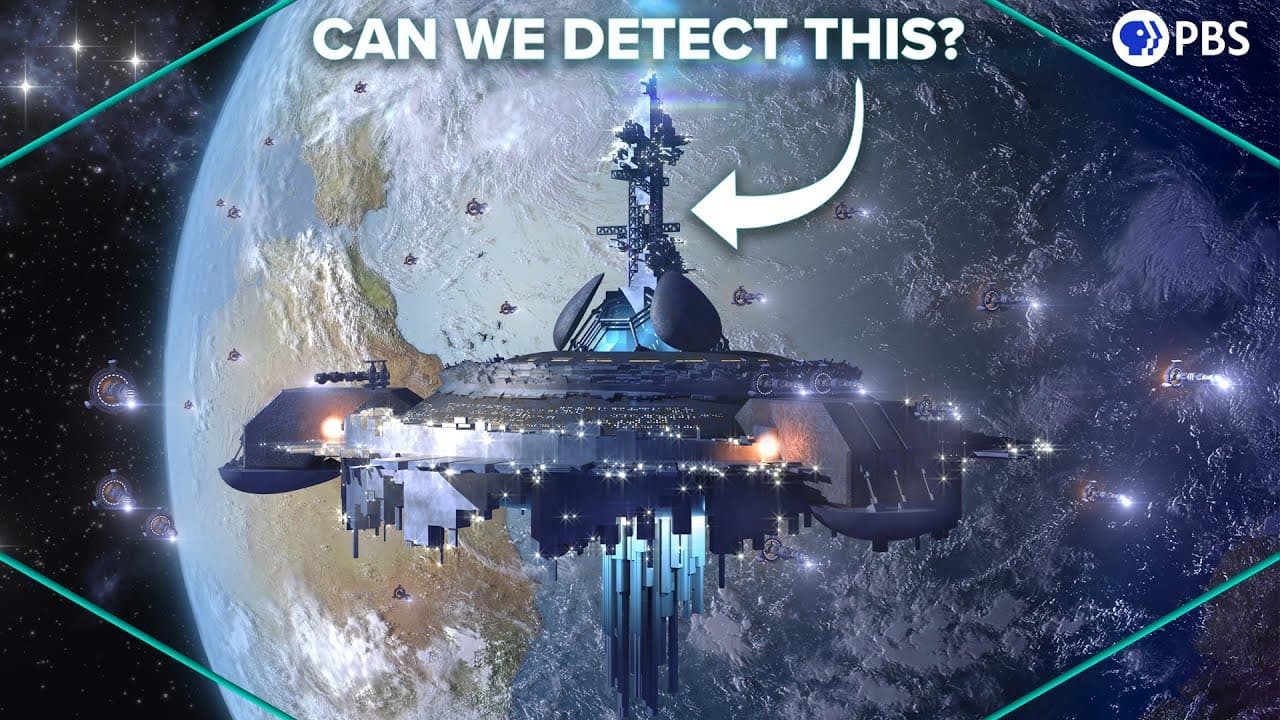
Could LIGO Find MASSIVE Alien Spaceships?
TL;DR
Explores LIGO's potential to detect massive alien spacecraft.
Transcript
Whenever we open a new window on the universe, we discover things that no one expected. Our newfound ability to measure ripples in the fabric of spacetime—gravitational waves—is a very new window, and so far we’ve seen a lot of wild stuff. We’ve observed black holes merging, and their oddly high masses challenges our understanding of black hole... Read More
Key Insights
- LIGO's ability to detect gravitational waves opens up possibilities for discovering unexpected cosmic phenomena, including massive alien spacecraft.
- Gravitational waves are ripples in spacetime caused by accelerating masses, and LIGO is sensitive to the most powerful of these events.
- The concept of a RAMAcraft, a massive accelerating spacecraft, raises questions about the potential for LIGO to detect alien technology.
- Detecting gravitational waves from spacecraft would require immense mass and acceleration, far beyond current technological capabilities.
- Gravitational waves weaken with distance less than electromagnetic waves, making them potentially more useful for detecting distant cosmic events.
- LIGO's sensitivity is limited to certain frequency ranges, which affects its ability to detect specific types of gravitational wave events.
- Future observatories like LISA and the Pulsar Timing Array may enhance our ability to detect gravitational waves from a wider range of sources.
- While detecting alien spacecraft with LIGO is speculative, exploring such possibilities helps expand our understanding of gravitational wave physics.
Install to Summarize YouTube Videos and Get Transcripts
Explore YouTube Video Summarizer or Get YouTube Transcript Extractor
Questions & Answers
Q: What is LIGO's primary purpose?
LIGO, the Laser Interferometer Gravitational Wave Observatory, is primarily designed to detect gravitational waves from massive cosmic events such as merging black holes and neutron stars. These waves are ripples in spacetime caused by accelerating masses, and LIGO's sensitivity allows it to observe these powerful phenomena, providing insights into the universe's most energetic events.
Q: What are gravitational waves and how are they detected?
Gravitational waves are ripples in the fabric of spacetime caused by accelerating masses, similar to how accelerating electric charges create electromagnetic waves. LIGO detects these waves by measuring tiny variations in the lengths of its 4-km-long arms. As a gravitational wave passes, the arms alternately grow and shrink, allowing LIGO to identify the nature of the wave's source.
Q: Could LIGO detect alien spacecraft?
Theoretically, LIGO could detect massive alien spacecraft if they were large enough and accelerated rapidly enough to produce observable gravitational waves. However, the required mass and acceleration are far beyond current technological capabilities, making this scenario speculative. Nonetheless, exploring such possibilities helps expand our understanding of gravitational wave physics.
Q: What is the RAMAcraft concept?
The RAMAcraft concept involves a hypothetical massive spacecraft that could produce detectable gravitational waves if it accelerates rapidly enough. This idea is speculative and serves as a thought experiment to explore the limits of LIGO's detection capabilities. The required mass and acceleration for such a craft are currently beyond known technological capabilities.
Q: How do gravitational waves compare to electromagnetic waves in terms of detection?
Gravitational waves weaken with distance less than electromagnetic waves, making them potentially more useful for detecting distant cosmic events. While electromagnetic waves dim quickly with distance, gravitational waves weaken only as an inverse law. Additionally, gravitational waves pass through matter unimpeded, unlike electromagnetic waves, which can be blocked by dust or other obstacles.
Q: What future observatories could enhance gravitational wave detection?
Future observatories like the Laser Interferometer Space Antenna (LISA) and the Pulsar Timing Array could enhance gravitational wave detection. LISA will have arms a million times longer than LIGO, making it sensitive to lower frequencies. The Pulsar Timing Array could detect waves from craft accelerating over longer periods, expanding the range of detectable sources.
Q: What challenges exist in detecting RAMAcraft with LIGO?
Detecting a RAMAcraft with LIGO would require the craft to be of immense mass and to accelerate at a rate far beyond current technological capabilities. The mass would need to be comparable to that of a planet or star, and the acceleration would need to be extremely rapid. These requirements make the scenario speculative and unlikely with current technology.
Q: Why is exploring speculative scenarios like RAMAcraft important?
Exploring speculative scenarios like RAMAcraft is important because it expands our understanding of gravitational wave physics and the potential for detecting unexpected cosmic phenomena. While the idea of detecting alien spacecraft is speculative, it encourages scientists to think creatively about the limits of current technology and the possibilities for future discoveries.
Summary & Key Takeaways
-
LIGO, the Laser Interferometer Gravitational Wave Observatory, is designed to detect gravitational waves from massive cosmic events like black hole mergers. The idea of detecting alien spacecraft through gravitational waves is speculative but intriguing.
-
A team has proposed the concept of a RAMAcraft, a massive spacecraft that could produce detectable gravitational waves if accelerated rapidly enough. However, the required mass and acceleration are currently beyond known technological capabilities.
-
Gravitational waves offer advantages over electromagnetic waves for detecting distant phenomena, as they weaken less with distance and pass through matter unimpeded. Future observatories may improve our ability to detect a broader range of gravitational wave events.
Read in Other Languages (beta)
Share This Summary 📚
Summarize YouTube Videos and Get Video Transcripts with 1-Click
Try YouTube Summary with ChatGPT & Claude or YouTube Transcript Generator
Explore More Summaries from PBS Space Time 📚

Summarize YouTube Videos and Get Video Transcripts with 1-Click
Try YouTube Summary with ChatGPT & Claude or YouTube Transcript Generator