Go-Back-N ARQ
TL;DR
Learn about the working of Go-Back-N ARQ, a sliding window protocol that allows the sender to send multiple frames before receiving acknowledgments.
Transcript
hello everyone welcome back to the next lecture in the computer network series and today we will see the go-back-n AR Q as usual let's start the session with the outcomes in today's session we have only one outcome and what is that upon the completion of decision the learner will be able to understand the working of go back and AR Q so in today's s... Read More
Key Insights
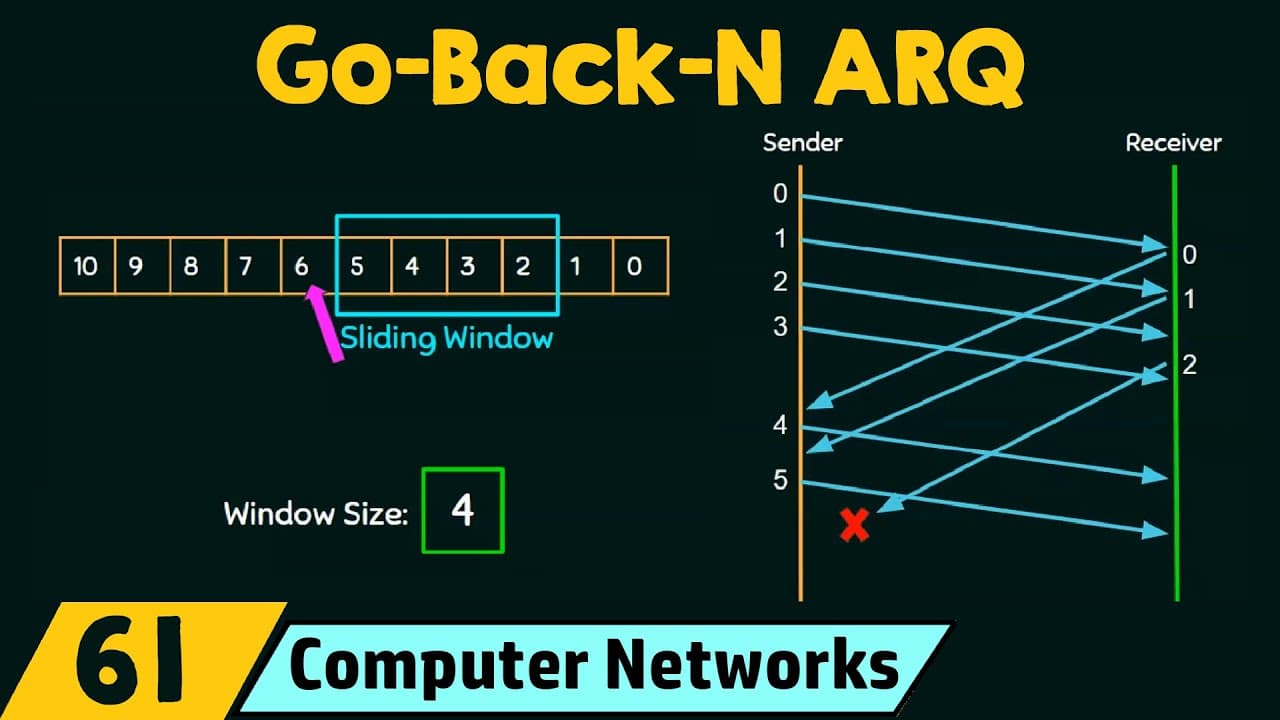
- 👻 Go-Back-N ARQ is a sliding window protocol that allows the sending of multiple frames before receiving acknowledgments.
- #️⃣ Frames in Go-Back-N ARQ are numbered in a sequential manner using sequence numbers.
- ⌛ The sender window size determines the number of frames that can be sent at a time.
- ⌛ If acknowledgments are not received within the specified time, all frames in the current window are retransmitted.
- 🍵 Frame retransmission occurs when an acknowledgment is not received within the agreed-upon time period.
- 🖼️ The sequence number of frames is determined by the sending window size.
- 😒 Go-Back-N ARQ uses protocol pipelining for efficient transmission of frames.
Install to Summarize YouTube Videos and Get Transcripts
Explore YouTube Video Summarizer or Get YouTube Transcript Extractor
Questions & Answers
Q: What is the difference between stop-and-wait protocol and sliding window protocol?
In stop-and-wait, only one frame is sent at a time and the sender waits for acknowledgment before sending the next frame. Sliding window protocols, such as Go-Back-N ARQ, allow multiple frames to be sent at a time.
Q: How are frames numbered in Go-Back-N ARQ?
Frames are numbered in a sequential manner using sequence numbers. These sequence numbers help to identify and distinguish one frame from other frames.
Q: What happens if an acknowledgment is not received on time?
If an acknowledgment for a frame is not received within an agreed-upon time period, all frames in the current window will be retransmitted by the sender.
Q: How does the sending window size determine the sequence number?
The size of the sending window determines the number of bits in the sequence number. For example, if the window size is 4, the sequence number will range from 0 to 3.
Key Insights:
- Go-Back-N ARQ is a sliding window protocol that allows the sending of multiple frames before receiving acknowledgments.
- Frames in Go-Back-N ARQ are numbered in a sequential manner using sequence numbers.
- The sender window size determines the number of frames that can be sent at a time.
- If acknowledgments are not received within the specified time, all frames in the current window are retransmitted.
- Frame retransmission occurs when an acknowledgment is not received within the agreed-upon time period.
- The sequence number of frames is determined by the sending window size.
- Go-Back-N ARQ uses protocol pipelining for efficient transmission of frames.
- The receiver discards frames that were not received, causing the sender to go back and retransmit those frames.
Summary & Key Takeaways
-
Go-Back-N ARQ is a sliding window protocol that allows multiple frames to be sent before acknowledgments are received.
-
The sender window size (N) determines the number of frames that can be sent at a time.
-
If an acknowledgment is not received within a time period, all frames in the current window are retransmitted.
Read in Other Languages (beta)
Share This Summary 📚
Summarize YouTube Videos and Get Video Transcripts with 1-Click
Try YouTube Summary with ChatGPT & Claude or YouTube Transcript Generator
Explore More Summaries from Neso Academy 📚





Summarize YouTube Videos and Get Video Transcripts with 1-Click
Try YouTube Summary with ChatGPT & Claude or YouTube Transcript Generator