How Did the Russian Civil War Unfold in 1919?
TL;DR
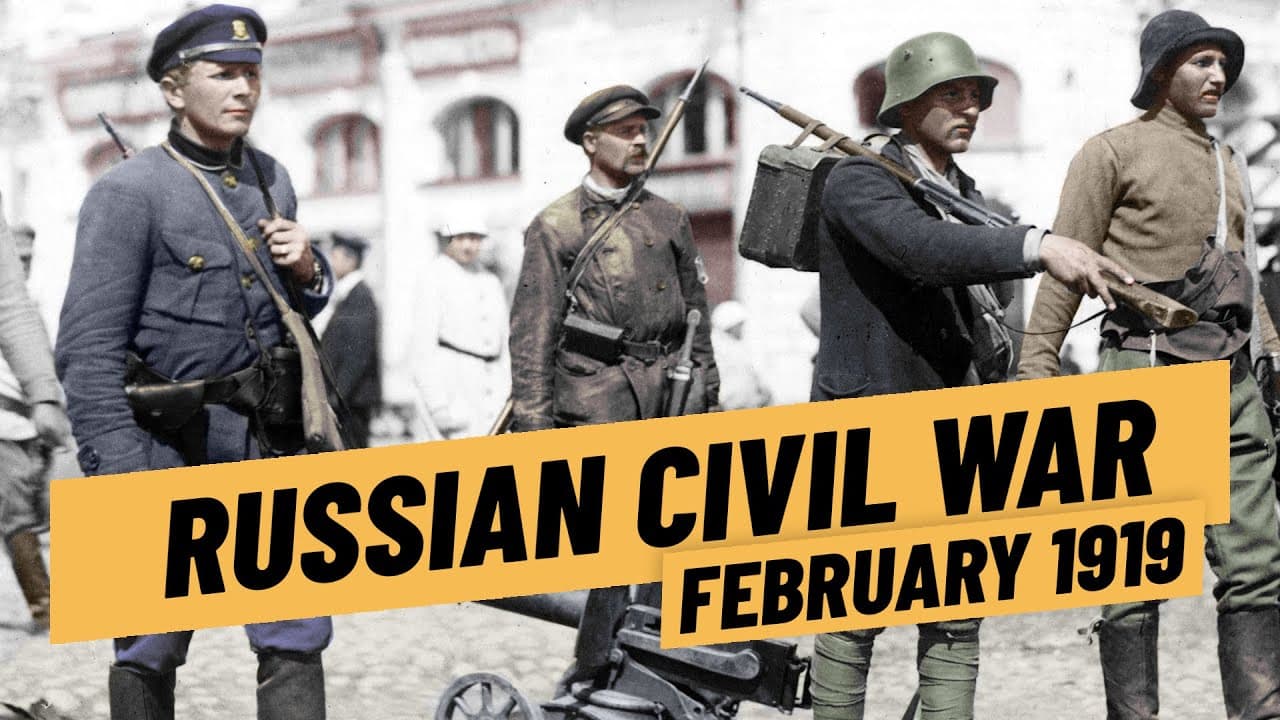
In early 1919, the Russian Civil War intensified as multiple factions, including Bolsheviks, Whites, and smaller national movements, vied for control. The Bolsheviks faced significant opposition from counter-revolutionary forces and foreign interventions. Despite holding industrial centers, the Bolsheviks struggled with internal resistance and external threats, leaving the war's outcome uncertain.
Transcript
This episode of the Great War 1919 is sponsored by Battlefront Miniatures, the creators of Flames Of War, and their new miniatures wargame The Great War. Supported by a complete range of miniatures and terrain, including trenches, tanks, and guns, The Great War provides a full selection of models suitable for wargaming, collecting or modelling. Eve... Read More
Key Insights
- The Russian Civil War involved multiple factions: Bolsheviks, Whites, independence movements, and foreign forces.
- Bolsheviks controlled industrial centers but faced resistance from peasants and counter-revolutionaries.
- The Whites were disorganized and struggled with coordination but received Allied support.
- Foreign intervention included British, French, American, and Japanese troops, complicating the conflict.
- War Communism was imposed by Bolsheviks, leading to peasant resistance and the Red Terror.
- The Whites' propaganda emphasized anti-Bolshevik and anti-Semitic themes, leading to the White Terror.
- Railways and armoured trains were crucial for troop movements and supply lines during the war.
- The war's outcome remained uncertain in early 1919, with both Reds and Whites experiencing victories and setbacks.
Install to Summarize YouTube Videos and Get Transcripts
Explore YouTube Video Summarizer or Get YouTube Transcript Extractor
Questions & Answers
Q: How did the Bolsheviks maintain control during the Russian Civil War?
The Bolsheviks maintained control during the Russian Civil War by consolidating power in major industrial centers like Moscow and Petrograd and implementing War Communism, which involved forcibly requisitioning food and resources to support the Red Army. They also used propaganda and the Red Terror, led by the Cheka, to suppress opposition and enforce their policies, despite facing significant resistance from peasants and counter-revolutionary forces.
Q: What role did foreign intervention play in the Russian Civil War?
Foreign intervention played a significant role in the Russian Civil War, with British, French, American, and Japanese troops entering Russia to support counter-revolutionary forces and protect strategic interests. The Allies provided military aid, including weapons and training, to the Whites, although their involvement was complicated by internal disagreements and a lack of commitment to full-scale intervention. This support helped the Whites sustain their efforts against the Bolsheviks.
Q: What challenges did the White forces face during the Russian Civil War?
The White forces faced several challenges during the Russian Civil War, including disorganization, lack of coordination, and remote, underdeveloped territories. Despite receiving Allied support, the Whites struggled to unify their military and political goals and had rocky relations with minority groups. Their reliance on anti-Bolshevik propaganda and terror campaigns further alienated potential supporters, and they lacked a coherent vision to rally the population against the Bolsheviks.
Q: How did the Russian Civil War impact smaller nations on the empire's western edge?
The Russian Civil War significantly impacted smaller nations on the empire's western edge, such as Estonia, Latvia, Lithuania, Belarus, Ukraine, and Poland, which sought independence amid the chaos. These fledgling states faced hostility from both Bolsheviks and Whites and relied on external support from countries like Finland and Germany. The conflict forced them to rapidly recruit armies and establish borders, often leading to clashes with neighboring forces and complicating their quests for sovereignty.
Q: What was War Communism, and how did it affect the Russian Civil War?
War Communism was a policy implemented by the Bolsheviks during the Russian Civil War to centralize and nationalize the economy, forcibly requisitioning food and resources to support the Red Army. It led to widespread peasant resistance and contributed to the Red Terror, as the Bolsheviks used force to suppress opposition. This policy strained relations with the rural population and created internal challenges for the Bolsheviks, despite helping them sustain their war efforts.
Q: Why was the Russian Civil War difficult to fight?
The Russian Civil War was difficult to fight due to the vast distances, poor transportation and communication networks, and the devastated economy following years of revolution and occupation. Armies on all sides faced logistical challenges, including maintaining supply lines and troop movements over large areas. The use of railways and armoured trains was crucial, and tactics evolved to include cavalry and mobile machine-gun carts. Both sides struggled with desertions and fluctuating morale among their troops.
Q: What were the key battles and regions of conflict in early 1919 during the Russian Civil War?
Key battles and regions of conflict in early 1919 during the Russian Civil War included skirmishes in the north, White victories in the south, and a White advance in the east. The south saw significant battles involving Cossack and White forces, while in the east, Admiral Kolchak's White army launched an offensive towards the Volga River. The west experienced clashes between Bolsheviks and independence movements, with the Reds attempting to expand their influence amid retreating German and Austrian forces.
Q: How did propaganda influence the Russian Civil War?
Propaganda played a crucial role in the Russian Civil War, with both Bolsheviks and Whites using it to rally support and demonize opponents. The Bolsheviks emphasized their revolutionary ideology and targeted propaganda to consolidate power, while the Whites focused on anti-Bolshevik and anti-Semitic themes, exploiting existing prejudices. Despite their efforts, the Whites struggled to present a coherent vision, which hindered their ability to effectively mobilize popular support against the Bolsheviks.
Summary & Key Takeaways
-
The Russian Civil War in early 1919 was marked by intense fighting between Bolsheviks and counter-revolutionary Whites, with foreign interventions complicating the conflict. The Bolsheviks held key industrial centers but faced internal resistance and external threats, while the Whites struggled with coordination despite Allied support. The war's outcome was still uncertain, with both sides experiencing victories and setbacks.
-
Bolsheviks implemented War Communism, leading to peasant resistance and the Red Terror. The Whites, although disorganized, received significant support from Allied forces, particularly the British. The conflict was characterized by the use of railways and armoured trains, which were crucial for troop movements and supply lines, and both sides engaged in propaganda and terror campaigns.
-
The Russian Civil War in early 1919 involved multiple factions, including Bolsheviks, Whites, and smaller national movements. The Bolsheviks controlled major cities but struggled with peasant resistance, while the Whites, supported by Allied forces, faced challenges in coordination. The conflict's outcome remained uncertain, with significant battles occurring in various regions.
Read in Other Languages (beta)
Share This Summary 📚
Summarize YouTube Videos and Get Video Transcripts with 1-Click
Try YouTube Summary with ChatGPT & Claude or YouTube Transcript Generator
Explore More Summaries from The Great War 📚
Summarize YouTube Videos and Get Video Transcripts with 1-Click
Try YouTube Summary with ChatGPT & Claude or YouTube Transcript Generator