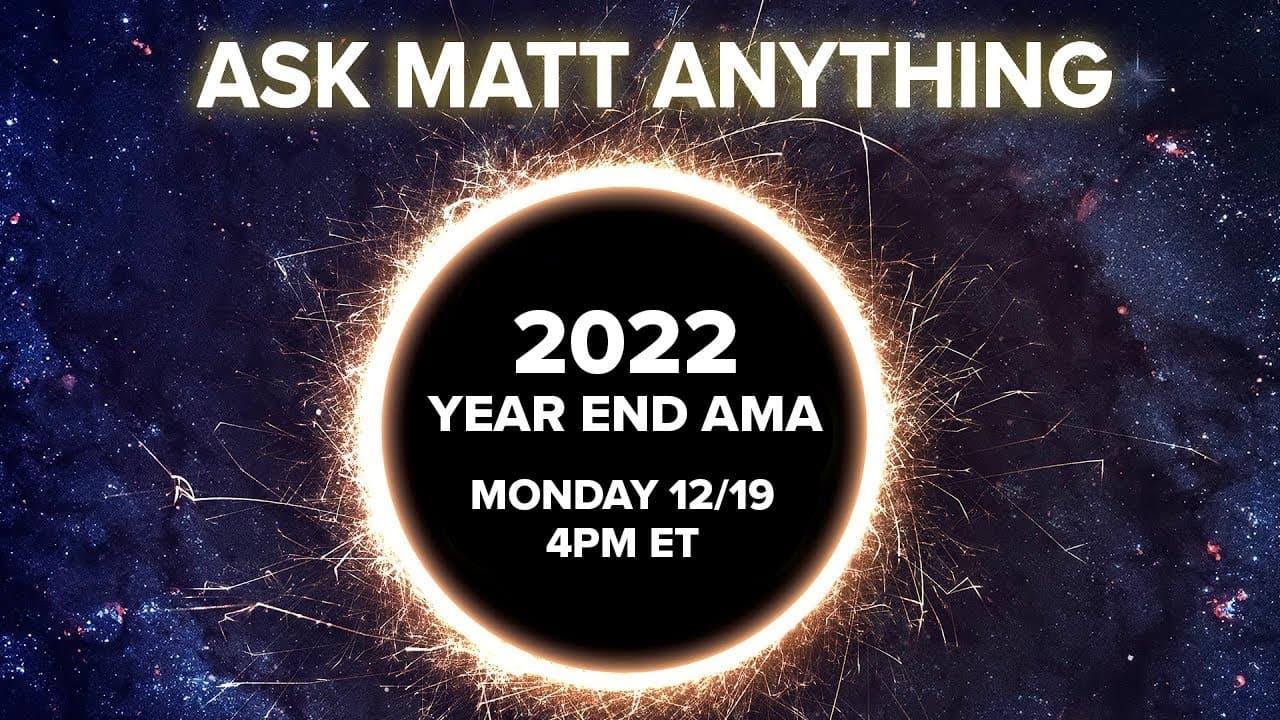
2022 Year End AMA
TL;DR
Matt discusses Space Time's future, black holes, and free will.
Transcript
hello everyone I'm Meadow Dowd Welcome to our 2022 end of year AMA live stream this is becoming a little bit of a tradition now so I kind of like to think of it as our state of space-time address which means before we get into me trying to answer as many of your questions as I possibly can a little overview of the state of the space-time I mean the... Read More
Key Insights
- The Space Time series has been running for seven years, covering diverse topics from quantum mechanics to astrophysics, and aims to explore even more abstract concepts in 2023.
- The concept of block time suggests that past, present, and future exist simultaneously, challenging traditional notions of time as a linear sequence.
- Black holes remain a significant area of interest, with discussions on their evaporation and the nature of their event horizons.
- The question of free will versus determinism is complex, and the notion of compatibilism suggests that free will can coexist with a deterministic universe.
- The universe's potential to cause itself, and the idea of retro causality, are intriguing concepts explored by physicists like John Archibald Wheeler.
- The role of an observer in physics is a profound question, touching on the nature of reality and the universe's ability to be self-aware.
- The upcoming documentary 'Inventing Reality' aims to synthesize knowledge from Space Time, exploring the knowability of the universe and the nature of reality.
- The concept of dualities in physics, where different theories describe the same phenomena, is an important area for understanding the universe's fundamental nature.
Install to Summarize YouTube Videos and Get Transcripts
Explore YouTube Video Summarizer or Get YouTube Transcript Extractor
Questions & Answers
Q: What is block time and how does it relate to our perception of time?
Block time is a concept from Einstein's relativity suggesting that past, present, and future exist simultaneously. It challenges the traditional linear perception of time by proposing that all moments are equally real. Observers within this block universe experience time as a sequence due to their limited range of space and time, akin to a needle playing a record.
Q: Why do black holes appear black if we can't see beyond their event horizon?
Black holes appear black because light from objects falling into them is infinitely redshifted, stretching wavelengths beyond detection. Even material near the event horizon is redshifted to low-energy radio waves, rendering the black hole effectively black. The Event Horizon Telescope has provided direct evidence of this phenomenon, confirming black holes as dark objects.
Q: What is the concept of compatibilism in the free will versus determinism debate?
Compatibilism is the idea that free will can coexist with a deterministic universe. It suggests that within the dynamical system of the mind, choices have causal power. While the substrate of neurons and particles may influence thoughts, the mind's dynamics are self-contained, allowing for meaningful choices within that framework, even in a mechanistic universe.
Q: Could the universe have caused itself, and what does retro causality imply?
The idea that the universe could have caused itself is linked to retro causality, where effects precede causes. John Archibald Wheeler proposed the universe might be a self-excited circuit, where its own observations create a feedback loop leading to its existence. While speculative, this concept challenges traditional notions of causality and the universe's origin.
Q: What role does the observer play in physics, and why is it significant?
The observer's role in physics is significant because it touches on the nature of reality and measurement. Observers within the block universe experience time and events, influencing the interpretation of quantum mechanics and the universe's informational nature. Understanding the observer's role could lead to insights into consciousness and the universe's fundamental workings.
Q: What is the documentary 'Inventing Reality' about, and what does it aim to achieve?
'Inventing Reality' is an upcoming documentary by the Space Time team, aiming to synthesize knowledge from the series. It explores the knowability of the universe, the nature of reality, and the role of observers. By delving into abstract concepts beyond typical episodes, it seeks to provide a deeper understanding of fundamental questions in physics and philosophy.
Q: How do dualities in physics help us understand the universe's nature?
Dualities in physics are where different theories describe the same phenomena, leading to the same outcomes despite conflicting narratives. They reveal that multiple perspectives can coexist, offering a more comprehensive understanding of complex systems. Dualities are found in theories like the holographic principle and string theory, highlighting the universe's interconnected and multifaceted nature.
Q: What is the significance of the holographic principle in understanding the universe?
The holographic principle suggests that the universe can be described as a hologram, with a dual description on its boundary. This concept, part of the ads CFT correspondence, implies that our 3D universe and its surface are equivalent descriptions. It challenges traditional views by proposing that reality can be understood from different perspectives, offering insights into the universe's structure and dynamics.
Summary & Key Takeaways
-
Matt discusses the diverse topics covered in Space Time over the past year, including black holes, quantum mechanics, and the universe's informational nature. The series aims to explore more abstract concepts in 2023, such as the role of the observer and the physics of the mind.
-
The concept of block time suggests that past, present, and future exist simultaneously, challenging traditional notions of time. Matt also addresses questions about black holes, including their evaporation and the nature of their event horizons, emphasizing the complexity of these phenomena.
-
The question of free will versus determinism is explored, with compatibilism suggesting that free will can coexist with a deterministic universe. The upcoming documentary 'Inventing Reality' aims to synthesize knowledge from Space Time, exploring the knowability of the universe and the nature of reality.
Read in Other Languages (beta)
Share This Summary 📚
Summarize YouTube Videos and Get Video Transcripts with 1-Click
Try YouTube Summary with ChatGPT & Claude or YouTube Transcript Generator
Explore More Summaries from PBS Space Time 📚
Summarize YouTube Videos and Get Video Transcripts with 1-Click
Try YouTube Summary with ChatGPT & Claude or YouTube Transcript Generator