What If There's A Black Hole Inside The Sun? | Hawking Stars
TL;DR
Explores the possibility of a black hole inside the Sun.
Transcript
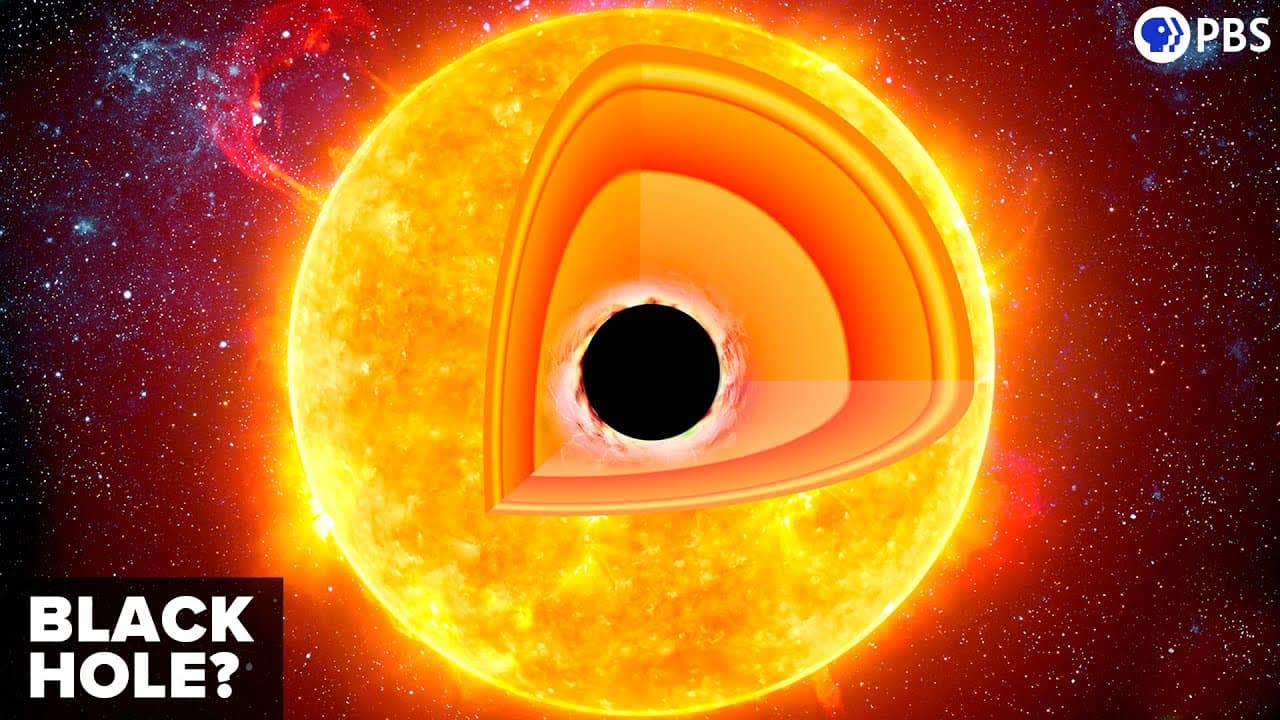
One of my favorite fictional astrophysics catastrophe scenarios is the sun being consumed by a black hole. Fortunately, the chance of a black hole randomly wandering into our solar system is pretty tiny. That’s good news. But what if it’s already here, hiding in the core of the Sun and slowly eating it from the inside out? Once upon a time we rea... Read More
Key Insights
- The concept of a black hole inside the Sun was once considered by Stephen Hawking, suggesting primordial black holes could be hidden within stars.
- Primordial black holes, possibly created in the early universe, might explain phenomena like dark matter and could exist in large numbers.
- The solar neutrino problem once suggested alternative energy sources for the Sun, but was resolved by understanding neutrino oscillation.
- Simulations show that a primordial black hole in a star could lead to unique stellar evolution phases, potentially creating what are called Hawking stars.
- A black hole inside a star would grow slowly, initially having minimal impact, but eventually altering the star's energy production and structure.
- The presence of a black hole could cause the star to expand prematurely, leading to a unique 'sub-subgiant' phase before the star is fully consumed.
- Asteroseismology could help detect Hawking stars by analyzing the vibrational modes of stars, potentially revealing hidden black holes.
- The existence of Hawking stars could provide insights into the nature of dark matter and the prevalence of primordial black holes in the universe.
Install to Summarize YouTube Videos and Get Transcripts
Explore YouTube Video Summarizer or Get YouTube Transcript Extractor
Questions & Answers
Q: What is the significance of a black hole inside the Sun?
The idea of a black hole inside the Sun, once considered by Stephen Hawking, suggests that primordial black holes could be hidden within stars. This scenario could provide insights into unresolved cosmic phenomena, such as dark matter, and offer a unique perspective on stellar evolution. Although unlikely, it remains a topic of scientific curiosity and exploration.
Q: How does a primordial black hole affect a star?
A primordial black hole within a star would initially have minimal impact due to its small size and limited gravitational influence. Over time, as it consumes matter, it would alter the star's energy production and structural balance, potentially leading to premature expansion and unique evolutionary phases. This process could transform the star into what is known as a Hawking star.
Q: What role does asteroseismology play in detecting Hawking stars?
Asteroseismology, the study of stellar oscillations, can help detect Hawking stars by analyzing their vibrational modes. Stars with hidden black holes would exhibit unusual vibrational patterns due to internal convective movements caused by the black hole. By identifying these patterns, scientists can infer the presence of primordial black holes within stars, contributing to our understanding of dark matter.
Q: What was the solar neutrino problem, and how was it resolved?
The solar neutrino problem arose when early neutrino detectors in the 1960s observed only a third of the expected neutrinos from the Sun, suggesting an alternative energy source. It was later resolved by understanding that neutrinos oscillate between different types, and detectors were initially sensitive to only one type. This discovery confirmed that the Sun's energy is primarily produced by fusion.
Q: Could primordial black holes explain dark matter?
Primordial black holes are a potential candidate for dark matter, as they could account for the universe's unseen mass. While most mass ranges for these black holes have been ruled out, there remains a possibility that they exist in a range that could explain dark matter. If detected, they could provide significant insights into one of astrophysics' biggest mysteries.
Q: How do simulations help in understanding Hawking stars?
Simulations model the evolution of stars containing primordial black holes, exploring how these stars, termed Hawking stars, differ from regular stars. They show that such stars would have unique life phases due to the black hole's influence, providing a framework for understanding potential observational signatures and the broader implications for dark matter and stellar evolution.
Q: What are the implications of detecting Hawking stars?
Detecting Hawking stars would provide evidence for the existence of primordial black holes and their role in cosmic phenomena like dark matter. It would validate theoretical models and simulations, offering new insights into stellar evolution and the universe's mass composition. Alternatively, not finding them could help constrain theories about primordial black holes and their contribution to dark matter.
Q: Why is the possibility of a black hole in the Sun considered unlikely?
The possibility of a black hole in the Sun is considered unlikely due to the lack of observational evidence and the precise understanding of solar energy production through fusion. Current neutrino measurements and asteroseismology studies do not support the presence of a black hole, making it a speculative scenario rather than a probable reality. However, it remains an intriguing concept for scientific exploration.
Summary & Key Takeaways
-
The video explores the hypothetical scenario of a black hole residing within the Sun, a concept once entertained by Stephen Hawking. It discusses how primordial black holes could have formed in the early universe and might exist in stars, offering a potential explanation for dark matter.
-
Simulations suggest that a primordial black hole within a star could lead to unique evolutionary stages, termed Hawking stars. These stars would exhibit distinct phases due to the black hole's influence, eventually expanding and altering their energy production.
-
Asteroseismology, the study of stellar vibrations, could potentially detect these Hawking stars by identifying unusual vibrational patterns. This research aims to understand the presence of primordial black holes and their role in cosmic phenomena like dark matter.
Read in Other Languages (beta)
Share This Summary 📚
Summarize YouTube Videos and Get Video Transcripts with 1-Click
Try YouTube Summary with ChatGPT & Claude or YouTube Transcript Generator
Explore More Summaries from PBS Space Time 📚
Summarize YouTube Videos and Get Video Transcripts with 1-Click
Try YouTube Summary with ChatGPT & Claude or YouTube Transcript Generator