What Are the Derivatives of Hyperbolic Functions?
TL;DR
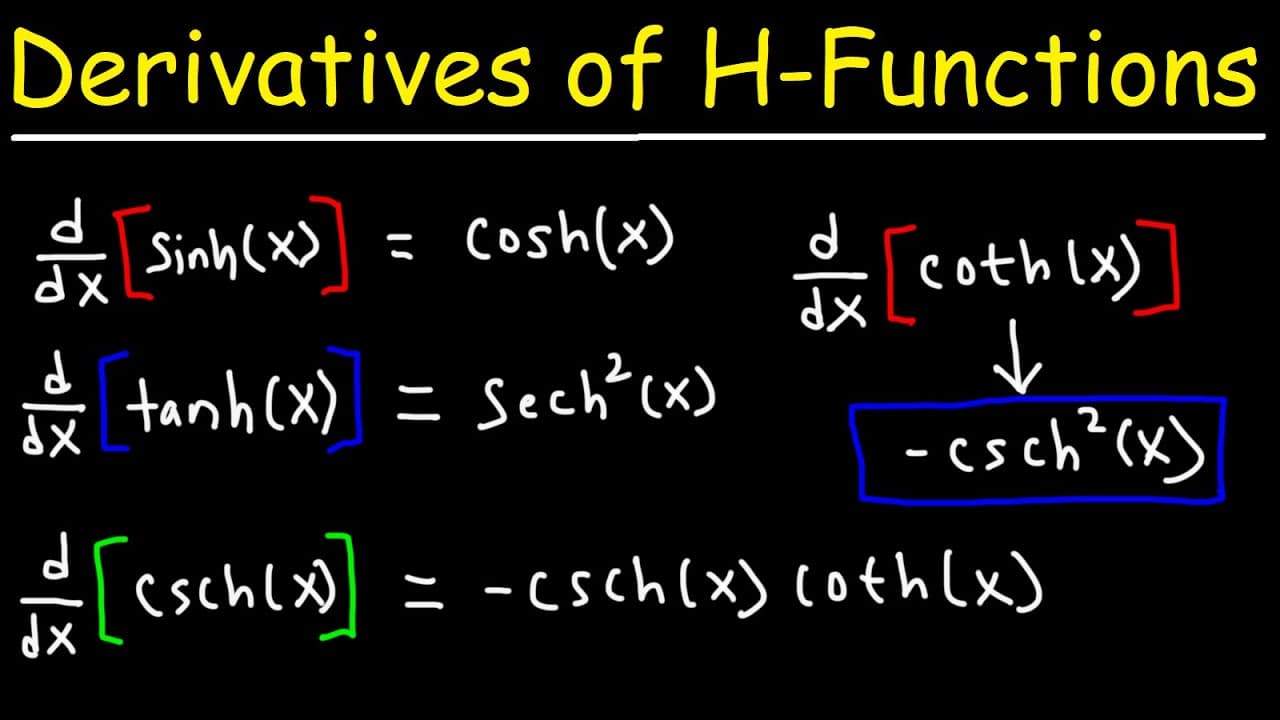
The derivatives of hyperbolic functions follow specific rules: the derivative of hyperbolic sine is hyperbolic cosine, and the derivative of hyperbolic cosine is hyperbolic sine. Additionally, the derivatives of hyperbolic tangent, cosecant, secant, and cotangent can be derived using exponential functions along with the product, quotient, and chain rules.
Transcript
in this video we're going to focus on the derivatives of hyperbolic functions so let's start with the derivative of hyperbolic sine this is equal to hyperbolic cosine so you may want to take some notes on this we'll work on a few practice problems shortly the derivative of hyperbolic cosine is hyperbolic sine it's a little bit different from the co... Read More
Key Insights
- ❓ The derivatives of hyperbolic functions follow similar patterns to their trigonometric counterparts.
- 👍 The exponential function and basic differentiation rules can be used to prove the derivative of hyperbolic cosine and sine.
- 📏 The chain rule, quotient rule, and product rule are applied to find the derivatives of other hyperbolic functions.
- 😑 The derivatives can be expressed using other hyperbolic functions, such as hyperbolic secant, cosecant, and cotangent.
- ❓ The derivatives of hyperbolic functions are useful in solving various calculus problems.
- 📏 The rules for differentiating hyperbolic functions are distinct from those for trigonometric functions.
- 🏑 Hyperbolic functions have applications in physics and engineering, particularly in the fields of electromagnetism and fluid dynamics.
Install to Summarize YouTube Videos and Get Transcripts
Explore YouTube Video Summarizer or Get YouTube Transcript Extractor
Questions & Answers
Q: How do you differentiate hyperbolic sine?
The derivative of hyperbolic sine is hyperbolic cosine. This can be proven using the exponential function and the chain rule.
Q: What is the derivative of hyperbolic tangent?
The derivative of hyperbolic tangent is hyperbolic secant squared. This can be derived by applying the chain rule and differentiating the inside function.
Q: How do you find the derivative of hyperbolic secant?
The derivative of hyperbolic secant x is negative hyperbolic secant x times hyperbolic tangent x. This can be derived using basic differentiation rules.
Q: How do you differentiate hyperbolic cosecant x?
The derivative of hyperbolic cosecant x is negative cosecant x times hyperbolic cotangent x. This can be proven using the quotient rule.
Q: How do you differentiate hyperbolic cosine?
The derivative of hyperbolic cosine is hyperbolic sine. Just like with trigonometric cosine, the derivative has a negative sign.
Summary & Key Takeaways
-
The derivative of hyperbolic sine is hyperbolic cosine, while the derivative of hyperbolic cosine is hyperbolic sine.
-
The derivatives of hyperbolic tangent, cosecant, secant, and cotangent are also discussed.
-
The derivatives can be proven using the exponential function and basic differentiation rules.
Read in Other Languages (beta)
Share This Summary 📚
Summarize YouTube Videos and Get Video Transcripts with 1-Click
Try YouTube Summary with ChatGPT & Claude or YouTube Transcript Generator
Explore More Summaries from The Organic Chemistry Tutor 📚

Summarize YouTube Videos and Get Video Transcripts with 1-Click
Try YouTube Summary with ChatGPT & Claude or YouTube Transcript Generator