How Does Focus of Attention Affect Athletic Performance?
TL;DR
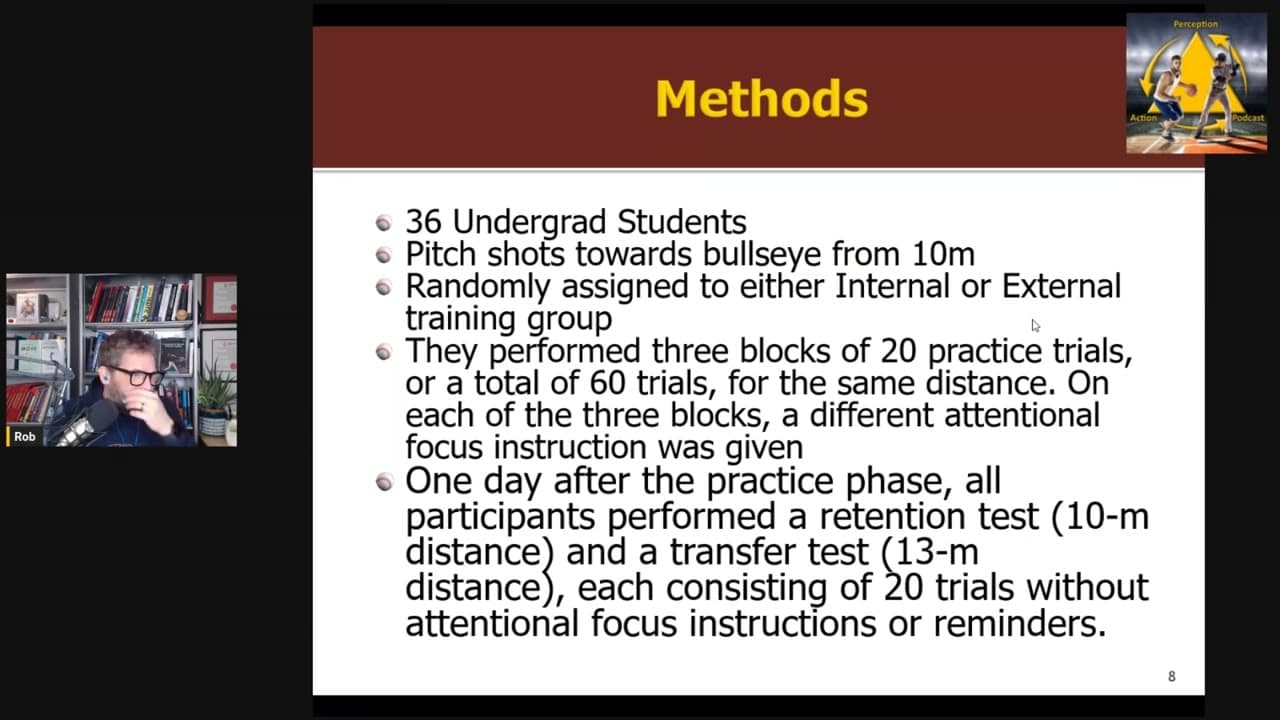
Research shows that external focus of attention, where athletes concentrate on the effects of their movements on the environment, leads to better performance and learning than internal focus, which is directed at body movements. Recent studies address critiques about unrealistic internal cues and uniform cue application, suggesting that tailored and varied instructions could further validate these findings.
Transcript
hi everyone this is Rob Gray from ASU in the perception action podcast back with another article review in today's episode what I want to do is look at a couple new recent papers on focus of attention and performance focus of attention and learning and that have addressed some of the issues that common issues critiques people have raised about the ... Read More
Key Insights
- External focus of attention enhances athletic performance by directing attention to the effects of movements.
- Internal focus involves directing attention to body movements and is often less effective.
- Recent studies attempt to address critiques of the focus of attention literature, such as unrealistic internal cues.
- Tailoring cues to individual athletes may improve the validity of focus of attention research.
- Changing cues across training blocks still shows benefits of external focus, suggesting flexibility in cue application.
- Comparison of different internal cues shows varying effectiveness, with some being more detrimental than others.
- Control conditions without specific cues often result in better performance than internal focus cues.
- Publication bias in focus of attention research is a concern, with calls for more balanced evidence.
Install to Summarize YouTube Videos and Get Transcripts
Explore YouTube Video Summarizer or Get YouTube Transcript Extractor
Questions & Answers
Q: How does external focus of attention improve athletic performance?
External focus of attention improves athletic performance by directing the athlete's attention to the effects of their movements on the environment, such as the trajectory of a ball or the movement of equipment. This focus helps athletes perform more efficiently and effectively by reducing conscious interference with automatic motor processes, leading to better immediate performance and enhanced motor learning over time.
Q: What are common critiques of focus of attention research?
Common critiques of focus of attention research include the use of unrealistic internal cues that do not reflect actual coaching practices, the uniform application of cues across participants without individualization, and the potential publication bias favoring studies that confirm the benefits of external focus. These critiques suggest the need for more realistic and tailored research designs to better understand the true impact of focus of attention on performance.
Q: Why is individualizing cues important in focus of attention studies?
Individualizing cues is important because athletes have unique needs and respond differently to instructions. Tailored cues can enhance learning and performance by addressing specific weaknesses or strengths. Without individualization, studies may not accurately reflect real-world coaching practices, potentially limiting the applicability and effectiveness of the research findings in practical settings.
Q: What did recent studies find about changing cues across training blocks?
Recent studies found that changing cues across training blocks does not diminish the benefits of external focus of attention. Even when different cues are used, athletes continue to show improved performance and learning outcomes. This suggests that the effectiveness of external focus is robust and can be maintained with varied cue application, providing flexibility for coaches in designing training programs.
Q: How do internal focus cues compare to control conditions in performance?
Internal focus cues often result in poorer performance compared to control conditions where no specific focus is instructed. In studies, athletes who were simply asked to perform a task to the best of their ability, without specific internal focus cues, tended to perform better. This indicates that internal focus may interfere with natural movement processes, while a lack of specific focus allows for more automatic and efficient performance.
Q: What are the implications of publication bias in focus of attention research?
Publication bias in focus of attention research suggests that studies confirming the benefits of external focus are more likely to be published, potentially skewing the body of evidence. This bias can lead to an overestimation of the effectiveness of external focus and underrepresentation of studies with null or negative findings. It highlights the need for more balanced research and publication practices to ensure a comprehensive understanding of focus of attention effects.
Q: What are the benefits of using realistic internal cues in research?
Using realistic internal cues in research can help bridge the gap between experimental studies and practical coaching. Realistic cues reflect what coaches actually use, making the findings more applicable to real-world settings. This approach can provide a more accurate assessment of the effectiveness of internal focus and help develop evidence-based coaching strategies that improve athletic performance.
Q: How can focus of attention research be improved?
Focus of attention research can be improved by incorporating more realistic and individualized cues, addressing publication bias, and ensuring a balanced representation of findings. Studies should consider the variability in athlete responses and the practical application of cues in coaching. Additionally, involving coaches in research design and focusing on longitudinal effects can provide deeper insights into the long-term benefits of different focus strategies.
Summary & Key Takeaways
-
External focus of attention, where athletes focus on the effects of their movements, generally leads to better performance than internal focus, which involves concentrating on body movements. Recent studies have addressed critiques of this research area, such as the use of unrealistic internal cues and the lack of individualized instruction.
-
Research suggests that changing cues across training blocks maintains the effectiveness of external focus. However, the use of control conditions without specific cues often shows better results than internal focus, highlighting the potential limitations of internal cues.
-
Critiques of focus of attention research include the use of non-realistic internal cues and lack of individualized coaching. Tailored and varied instructions could further validate the benefits of external focus, although publication bias remains a concern in this field.
Read in Other Languages (beta)
Share This Summary 📚
Summarize YouTube Videos and Get Video Transcripts with 1-Click
Try YouTube Summary with ChatGPT & Claude or YouTube Transcript Generator
Explore More Summaries from Rob Gray 📚

Summarize YouTube Videos and Get Video Transcripts with 1-Click
Try YouTube Summary with ChatGPT & Claude or YouTube Transcript Generator