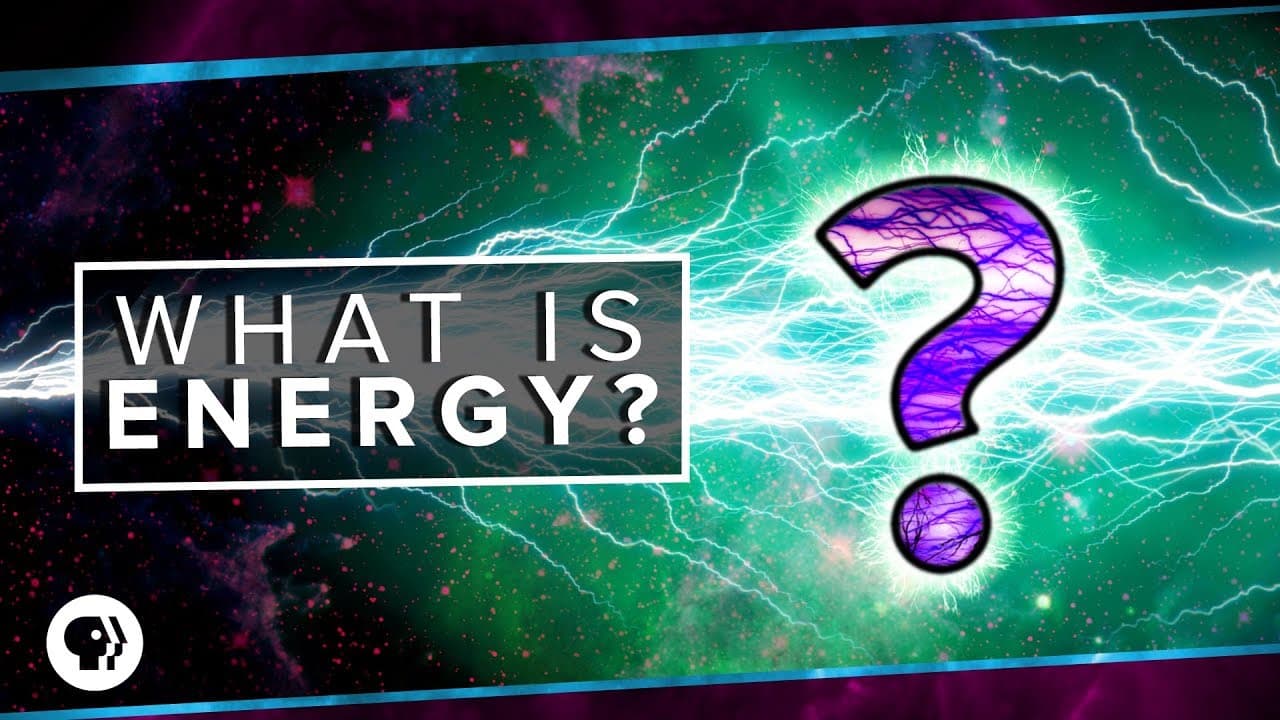
What is Energy?
TL;DR
Energy is a fundamental concept in physics, explained through conservation and transformation.
Transcript
This episode is supported by The Great Courses Plus. A physicist sees a guy standing on the edge of a rooftop and shouts, don't do it. You have so much potential. We all know what it feels like to be energetic to have energy it's this something that allows us to move, be active, get out of bed in the morning. And you can have more or less of the st... Read More
Key Insights
- Energy is not a physical substance, but a mathematical relationship between more fundamental quantities, crucial for understanding physics.
- Gottfried Leibniz first formulated kinetic energy, demonstrating its conservation in systems without friction, calling it vis viva.
- Emilie du Chatelet introduced gravitational potential energy, equating energy conservation with momentum conservation.
- Energy conservation applies to all forms, including heat, as shown by James Prescott Joule, expanding the concept's utility.
- The concept of energy helps solve complex physical problems, transcending Newtonian mechanics with Lagrangian and Hamiltonian mechanics.
- Energy conservation is linked to time symmetry, with implications for understanding the universe's expansion and dark energy.
- Hamiltonian mechanics extends to quantum mechanics, using energy to describe particle behavior and interactions.
- Energy conservation laws arise from symmetries, as discovered by Emmy Noether, revealing deeper insights into physical laws.
Install to Summarize YouTube Videos and Get Transcripts
Explore YouTube Video Summarizer or Get YouTube Transcript Extractor
Questions & Answers
Q: What is the fundamental nature of energy according to the video?
The video explains that energy is not a tangible substance or mystical force but a mathematical relationship between more fundamental quantities. It is a conserved quantity that arises from the symmetries in the laws of physics, specifically time translational symmetry, and serves as a powerful tool for understanding and predicting physical systems.
Q: How did Gottfried Leibniz contribute to the concept of energy?
Gottfried Leibniz contributed by formulating the concept of kinetic energy, which he called vis viva or the living force. He demonstrated that in a frictionless system, the sum of mass times velocity squared is conserved. This early understanding laid the groundwork for the modern concept of energy conservation in physics.
Q: What role did Emilie du Chatelet play in the development of energy theory?
Emilie du Chatelet played a crucial role by introducing the concept of gravitational potential energy, putting the conservation of energy on equal footing with momentum conservation. Her work showed that energy could transform between kinetic and potential forms, reinforcing the idea of energy conservation as a fundamental principle in physics.
Q: How does the conservation of energy apply to different forms of energy?
The conservation of energy applies to all forms, including kinetic, potential, and heat energy. James Prescott Joule's experiments expanded the concept to include heat, demonstrating that energy can change forms but is always conserved. This principle is essential for understanding various physical processes and solving complex problems in physics.
Q: What is the significance of energy conservation in solving complex physics problems?
Energy conservation is significant because it provides an additional constraint that simplifies the analysis of complex systems. By focusing on the total energy rather than individual particle motions, physicists can predict system behavior more efficiently. This approach transcends Newtonian mechanics, leading to the development of Lagrangian and Hamiltonian mechanics.
Q: How is energy conservation related to time symmetry?
Energy conservation is related to time symmetry through Noether's theorem, which states that every symmetry in physics corresponds to a conserved quantity. Time translational symmetry, where the laws of physics remain unchanged over time, results in energy conservation. This relationship has profound implications for understanding the universe's behavior, particularly in an expanding cosmos.
Q: What are the implications of energy conservation in an expanding universe?
In an expanding universe, energy conservation is challenged because the universe's large-scale structure changes over time. This leads to phenomena like dark energy and the accelerating expansion of the universe. These effects suggest that energy conservation, while locally valid, may not hold universally in the context of general relativity and cosmic scales.
Q: How does Hamiltonian mechanics extend the concept of energy conservation to quantum mechanics?
Hamiltonian mechanics extends energy conservation to quantum mechanics by using the Hamiltonian operator to describe the total energy of quantum systems. This approach allows physicists to model complex interactions and particle behaviors, from single particles to quantum field theories, highlighting energy's versatility and fundamental role in both classical and quantum physics.
Summary & Key Takeaways
-
Energy, in physics, is a mathematical concept representing conserved quantities in systems, crucial for understanding motion and interactions. Initially formulated by Leibniz as kinetic energy, it was expanded to include potential energy by du Chatelet. The conservation of energy is a powerful tool in solving complex physics problems.
-
The conservation of energy, demonstrated by Joule and others, includes all forms, such as heat, and is vital for understanding the universe's behavior. Energy calculations allow predictions in systems with numerous particles, transcending Newtonian mechanics through Lagrangian and Hamiltonian approaches.
-
Energy's conservation is tied to time symmetry, with broader implications in an expanding universe, affecting concepts like dark energy. Noether's theorem connects symmetries to conservation laws, providing deeper insights into fundamental physics, with applications in quantum mechanics and relativity.
Read in Other Languages (beta)
Share This Summary 📚
Summarize YouTube Videos and Get Video Transcripts with 1-Click
Try YouTube Summary with ChatGPT & Claude or YouTube Transcript Generator
Explore More Summaries from PBS Space Time 📚
Summarize YouTube Videos and Get Video Transcripts with 1-Click
Try YouTube Summary with ChatGPT & Claude or YouTube Transcript Generator