Products
Features
YouTube Video Summarizer
Summarize YouTube videos
Web & PDF Highlighter
Highlight web pages & PDFs
Chat with PDF
Ask any PDF questions with AI
Ask AI Clone
Chat with your highlights & memories
Audio Transcriber
Transcribe audio files to text
Glasp Reader
Read and highlight articles
Kindle Highlight Export
Export your Kindle highlights
Idea Hatch
Hatch ideas from your highlights
Integrations
Obsidian Plugin
Notion Integration
Pocket Integration
Instapaper Integration
Medium Integration
Readwise Integration
Snipd Integration
Hypothesis Integration
Apps & Extensions
Chrome Extension
Safari Extension
Edge Add-ons
Firefox Add-ons
iOS App
Android App
Discover
Discover
Ideas
Discover new ideas and insights
Articles
Curated articles and insights
Books
Book recommendations by great minds
Posts
Essays and notes from readers
Quotes
Inspiring quotes collection
Videos
Curated videos and summaries
Explore Glasp
Glasp Newsletter
Weekly insights and updates
Glasp Talk
Interview series with great minds
Glasp Blog
Latest news and articles
Glasp Use Cases
Learn how others use Glasp
Build & Support
Glasp API
Access Glasp's API for developers
MCP Connector
Connect Glasp to Claude & ChatGPT
Community
Glasp Reddit Community
Students
Student discount and benefits
FAQs
Frequently Asked Questions
AboutPricing
DashboardLog inSign up

Infinite Chess | Infinite Series
354.0K views
•
March 2, 2017
by
PBS Infinite Series
YouTube video player
Infinite Chess | Infinite Series

TL;DR

Chess on an infinite board with unbounded moves has determined winning strategies and game lengths.

Transcript

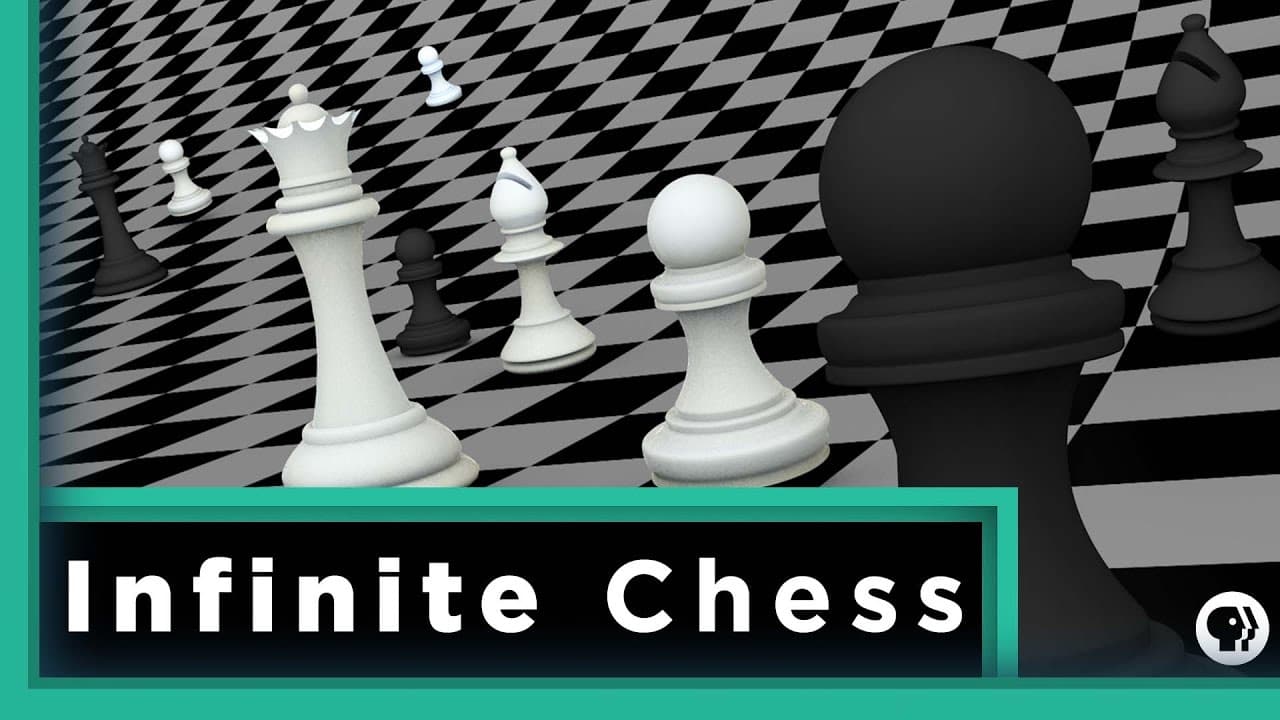
Let's put a handful of chess pieces down on an infinite chess board. All the pieces move according to their usual rules, but there are no bounds on how far they can move. Who will win, and in how many moves? To understand infinite chess, let's start with finite chess. Chess is the kind of game mathematicians like. For one, it's a game of perfect i... Read More

Key Insights

  • 😉 Chess, with its perfect information and lack of randomness, allows for determined outcomes with winning strategies.
  • 👾 Pile game strategies demonstrate the concept of winning strategies and game determinacy in simpler games.
  • ⏲️ Doomsday clock in chess measures the time until victory, showcasing the strategic depth and inevitability of outcomes.

Install to Summarize YouTube Videos and Get Transcripts

Explore YouTube Video Summarizer or Get YouTube Transcript Extractor

Questions & Answers

Q: What defines a determined game in chess?

A determined game in chess is one where one player has a winning strategy, ensuring an inevitable outcome, either for White or Black.

Q: How does the doomsday clock concept apply in infinite chess?

The doomsday clock in infinite chess represents the number of moves until one player achieves victory, showcasing the strategic depth of the game.

Q: Can infinite games be determined like finite games in chess?

Within certain set theory axioms, infinite games like infinite chess can be determined, indicating the presence of winning strategies from any starting position.

Q: What implications does Zermelo's Theorem have on game determinacy?

Zermelo's Theorem states that games of perfect information with no randomness and finite moves are determined, highlighting the strategic nature of games like chess.

Summary & Key Takeaways

  • Chess, a game of perfect information, has determined strategies on an infinite board with unbounded moves.

  • In finite and infinite games, players have winning strategies, leading to an inevitable winner.

  • Doomsday clock measures time to victory, with infinite chess showing complex strategies.


Read in Other Languages (beta)

English

Share This Summary 📚

Summarize YouTube Videos and Get Video Transcripts with 1-Click

Download browser extensions on:

Try YouTube Summary with ChatGPT & Claude or YouTube Transcript Generator

Explore More Summaries from PBS Infinite Series 📚
Can a Chess Piece Explain Markov Chains? | Infinite Series thumbnail
Can a Chess Piece Explain Markov Chains? | Infinite Series
PBS Infinite Series
Making Probability Mathematical | Infinite Series thumbnail
Making Probability Mathematical | Infinite Series
PBS Infinite Series
The Mathematics of Quantum Computers | Infinite Series thumbnail
The Mathematics of Quantum Computers | Infinite Series
PBS Infinite Series
What Is the Cops and Robbers Theorem in Graph Theory? thumbnail
What Is the Cops and Robbers Theorem in Graph Theory?
PBS Infinite Series
Singularities Explained | Infinite Series thumbnail
Singularities Explained | Infinite Series
PBS Infinite Series
Topology Riddles | Infinite Series thumbnail
Topology Riddles | Infinite Series
PBS Infinite Series

Summarize YouTube Videos and Get Video Transcripts with 1-Click

Download browser extensions on:

Try YouTube Summary with ChatGPT & Claude or YouTube Transcript Generator

Apps & Extensions

  • Chrome Extension
  • Safari Extension
  • Edge Add-ons
  • Firefox Add-ons
  • iOS App
  • Android App

Key Features

  • YouTube Video Summarizer
  • Web & PDF Summarizer
  • Web & PDF Highlighter
  • Chat with PDF
  • Ask AI Clone
  • Audio Transcriber
  • Glasp Reader
  • Kindle Highlight Export
  • Idea Hatch

Integrations

  • Obsidian Plugin
  • Notion Integration
  • Pocket Integration
  • Instapaper Integration
  • Medium Integration
  • Readwise Integration
  • Snipd Integration
  • Hypothesis Integration

More Features

  • APIs
  • MCP Connector
  • Blog & Post
  • Embed Links
  • Image Highlight
  • Personality Test
  • Quote Shots

Company

  • About us
  • Blog
  • Community
  • FAQs
  • Job Board
  • Newsletter
  • Pricing
Terms

•

Privacy

•

Guidelines

© 2026 Glasp Inc. All rights reserved.