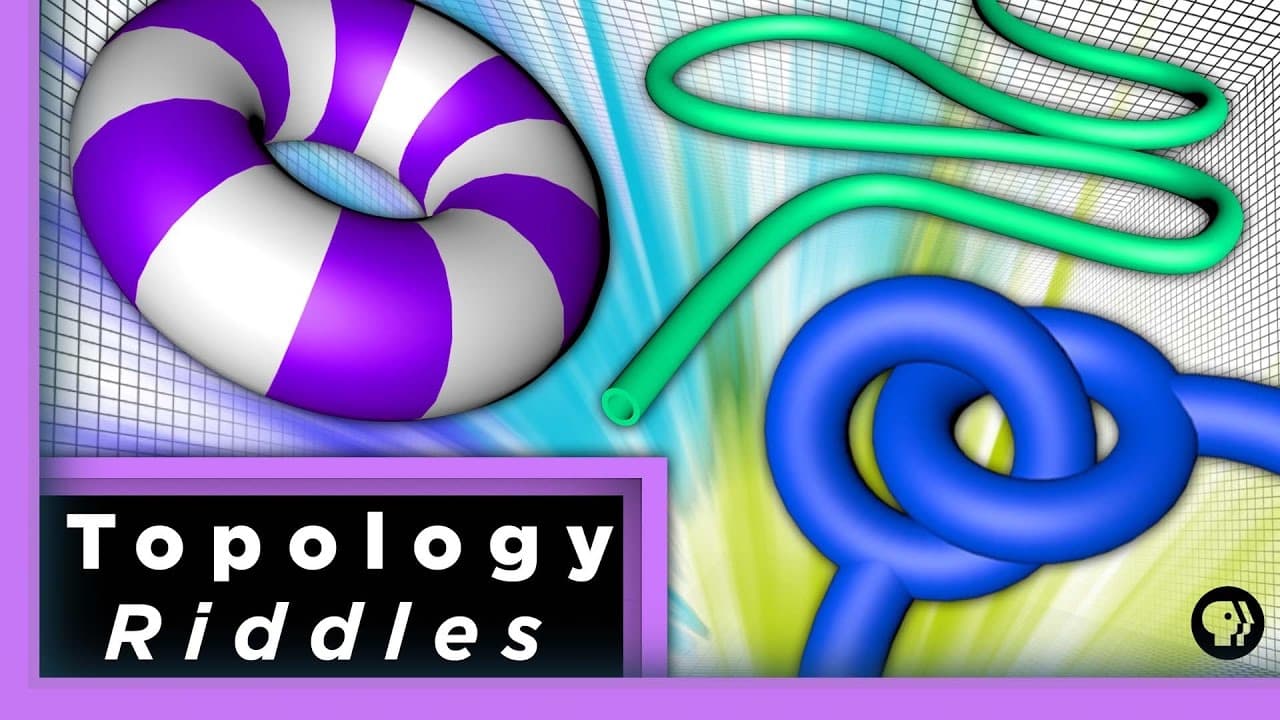
Topology Riddles | Infinite Series
TL;DR
Shapes can be morphed without tearing or gluing due to topological equivalences.
Transcript
[MUSIC PLAYING] NARRATOR: This episode is supported by Squarespace. If you had very stretchy pants, could you turn them inside out without taking your feet off the ground? [MUSIC PLAYING] Typology is a branch of math which is kind of like geometry. It studies shapes and spaces, but ones that are arbitrarily stretchy and bendy. It's sometimes calle... Read More
Key Insights
- 😂 Topological equivalences allow shapes to be morphed without tearing or gluing, showcasing the flexibility of typology.
- 🕳️ Genus classification categorizes shapes based on the number of holes they possess, providing a unique perspective in topology.
- 👥 The fundamental group of a shape determines the distinct loops that can be drawn on its surface, influencing its topological properties.
- 💘 Shapes like a coffee cup and a donut are considered equivalent in topology due to their shared characteristics and hole configurations.
- 💠 Typology challenges traditional intuition by exploring shapes that can be infinitely flexible and deformable without constraints.
- 🌍 Topological puzzles highlight the complexity of shapes that exist beyond the restrictions of real-world materials.
- 💠 Topological illusions and equivalences demonstrate the intriguing nature of shapes and their transformative abilities.
Install to Summarize YouTube Videos and Get Transcripts
Explore YouTube Video Summarizer or Get YouTube Transcript Extractor
Questions & Answers
Q: How does typology differ from traditional geometry?
Typology studies stretchy and bendy shapes that can be morphed without tearing or gluing, unlike traditional geometry.
Q: What makes shapes like a coffee cup and a donut equivalent?
These shapes are considered topologically equivalent because they have the same number of holes and can be morphed into each other without tearing or gluing.
Q: What is the significance of genus in typology?
Genus classifies shapes based on the number of holes they have, providing a way for topologists to distinguish between different shapes.
Q: How does the fundamental group of a shape affect its topological classification?
The fundamental group describes the collection of distinct loops on a shape, showing how shapes can be morphed without tearing or gluing based on loop configurations.
Summary & Key Takeaways
-
Typology is a branch of math studying stretchy and bendy shapes known as rubber sheet geometry.
-
Shapes like a sphere and a cube are topologically the same, while a sphere and a donut are fundamentally different.
-
Topological equivalences allow for shapes like a coffee cup and a donut to be morphed without tearing or gluing.
Read in Other Languages (beta)
Share This Summary 📚
Summarize YouTube Videos and Get Video Transcripts with 1-Click
Try YouTube Summary with ChatGPT & Claude or YouTube Transcript Generator
Explore More Summaries from PBS Infinite Series 📚





Summarize YouTube Videos and Get Video Transcripts with 1-Click
Try YouTube Summary with ChatGPT & Claude or YouTube Transcript Generator