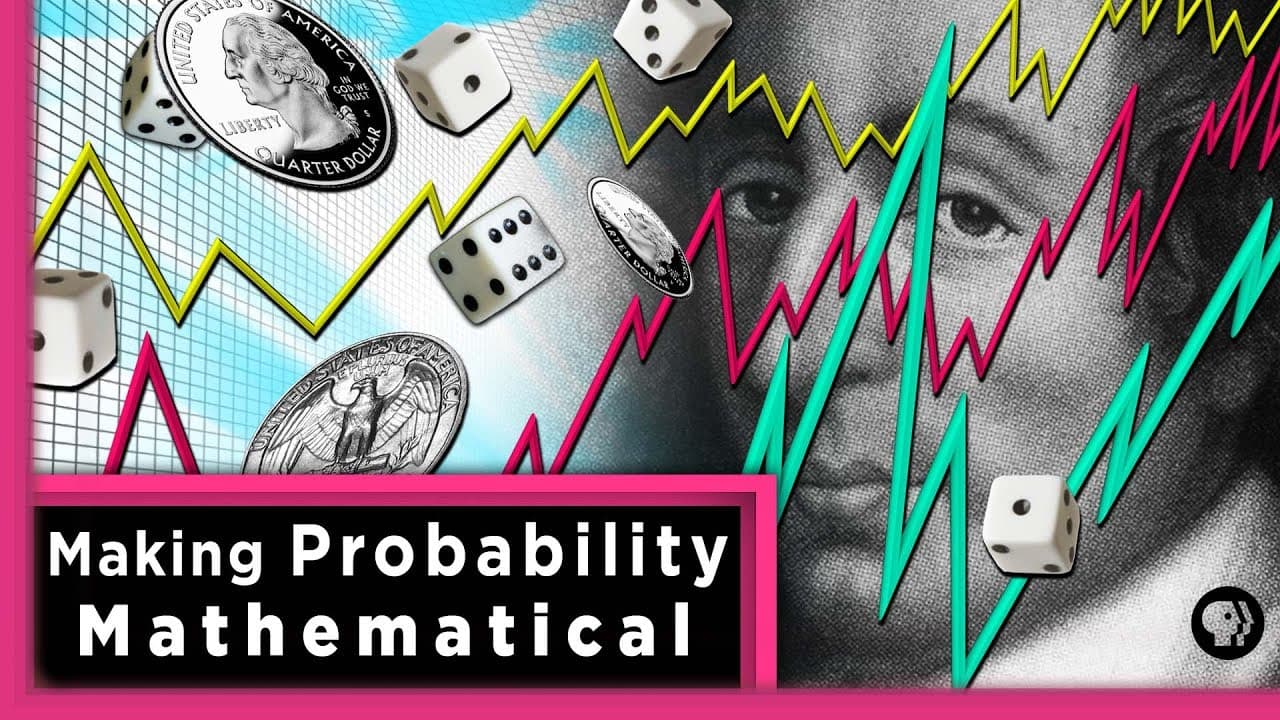
Making Probability Mathematical | Infinite Series
TL;DR
Probability theory emerged in the 17th century and was formalized by mathematician Andrei Kolmogorov using measure theory.
Transcript
KELSEY HOUSTON-EDWARDS This episode is supported by Squarespace. Randomness is everywhere. But somewhat surprisingly, the mathematical study of probability began relatively recently, when a troubled gambler reached out to a mathematician for help. [MUSIC PLAYING] Let's start with the word "probability." It and its relatives "probable" and "probabil... Read More
Key Insights
- 🎲 Probability theory originated from Pascal and Fermat's correspondence on a gambling problem in the 17th century.
- ⚾ Pascal's Wager demonstrated a different notion of probability, one based on belief and rationality.
- 🖤 Probability theory lacked a rigorous foundation until Kolmogorov's development of measure theory.
Install to Summarize YouTube Videos and Get Transcripts
Explore YouTube Video Summarizer or Get YouTube Transcript Extractor
Questions & Answers
Q: How did the mathematical study of probability begin?
The study of probability began in the mid-17th century when Pascal and Fermat corresponded about a gambling problem involving coin flips.
Q: What is Pascal's Wager, and how does it relate to probability?
Pascal's Wager is a philosophical argument that uses probability to rationalize belief in God. Pascal argued that it is rational to bet on God's existence because the potential rewards, infinite in nature, outweigh any losses.
Q: How did Andrei Kolmogorov contribute to the development of probability theory?
Kolmogorov established a rigorous foundation for probability theory by using measure theory, a branch of mathematics that formalizes the notions of size and probability.
Q: Can probability theory be used to answer philosophical and scientific questions?
Yes, probability theory can be applied to various questions, such as the existence of extraterrestrial life or the guilt or innocence of a defendant. Probability theory allows for a mathematical analysis of probabilities and uncertainties.
Summary & Key Takeaways
-
Probability, derived from the Latin word "probabilis," came into mathematical focus in the mid-17th century, thanks to a correspondence between Blaise Pascal and Pierre de Fermat.
-
Pascal made significant contributions to probability theory, including the famous Pascal's Wager, which used probability to rationalize belief in God.
-
The field of probability theory lacked a rigorous foundation until Andrei Kolmogorov's development of measure theory in the 20th century.
Read in Other Languages (beta)
Share This Summary 📚
Summarize YouTube Videos and Get Video Transcripts with 1-Click
Try YouTube Summary with ChatGPT & Claude or YouTube Transcript Generator
Explore More Summaries from PBS Infinite Series 📚

Summarize YouTube Videos and Get Video Transcripts with 1-Click
Try YouTube Summary with ChatGPT & Claude or YouTube Transcript Generator