Products
Features
YouTube Video Summarizer
Summarize YouTube videos
Web & PDF Highlighter
Highlight web pages & PDFs
Chat with PDF
Ask any PDF questions with AI
Ask AI Clone
Chat with your highlights & memories
Audio Transcriber
Transcribe audio files to text
Glasp Reader
Read and highlight articles
Kindle Highlight Export
Export your Kindle highlights
Idea Hatch
Hatch ideas from your highlights
Integrations
Obsidian Plugin
Notion Integration
Pocket Integration
Instapaper Integration
Medium Integration
Readwise Integration
Snipd Integration
Hypothesis Integration
Apps & Extensions
Chrome Extension
Safari Extension
Edge Add-ons
Firefox Add-ons
iOS App
Android App
Discover
Discover
Ideas
Discover new ideas and insights
Articles
Curated articles and insights
Books
Book recommendations by great minds
Posts
Essays and notes from readers
Quotes
Inspiring quotes collection
Videos
Curated videos and summaries
Explore Glasp
Glasp Newsletter
Weekly insights and updates
Glasp Talk
Interview series with great minds
Glasp Blog
Latest news and articles
Glasp Use Cases
Learn how others use Glasp
Build & Support
Glasp API
Access Glasp's API for developers
MCP Connector
Connect Glasp to Claude & ChatGPT
Community
Glasp Reddit Community
Students
Student discount and benefits
FAQs
Frequently Asked Questions
AboutPricing
DashboardLog inSign up

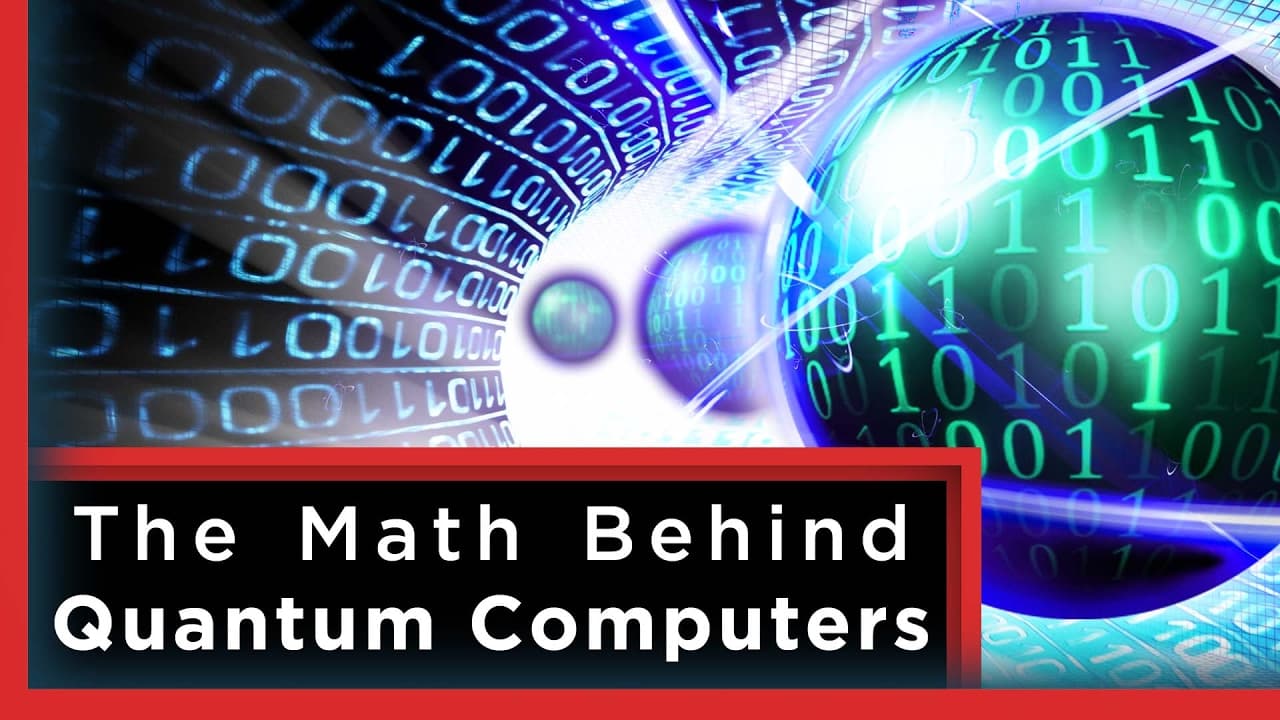
The Mathematics of Quantum Computers | Infinite Series
690.7K views
•
February 16, 2017
by
PBS Infinite Series
YouTube video player
The Mathematics of Quantum Computers | Infinite Series

TL;DR

Quantum computing uses qubits in superpositions to process information exponentially faster than traditional computers.

Transcript

Quantum computers don't exist yet. At least, not physically. But if we peek into the world of mathematics where they do exist, we can learn how they might work. Let's break down the mathematics of a quantum computer in three parts. First, what is a quantum computer doing? Second, how do we represent it mathematically? And third, why is quantum comp... Read More

Key Insights

  • 😒 Quantum computing uses qubits in superpositions for parallel processing.
  • 👾 Mathematically, qubits are represented by vectors in multi-dimensional space.
  • 💻 Quantum computers have the potential to significantly impact data encryption and security.
  • ❓ Challenges in physical implementation include quantum decoherence.
  • 💨 Quantum computing can solve complex problems exponentially faster than classical computers.
  • 🐎 Shor's algorithm illustrates the speed advantage of quantum computation.
  • 💻 Quantum computers are not yet physically realized due to implementation challenges.

Install to Summarize YouTube Videos and Get Transcripts

Explore YouTube Video Summarizer or Get YouTube Transcript Extractor

Questions & Answers

Q: How do quantum computers differ from classical computers?

Quantum computers use qubits in superpositions, allowing for parallel processing and exponential speed gains compared to classical computers.

Q: What is the mathematical representation of qubits in quantum computing?

Qubits are represented by vectors on spheres in multi-dimensional space, with each quantum gate changing the state using unitary matrices.

Q: How can quantum computing impact data encryption and security?

Quantum computers could potentially break traditional encryption methods due to their exponential processing capabilities, posing a future threat to data security.

Q: What are the challenges in implementing physical quantum computers?

Quantum decoherence is a major hurdle as the environment can disrupt the fragile quantum state, requiring advancements in technology to overcome.

Summary & Key Takeaways

  • Quantum computers use qubits in superpositions to process information exponentially faster than traditional computers.

  • Mathematically, qubits are represented by vectors on spheres in multi-dimensional space.

  • Quantum computing has the potential to revolutionize data encryption and security.


Read in Other Languages (beta)

English

Share This Summary 📚

Summarize YouTube Videos and Get Video Transcripts with 1-Click

Download browser extensions on:

Try YouTube Summary with ChatGPT & Claude or YouTube Transcript Generator

Explore More Summaries from PBS Infinite Series 📚
What Is the Cops and Robbers Theorem in Graph Theory? thumbnail
What Is the Cops and Robbers Theorem in Graph Theory?
PBS Infinite Series
Splitting Rent with Triangles | Infinite Series thumbnail
Splitting Rent with Triangles | Infinite Series
PBS Infinite Series
How to Break Cryptography | Infinite Series thumbnail
How to Break Cryptography | Infinite Series
PBS Infinite Series
Building an Infinite Bridge | Infinite Series thumbnail
Building an Infinite Bridge | Infinite Series
PBS Infinite Series
Singularities Explained | Infinite Series thumbnail
Singularities Explained | Infinite Series
PBS Infinite Series
Can a Chess Piece Explain Markov Chains? | Infinite Series thumbnail
Can a Chess Piece Explain Markov Chains? | Infinite Series
PBS Infinite Series

Summarize YouTube Videos and Get Video Transcripts with 1-Click

Download browser extensions on:

Try YouTube Summary with ChatGPT & Claude or YouTube Transcript Generator

Apps & Extensions

  • Chrome Extension
  • Safari Extension
  • Edge Add-ons
  • Firefox Add-ons
  • iOS App
  • Android App

Key Features

  • YouTube Video Summarizer
  • Web & PDF Summarizer
  • Web & PDF Highlighter
  • Chat with PDF
  • Ask AI Clone
  • Audio Transcriber
  • Glasp Reader
  • Kindle Highlight Export
  • Idea Hatch

Integrations

  • Obsidian Plugin
  • Notion Integration
  • Pocket Integration
  • Instapaper Integration
  • Medium Integration
  • Readwise Integration
  • Snipd Integration
  • Hypothesis Integration

More Features

  • APIs
  • MCP Connector
  • Blog & Post
  • Embed Links
  • Image Highlight
  • Personality Test
  • Quote Shots

Company

  • About us
  • Blog
  • Community
  • FAQs
  • Job Board
  • Newsletter
  • Pricing
Terms

•

Privacy

•

Guidelines

© 2026 Glasp Inc. All rights reserved.