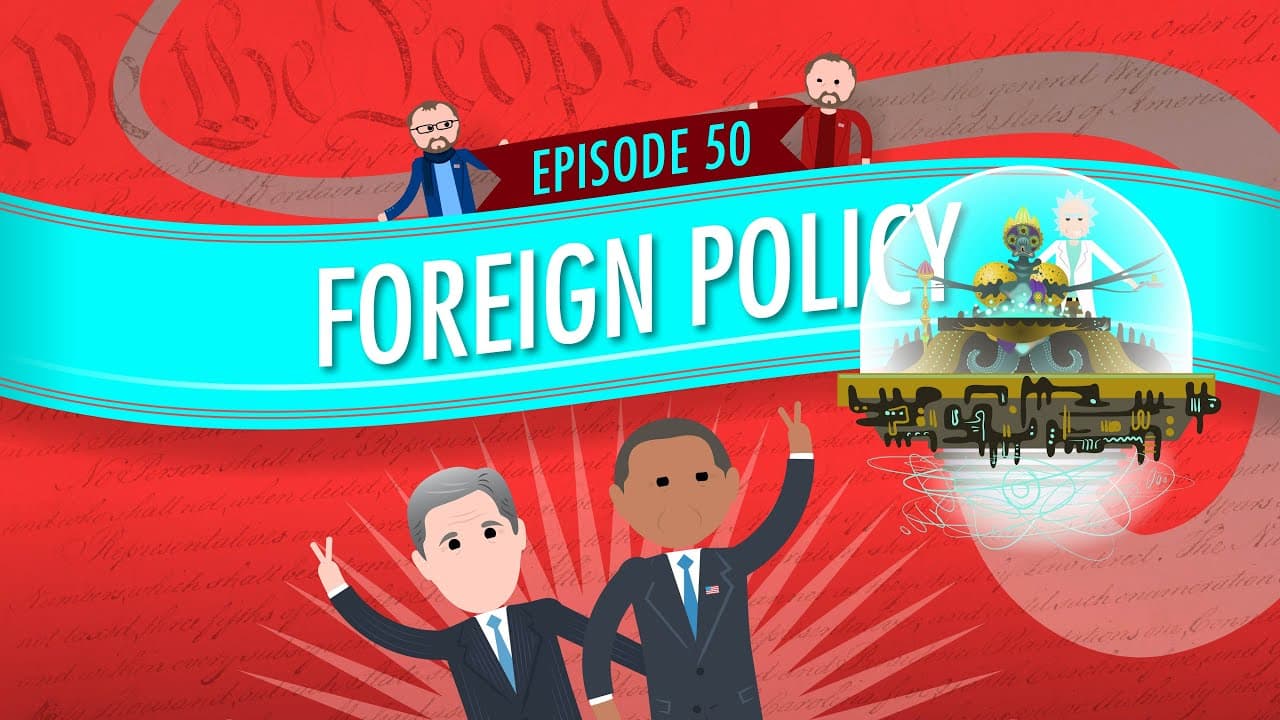
Foreign Policy: Crash Course Government and Politics #50
TL;DR
Foreign policy impacts globally but minimally affects American perception.
Transcript
Hello. I’m Craig and this is Crash Course Government and Politics and congratulations you have made it to the final Crash Course Government and Politics video! Whoo! Today we’re going to look at the mystifying paradox of both the least and most important aspect of government: foreign policy. Foreign policy is the most important because it has the p... Read More
Key Insights
- Foreign policy is crucial as it affects global populations, encompassing diplomacy, security, human rights, economic, and environmental policies.
- Despite its global importance, foreign policy minimally influences American public perception unless the nation is at war.
- The President plays a central role in foreign policy, acting as the chief diplomat and decision-maker, often bypassing Congress with executive agreements.
- Foreign policy goals include security, economic prosperity, and global betterment, with security being prioritized over other objectives.
- Military force is a visible aspect of foreign policy but is generally a last resort due to its high costs and potential political backlash.
- Economic goals in foreign policy focus on expanding trade, investment, and energy access, often involving international organizations like the WTO.
- The U.S. engages in international human rights initiatives and peacekeeping but has a complex relationship with international law, often avoiding treaties like the ICC.
- Interest groups and Congress have limited influence on foreign policy, with the President and bureaucracies leading the decision-making process.
Install to Summarize YouTube Videos and Get Transcripts
Explore YouTube Video Summarizer or Get YouTube Transcript Extractor
Questions & Answers
Q: What are the main components of foreign policy?
Foreign policy comprises diplomacy, military and security policy, international human rights policies, economic policies like trade and energy, and environmental policy. These elements collectively shape how a nation interacts with the global community, aiming to ensure security, prosperity, and global betterment.
Q: How does foreign policy impact American public perception?
Foreign policy generally has a minimal impact on American public perception unless the U.S. is at war. In such cases, public interest and scrutiny increase. Otherwise, foreign policy decisions are often seen as distant and less relevant to everyday American life, despite their global significance.
Q: What role does the President play in foreign policy?
The President is the chief diplomat and primary decision-maker in foreign policy, holding the power to negotiate treaties and executive agreements. This role allows the President to act swiftly in international matters, often bypassing Congress, which can streamline decision-making but also concentrate power.
Q: What are the primary goals of U.S. foreign policy?
The primary goals of U.S. foreign policy include ensuring national security, promoting economic prosperity through trade and investment, and contributing to global betterment through human rights and environmental initiatives. Security is prioritized, with economic and humanitarian goals following in importance.
Q: How does military force fit into foreign policy?
Military force is a visible but often last-resort tool in foreign policy, used primarily for deterrence and addressing immediate threats. It is costly in terms of lives and finances and can lead to political backlash, especially if conflicts are prolonged without clear victories.
Q: What economic goals does foreign policy pursue?
Economic goals in foreign policy focus on expanding opportunities for U.S. businesses, promoting foreign investment, ensuring access to energy supplies, and maintaining favorable trade policies. These efforts often involve participation in international organizations like the World Trade Organization.
Q: How does the U.S. engage in international human rights initiatives?
The U.S. participates in various human rights treaties and engages in peacekeeping missions, although it has a complex relationship with international law and often avoids treaties like the International Criminal Court. The U.S. prefers forming its coalitions or working through NATO for peacekeeping.
Q: What influence do interest groups and Congress have on foreign policy?
Interest groups and Congress have limited influence on foreign policy, as the President and bureaucracies primarily lead decision-making. Interest groups can shape the agenda, especially on single issues, but the President's central role and the executive branch's expertise typically dominate the process.
Summary & Key Takeaways
-
Foreign policy is a critical yet often overlooked aspect of government, affecting global populations through diplomacy, security, and economic policies. It is primarily shaped by the President and involves significant international cooperation.
-
While foreign policy has the potential to impact many, it plays a minimal role in American perceptions unless in wartime. The President's central role often leads to executive agreements bypassing Congress.
-
Security, economic prosperity, and global betterment are the main goals of U.S. foreign policy, with military force being a last resort. Interest groups and Congress have limited influence, with the President and bureaucracies leading.
Read in Other Languages (beta)
Share This Summary 📚
Summarize YouTube Videos and Get Video Transcripts with 1-Click
Try YouTube Summary with ChatGPT & Claude or YouTube Transcript Generator
Explore More Summaries from CrashCourse 📚

Summarize YouTube Videos and Get Video Transcripts with 1-Click
Try YouTube Summary with ChatGPT & Claude or YouTube Transcript Generator