The Equation That Explains (Nearly) Everything!
TL;DR
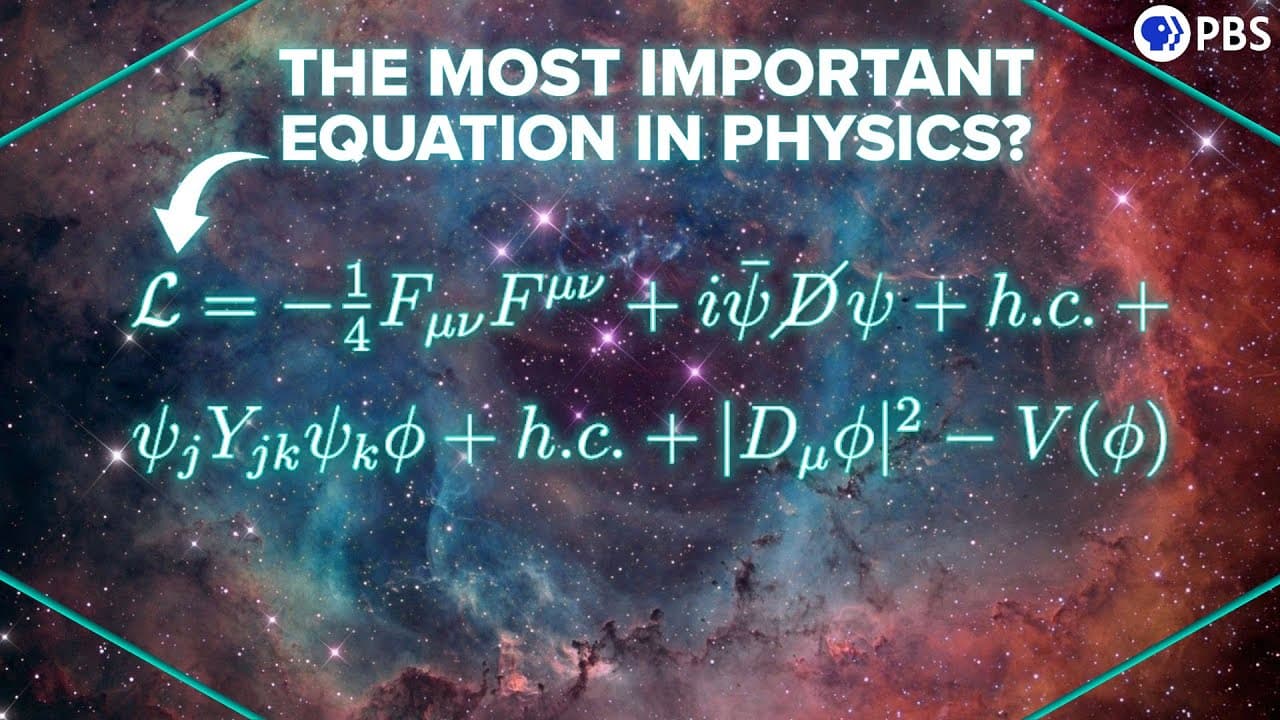
The Standard Model Lagrangian encapsulates our best understanding of subatomic particles and forces.
Transcript
The Standard Model of particle physics is arguably the most successful theory in the history of physics. It predicts the results of experiments with a numerical precision unmatched by any other branch of science, and it does so almost unfailingly. The theory is encapsulated in a single equation known as The Standard Model Lagrangian. It's probably ... Read More
Key Insights
- The Standard Model Lagrangian is a complex equation that encapsulates the interactions of subatomic particles, predicting experimental results with unmatched precision.
- Gauge symmetries are central to the Standard Model, with U(1), SU(2), and SU(3) symmetries explaining electromagnetism, weak, and strong forces, respectively.
- The Lagrangian is based on the Principle of Least Action, which posits that nature follows paths minimizing the rate of change of a quantity called Action.
- Fermions and bosons, distinguished by their spin, form the building blocks of matter and forces, respectively, with the Lagrangian describing their interactions.
- The Lagrangian Density, often referred to simply as the Lagrangian, is a foundational tool in quantum field theory, describing particle interactions over a volume.
- The kinetic and potential energy terms in the Lagrangian describe particle motion and interactions, with indices accounting for spacetime dimensions and symmetries.
- The Higgs field is crucial for imparting mass to particles, with its discovery completing the Standard Model, though it does not predict particle masses.
- Despite its complexity, the Standard Model Lagrangian is a monumental success in physics, though it doesn't account for phenomena like dark matter or dark energy.
Install to Summarize YouTube Videos and Get Transcripts
Explore YouTube Video Summarizer or Get YouTube Transcript Extractor
Questions & Answers
Q: What is the Standard Model Lagrangian?
The Standard Model Lagrangian is a complex equation that encapsulates our best understanding of the interactions and behaviors of subatomic particles. It predicts experimental results with remarkable precision and is based on the principle of gauge symmetries, which explain the fundamental forces of nature, excluding gravity.
Q: How do gauge symmetries relate to the Standard Model?
Gauge symmetries are central to the Standard Model, explaining the fundamental forces of nature. The U(1) symmetry accounts for electromagnetism, SU(2) symmetry for the weak force, and SU(3) symmetry for the strong force. These symmetries arise from the idea that the wavefunction can be distorted in ways that do not affect the laws of nature.
Q: What role does the Principle of Least Action play in the Lagrangian?
The Principle of Least Action is foundational to the Lagrangian, positing that nature follows paths that minimize the rate of change of a quantity called Action. This principle is used to determine the paths of particles, whether calculating the trajectory of a classical object or the probability of quantum interactions.
Q: What distinguishes fermions from bosons in the Standard Model?
Fermions and bosons are distinguished by their spin, with fermions having half-integer spins and forming the building blocks of matter, such as electrons and quarks. Bosons have integer spins and mediate forces, transmitting energy and momentum according to the symmetries of each force, such as photons for electromagnetism.
Q: Why is the Higgs field important in the Standard Model?
The Higgs field is crucial for imparting mass to particles within the Standard Model. It interacts with fermions and bosons, allowing them to acquire mass through the Higgs mechanism. The discovery of the Higgs boson confirmed this aspect of the model, though the equation does not predict the exact masses of particles.
Q: What are the limitations of the Standard Model Lagrangian?
Despite its success, the Standard Model Lagrangian has limitations. It does not account for phenomena such as dark matter, dark energy, or the matter-antimatter imbalance. Additionally, it does not predict the masses of particles or the strengths of their interactions, which must be determined experimentally.
Q: How does the Lagrangian account for particle interactions?
The Lagrangian includes terms for kinetic and potential energies of particles, describing their motion and interactions. Indices account for spacetime dimensions and symmetries, while coupling constants represent interaction strengths. The Lagrangian Density is integrated over a volume to describe particle behavior comprehensively.
Q: What is the significance of the Standard Model Lagrangian in physics?
The Standard Model Lagrangian is a monumental achievement in physics, providing a comprehensive framework for understanding subatomic particles and their interactions. It predicts experimental outcomes with unmatched precision and has withstood rigorous testing, though it remains incomplete in explaining all aspects of the universe.
Summary & Key Takeaways
-
The Standard Model Lagrangian is a comprehensive equation encapsulating the known interactions of subatomic particles, providing unmatched precision in predicting experimental outcomes. It is based on the principle of gauge symmetries, which explain the fundamental forces of nature, excluding gravity, through U(1), SU(2), and SU(3) symmetries.
-
The Lagrangian uses the Principle of Least Action to determine the paths of particles, with fermions and bosons forming the core components of matter and forces. The equation, though complex, describes the kinetic and potential energies of particles, accounting for various symmetries and interactions.
-
Despite its success, the Standard Model Lagrangian does not explain certain phenomena such as dark matter, dark energy, or the matter-antimatter imbalance. The Higgs field plays a crucial role in imparting mass to particles, yet the equation remains a triumph in physics, predicting known particle behaviors accurately.
Read in Other Languages (beta)
Share This Summary 📚
Summarize YouTube Videos and Get Video Transcripts with 1-Click
Try YouTube Summary with ChatGPT & Claude or YouTube Transcript Generator
Explore More Summaries from PBS Space Time 📚




Summarize YouTube Videos and Get Video Transcripts with 1-Click
Try YouTube Summary with ChatGPT & Claude or YouTube Transcript Generator