What Is Classless Addressing and Why Is It Important?
TL;DR
Classless addressing, also known as CIDR, offers a flexible way to allocate IPv4 addresses using variable-length prefixes instead of fixed classes, overcoming the limitations of classful addressing. It allows for more efficient use of IP addresses and helps in creating custom subnet masks to tailor networks according to specific needs.
Transcript
we are now in part two of classless addressing let's start the session with the outcomes upon the completion of this session the learner will be able to outcome number one we will understand the need for classless addressing and outcome number two we will identify the valid and invalid subnet mask with the help of an activity let's start the sessio... Read More
Key Insights
- 🏛️ Classful addressing in IPv4 consists of five classes, of which A, B, and C are commonly used.
- 👾 Classless addressing, or CIDR, overcomes the limitations of classful addressing, such as inflexibility and inefficient address space utilization.
- 😷 Subnetting plays a vital role in classless addressing, allowing for custom subnet masks and efficient allocation of IP addresses.
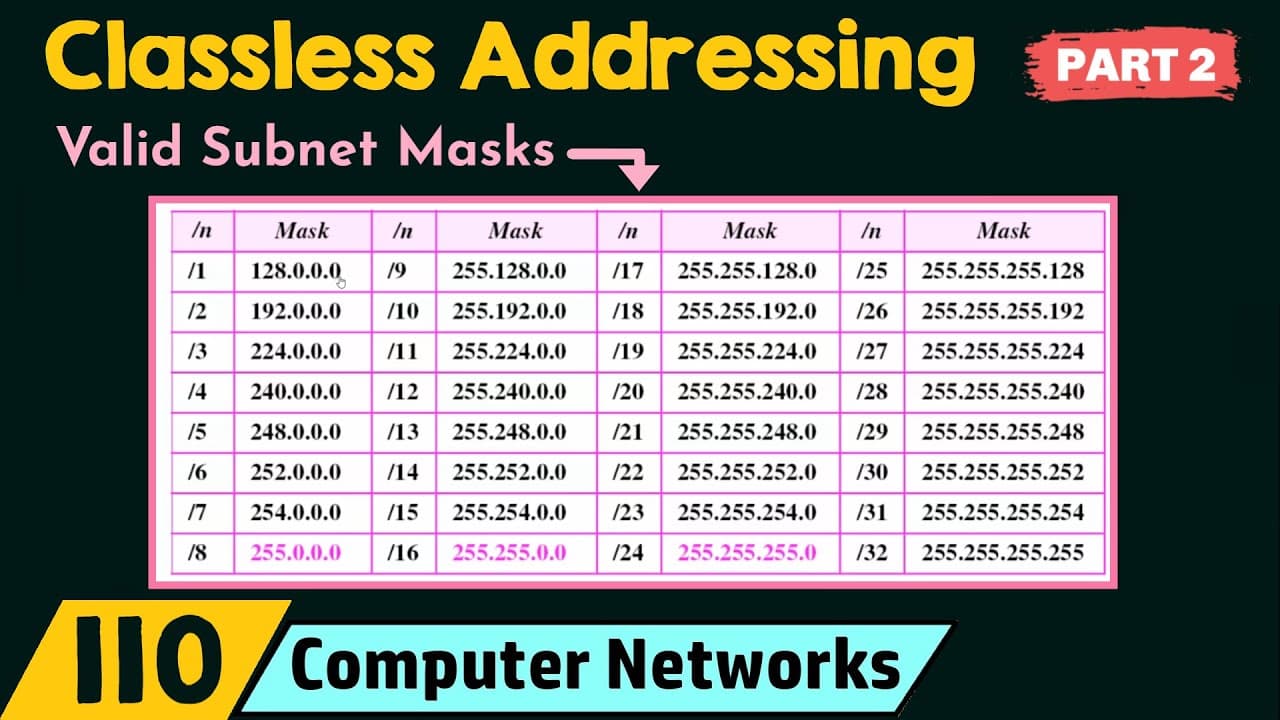
- 🤑 Valid subnet masks consist of consecutive ones followed by consecutive zeros, with no mixture of zeros and ones in any octet.
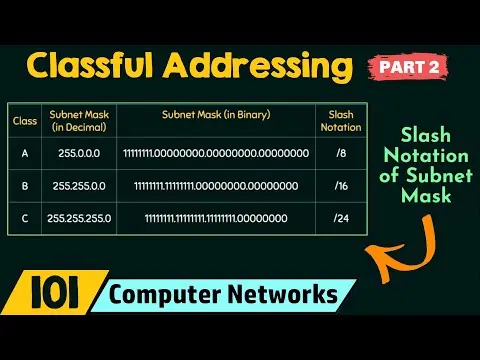
- 😷 Subnet masks can be represented in decimal, binary, or slash notation.
- 😷 Subnet masks range from /1 to /32, with /8, /16, and /24 representing class A, B, and C subnet masks, respectively.
- 🤑 A subnet mask can be considered valid or invalid by analyzing its binary representation for the presence of consecutive ones and zeros.
Install to Summarize YouTube Videos and Get Transcripts
Explore YouTube Video Summarizer or Get YouTube Transcript Extractor
Questions & Answers
Q: What are the drawbacks of classful addressing?
The drawbacks of classful addressing include lack of internal address flexibility, inefficient use of address space, and a proliferation of router table entries.
Q: What is the main advantage of classless addressing?
Classless addressing allows for the allocation of IPv4 addresses on any address bit boundary, providing greater flexibility and efficient use of address space.
Q: How does subnetting facilitate classless addressing?
Subnetting allows for the creation of custom subnet masks, which enable classless addressing by determining the number of devices needed for a network and judiciously allocating IP addresses.
Q: How can subnet masks be represented?
Subnet masks can be represented in decimal format (e.g., 255.0.0.0), binary format, or using slash notation, where the number after the slash represents the number of consecutive ones in the subnet mask.
Key Insights:
- Classful addressing in IPv4 consists of five classes, of which A, B, and C are commonly used.
- Classless addressing, or CIDR, overcomes the limitations of classful addressing, such as inflexibility and inefficient address space utilization.
- Subnetting plays a vital role in classless addressing, allowing for custom subnet masks and efficient allocation of IP addresses.
- Valid subnet masks consist of consecutive ones followed by consecutive zeros, with no mixture of zeros and ones in any octet.
- Subnet masks can be represented in decimal, binary, or slash notation.
- Subnet masks range from /1 to /32, with /8, /16, and /24 representing class A, B, and C subnet masks, respectively.
- A subnet mask can be considered valid or invalid by analyzing its binary representation for the presence of consecutive ones and zeros.
- Understanding classless addressing and subnet masks is crucial for efficient network design and utilization of IP addresses.
Summary & Key Takeaways
-
Classful addressing in IPv4 involves using five classes (A, B, C, D, and E), with classes A, B, and C being the most commonly used. However, classful addressing has drawbacks such as inflexibility, inefficient use of address space, and large router table entries.
-
Classless addressing, or CIDR, allows for greater flexibility in allocating IPv4 addresses by using variable prefix lengths instead of fixed classes.
-
Subnetting is a crucial topic in computer networks that enables classless addressing by creating custom subnet masks. Subnet masks determine network and neighbor identification in a network.
Read in Other Languages (beta)
Share This Summary 📚
Summarize YouTube Videos and Get Video Transcripts with 1-Click
Try YouTube Summary with ChatGPT & Claude or YouTube Transcript Generator
Explore More Summaries from Neso Academy 📚



Summarize YouTube Videos and Get Video Transcripts with 1-Click
Try YouTube Summary with ChatGPT & Claude or YouTube Transcript Generator