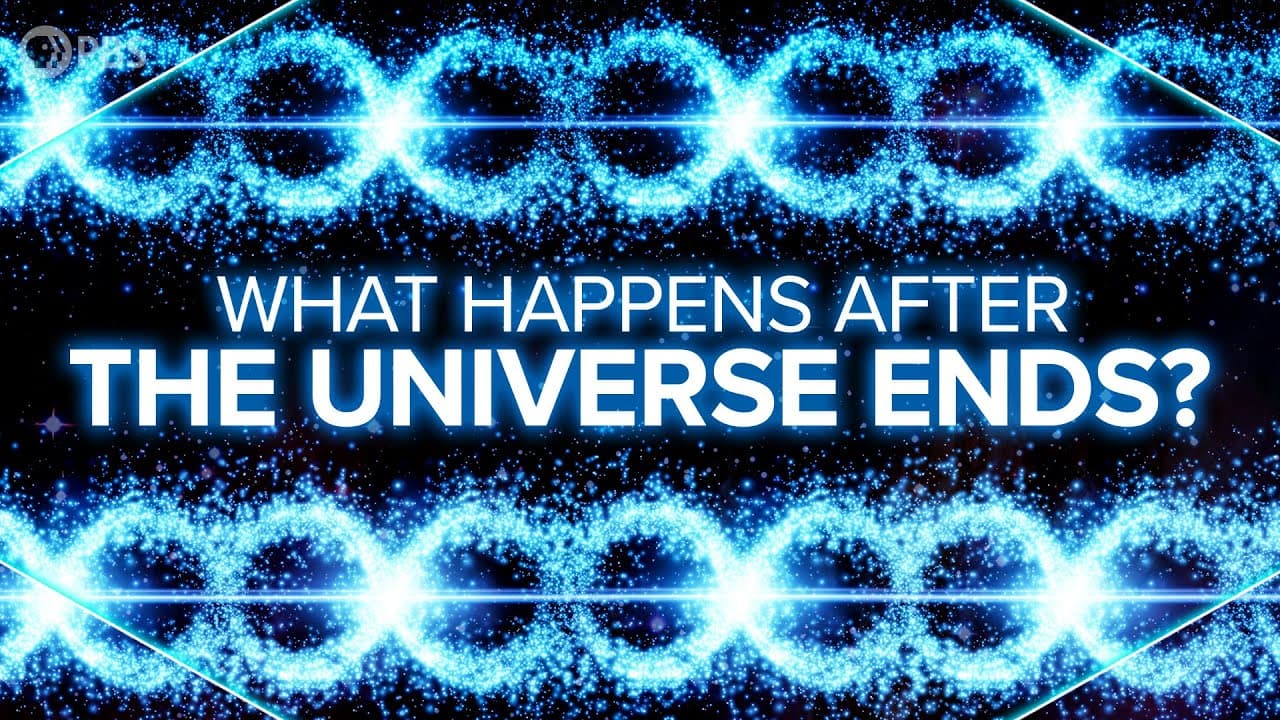
What Happens After the Universe Ends?
TL;DR
Explores the theory of endless universes through conformal cyclic cosmology.
Transcript
Our universe began in a state of ultimate heat and compression in what we call the big bang. And it will “end” by expanding forever towards a state of perfect cold and emptiness. It’s incredible that we could figure this much out, but we should not get too cocky - big questions remain open. Like, what happened before the big bang? What, if anything... Read More
Key Insights
- Conformal Cyclic Cosmology (CCC) suggests the universe's end is identical to a new Big Bang, creating endless universes.
- CCC relies on conformal transformations, preserving angles in space, to propose a seamless transition between universes.
- In CCC, the universe's far future state of only radiation may resemble the massless early universe, equating the two.
- Mass is considered non-fundamental in CCC, potentially decaying to a state where particles are massless, like early universe conditions.
- Penrose's theory suggests a positive cosmological constant, such as dark energy, is necessary for CCC's framework.
- CCC proposes that radiation and possibly gravitational waves can traverse the boundary between universes, influencing new aeons.
- Penrose's theory challenges the standard cosmic inflation model by offering an alternative explanation for low early universe entropy.
- Penrose suggests potential evidence for CCC in cosmic microwave background radiation, though methods and findings are debated.
Install to Summarize YouTube Videos and Get Transcripts
Explore YouTube Video Summarizer or Get YouTube Transcript Extractor
Questions & Answers
Q: What is Conformal Cyclic Cosmology?
Conformal Cyclic Cosmology (CCC) is a theory proposed by Sir Roger Penrose that suggests the universe undergoes endless cycles. According to CCC, the universe's infinitely far future, when it has expanded and cooled, is equivalent to the Big Bang of a new universe. This theory relies on conformal transformations, which preserve geometric angles, to propose a seamless transition between the end of one universe and the beginning of another.
Q: How does CCC explain the transition between universes?
CCC explains the transition between universes through conformal transformations, which preserve angles in space and time. In this framework, the universe's far future, characterized by only radiation, is equivalent to its early massless state. This equivalency suggests that the universe's end and beginning are the same, allowing for an endless cycle of universes. The theory proposes that mass is not fundamental and may decay, aligning the conditions of the universe's end with its beginning.
Q: What role does mass play in CCC?
In CCC, mass is considered a non-fundamental property that may decay over time. This idea is based on the notion that particles gain mass through interactions with quantum fields, such as the Higgs field. In the universe's far future, it's speculated that particles may become massless, similar to conditions in the early universe. This mass decay aligns with CCC's concept that the universe's end resembles its beginning, facilitating the transition between cycles.
Q: How does CCC address the concept of entropy?
CCC addresses the concept of entropy by proposing that the universe's end and beginning are equivalent, eliminating the need for cosmic inflation to explain the early universe's low entropy. In CCC, the universe's far future state is smoothed out over time, including the gravitational field, resulting in low entropy conditions. This theory suggests that black holes swallow and destroy entropy, cleaning the slate between aeons, although this idea is controversial as it challenges the notion that quantum information cannot be destroyed.
Q: What evidence supports CCC?
Penrose has proposed potential evidence for CCC in the cosmic microwave background (CMB) radiation. He suggests that if radiation can traverse universes, features from the end of a previous universe could be imprinted on the CMB of the next. Specifically, Penrose and his colleague Vahe Gurzadyan claim to have detected concentric rings in the CMB, which they attribute to the collisions of supermassive black holes in a prior universe. However, this evidence and the statistical methods used are debated within the scientific community.
Q: What are the criticisms of CCC?
Criticisms of CCC include the debate over its proposed evidence and the challenge it poses to established cosmological models like cosmic inflation. The statistical methods used to identify features in the cosmic microwave background, claimed as evidence for CCC, have been questioned. Additionally, CCC's suggestion that black holes can destroy entropy and information is controversial, as it contradicts the widely accepted belief that quantum information cannot be destroyed.
Q: How does CCC relate to dark energy?
CCC posits that a positive cosmological constant, such as dark energy, is necessary for its framework. Dark energy drives the universe's accelerated expansion, which CCC suggests is crucial for the universe's far future state to resemble its massless early state. This expansion aligns with the theory's requirement for a seamless transition between universes, as it facilitates the conditions needed for conformal transformations and the equivalence of the universe's beginning and end.
Q: Can civilizations communicate between universes in CCC?
Penrose and Gurzadyan speculate that advanced civilizations might communicate between universes in CCC. They propose that, besides photons, gravitational waves could traverse the boundary between aeons. If a civilization could manipulate massive black holes to produce specific gravitational wave patterns, they might send messages across universes. While this idea is intriguing, there is currently no evidence of such inter-universal communication.
Summary & Key Takeaways
-
Conformal Cyclic Cosmology (CCC) is a theory by Roger Penrose proposing that the universe's end is the beginning of a new Big Bang, forming an endless chain of universes. This theory relies on conformal transformations, which preserve angles in space, to suggest that the universe's far future state of only radiation is equivalent to its massless early state.
-
CCC challenges traditional cosmological models by positing that mass is not a fundamental property and may decay, allowing particles to become massless over time. This aligns the universe's end with its beginning, potentially eliminating the need for cosmic inflation to explain the early universe's low entropy.
-
Penrose's theory suggests that a positive cosmological constant, such as dark energy, is essential for CCC. It also proposes that radiation and gravitational waves might traverse the boundary between universes, influencing new aeons. Penrose claims potential evidence for CCC in the cosmic microwave background radiation, though this is contested.
Read in Other Languages (beta)
Share This Summary 📚
Summarize YouTube Videos and Get Video Transcripts with 1-Click
Try YouTube Summary with ChatGPT & Claude or YouTube Transcript Generator
Explore More Summaries from PBS Space Time 📚
Summarize YouTube Videos and Get Video Transcripts with 1-Click
Try YouTube Summary with ChatGPT & Claude or YouTube Transcript Generator